
**Get Caratflow’s live rates now →
This beginner guide understanding gold starts with today’s number: Gold 999 cost ₹7,285/g. The gold rate is the per‑gram price for a stated purity, built from the global spot price in USD, converted to INR, plus import duty and GST.
For you, that means the board price in a store reflects more than one market. It tracks London/COMEX quotes in dollars, the USD/INR exchange rate, and India’s tax structure. In 2026, these pieces still move daily, so a small swing in any one of them can change the tag you see. If you plan to invest too, bookmark our gold investment guide for strategy basics that pair well with price checks.
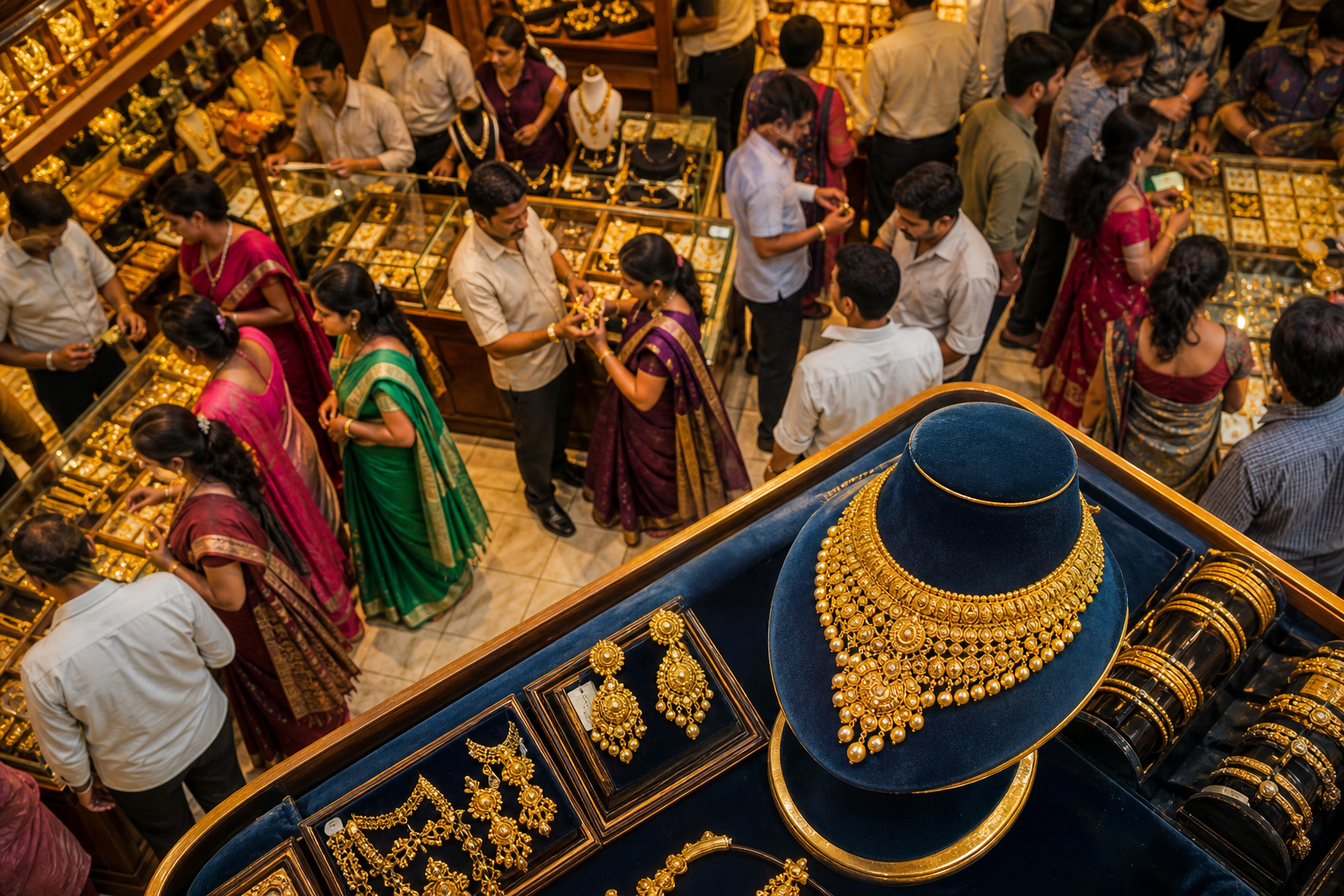
What Does 'Gold Rate' Actually Mean and How Is It Set?
At its core, “gold rate” is the price per gram (or per 10 grams) for a specific purity. A 24K quote refers to 999 (99.9% pure) metal, while 22K maps to 916 (91.6% pure), and 18K to 750 (75.0% pure). Because purities differ, rates differ. For example, based on live snapshots: Gold 999 cost ₹7,285/g, Gold 916 cost ₹6,673/g, and Gold 750 cost ₹5,464/g. You’ll see these side by side on a rate board.
Specifically, the global spot price sets the base. That’s traded on platforms like LBMA and COMEX. If you’d like background on how global gold pricing evolved, see this primer on the London Bullion Market Association (Wikipedia).
Next, the USD price converts to INR using the day’s exchange rate. Finally, India’s import duty applies, and then GST at billing time. Retailers also add making charges for jewelry work.
In practice, your city’s board rate can be a shade higher or lower than a headline number you saw online. Logistics, local demand, and timing matter. However, the structure doesn’t change: global quote → currency conversion → duty → GST → retailer quote.
From Spot to Your Bill: The Flow
- Global spot price in USD (LBMA/COMEX reference)
- Convert to INR using USD/INR
- Add import duty to land in India
- Add GST at purchase (on metal and on making)
- You get the live retail gold rate for a given purity
| Purity | Marking | Illustrative rate |
|---|---|---|
| 24K | 999 | ₹7,285/g |
| 22K | 916 | ₹6,673/g |
| 18K | 750 | ₹5,464/g |
As a quick check, a beginner guide understanding gold always looks at purity first. A 22K ring should be costed at the 916 line, not at the 24K number. That small step avoids the most common error for first-time buyers.
How to Read Gold Rates: 24K, 22K, and 18K Explained Step by Step
You’ll see two styles on boards: per gram and per 10 grams. Read the unit carefully. If the quote is per 10g and you need a 3.6g stud, divide first. Then check purity, because 22K and 18K are what most jewelry uses.
Before you enter a store or add to cart, decide on purity for the piece. 22K (916) works well for plain gold jewelry. 18K (750) is common for diamond settings since the harder alloy holds stones well. 24K (999) is best for coins and bars.
The Four Steps Most Shoppers Miss
- Step 1: Match karat to purity
- 24K = 999, 22K = 916, 18K = 750.
- Confirm this on the BIS hallmark stamp.
- Step 2: Confirm the unit
- Check if the board shows per gram or per 10 grams.
- Convert to the unit you need.
- Step 3: Find the metal value for your piece
- Multiply the live rate for your purity by the net gold weight.
- Net weight excludes stones or beads.
- Step 4: Add making, stone charges, and GST
- Making and stone work add to the craft value.
- GST applies on both the metal and the making line.
Total = Metal value (live rate x net weight) + Making charges + Stone charges + 3% GST on jewelry + 5% GST on making charges
A Simple Price Example (22K Pendant)
- Net gold weight: 4.
- Live 22K rate: ₹6,673/g
- Metal value: 4.20 × ₹6,673 = ₹28,026.
- Making charges: say ₹2,000
- Stones: none
Now add GST lines:
- 3% GST on jewelry metal: 0.03 × ₹28,026.6 = ₹840.
- 5% GST on making: 0.05 × ₹2,000 = ₹100.
Final bill: ₹28,026.6 + ₹2,000 + ₹840.80 + ₹100.00 = ₹30,967.
 , live rate ₹6,673/g, net weight 4.20g, making charges, GST lines, and final total with INR figures)
As you can see, the 24K rate isn’t used for 22K jewelry math. Use the 916 line. For investment math beyond the store counter, your next read should be the in-depth gold investment guide, which builds on the same purity and rate logic.
**Compare at Caratflow with live pricing →
Also Read!
NRI’s Guide to Buying BIS Hallmarked Gold Jewelry Online from India
Bride’s Guide to Gold Jewelry with Lifetime Exchange and Buyback Policies
5 Common Mistakes People Make When Checking Gold Rates
First buyers mix up purity and price. They see a 24K quote online and apply it to a 22K bangle. That error alone can inflate a mental budget by thousands. Slow down. Match purity, then multiply by the weight on the tag.
Second, shoppers ignore making charges. The craft work adds real cost, and it varies by design. Transparent making charges make it easier to compare. Ask for them in writing before you decide.
Third, some skip checking purity marks. A proper BIS hallmarked piece shows karat, the BIS mark, and a Unique 6-digit HUID. You can verify the HUID on the BIS portal or in the BIS CARE app. That’s your proof the metal matches the stamp.
- Confusing 24K rate with 22K price: Use 916 for 22K pieces.
- Ignoring making charges: They differ by design; get a quote.
- Not checking BIS hallmark purity: Look for HUID and verify it.
- Comparing rates across different purities: Keep like with like.
- Assuming rates match across all cities: Local spreads exist.
“The bridal set I bought for my wedding was breathtaking. Craftsmanship is top and the BIS hallmark gave me total peace of mind.” — Priya Sharma, Mumbai
Fourth, rate shopping across cities without context. A board in Delhi may differ from one in Kochi on the same morning due to logistics and timing. Always compare total bills, not just the headline gram rate. Finally, a solid beginner guide understanding gold treats the hallmark as non‑negotiable and weighs the full bill, including GST.
Tools and Resources to Track Gold Rates Daily
You don’t need ten tabs open. Start with IBJA (India Bullion and Jewellers Association) as your daily benchmark for India. Then glance at MCX if you want to see futures for trend color. For hallmark checks, use the BIS CARE app to scan or enter the HUID on your invoice and on the piece.
Retailers like Caratflow publish live rates with purity breakdowns, which makes in‑store math fast. Live Rates as of 06:44 am: 22K Gold ₹6,673/g, 18K Gold ₹5,464/g, Silver ₹89/g. Those lines mirror real counters you’ll see on a rate board, so you won’t need to convert 24K to 22K on the fly.
Reliable Daily Sources to Bookmark
- IBJA: India’s widely used benchmark for physical rates.
- MCX: Futures quotes to understand near‑term trend and volatility.
- BIS CARE app: Verify BIS hallmarked purity and HUID authenticity.
- A retailer board with purity splits: Helps match quotes to your jewelry.
For background on taxes that impact your bill, the Goods and Services Tax (India) page explains how GST works at a high level. In 2026, your jewelry invoice still uses two GST lines: 3% on the metal and 5% on the making line. A beginner guide understanding gold doesn’t end at the rate board; it includes how invoices are written too.
If you’re evaluating gold as an asset alongside jewelry, return to the store math with the gold investment guide. It shows how purity, spreads, and buy‑back policies affect long‑term returns.
What to Do Before Your Next Gold Purchase
Treat this as your pre‑purchase ritual. First, check today’s benchmark from IBJA and confirm the purity you want. For everyday wear, 22K is sturdy and classic. In diamond jewelry, 18K works well. 24K is standard for coins or bars.
Second, ask to see the BIS hallmark with the HUID on the piece and on the bill. Use the BIS CARE app to verify it on the spot. Third, get making charges in writing. Fixed per‑gram or a set amount per design are both fine. Clarity matters more than the style.
- Check today’s rate from IBJA before you shop.
- Decide purity: 22K for jewelry, 24K for bars/coins, 18K for stone‑set pieces.
- Ask for BIS hallmark with the Unique 6‑digit HUID and verify it.
- Get transparent making charges in writing and confirm stone charges.
- Compare total cost, not just the metal rate, across two stores.
If you’re choosing where to buy, look for signs of accountability. For example, 100% BIS hallmarked gold and silver jewelry is a baseline. A stronger signal is a commitment to refund twice the difference if purity is below standard.
That kind of risk reversal shows the seller stands behind their stamp. Add one last line to your checklist: confirm the buy‑back policy at the prevailing rate, so you know your exit route too. With these points ticked, a beginner guide understanding gold turns into a smooth, confident purchase.
Key Takeaways
- Gold rate is the per‑gram price of a specific purity, built from global spot price → USD/INR → import duty → GST.
- Match purity to price: 24K=999, 22K=916, 18K=750. Use the right line for your piece.
- Jewelry total = metal value + making + stones + 3% GST on metal + 5% GST on making.
- Verify BIS hallmark and the 6‑digit HUID with the BIS CARE app before you pay.
- Compare final bills across cities and stores, not headline gram rates.
What to Do This Week
Pick one piece you plan to buy in 2026. Check IBJA for today’s benchmark, note 22K and 18K rates, and run the math on a design you like using the steps above. Verify a hallmark with the BIS CARE app to practice. Then compare two stores on total bill, not just rate. You’ll walk in ready, and you’ll walk out happy.