Start your custom design with a free 3D mockup →
Commissioning a custom jewelry gift used to be a nerve-wracking gamble. You described your vision to a jeweler, received rough hand-drawn sketches, and hoped the final piece matched what you imagined. The ability to design custom jewelry 3d has changed everything. You see a photorealistic digital mockup of your piece before any metal is cast or stones are set.
This matters especially for gift buyers. You're not shopping for yourself, you're interpreting someone else's style, and getting it wrong means disappointment on a day that's supposed to be special. A 3D preview eliminates that anxiety.
You rotate the model, check proportions from every angle, share it with a trusted friend for a second opinion, and request changes without wasting materials or time. The finished piece arrives exactly as you approved it.
In 2026, more jewelers offer 3D rendering services than ever before, yet most gift buyers still don't know what to ask for or how to evaluate the preview they receive. This guide walks you through the entire process, from defining your budget to approving the final render, so you commission a piece that feels like you spent months planning it, even if you only have weeks.
What Is 3D Preview in Custom Jewelry Design and Why It Matters for Gift Buyers
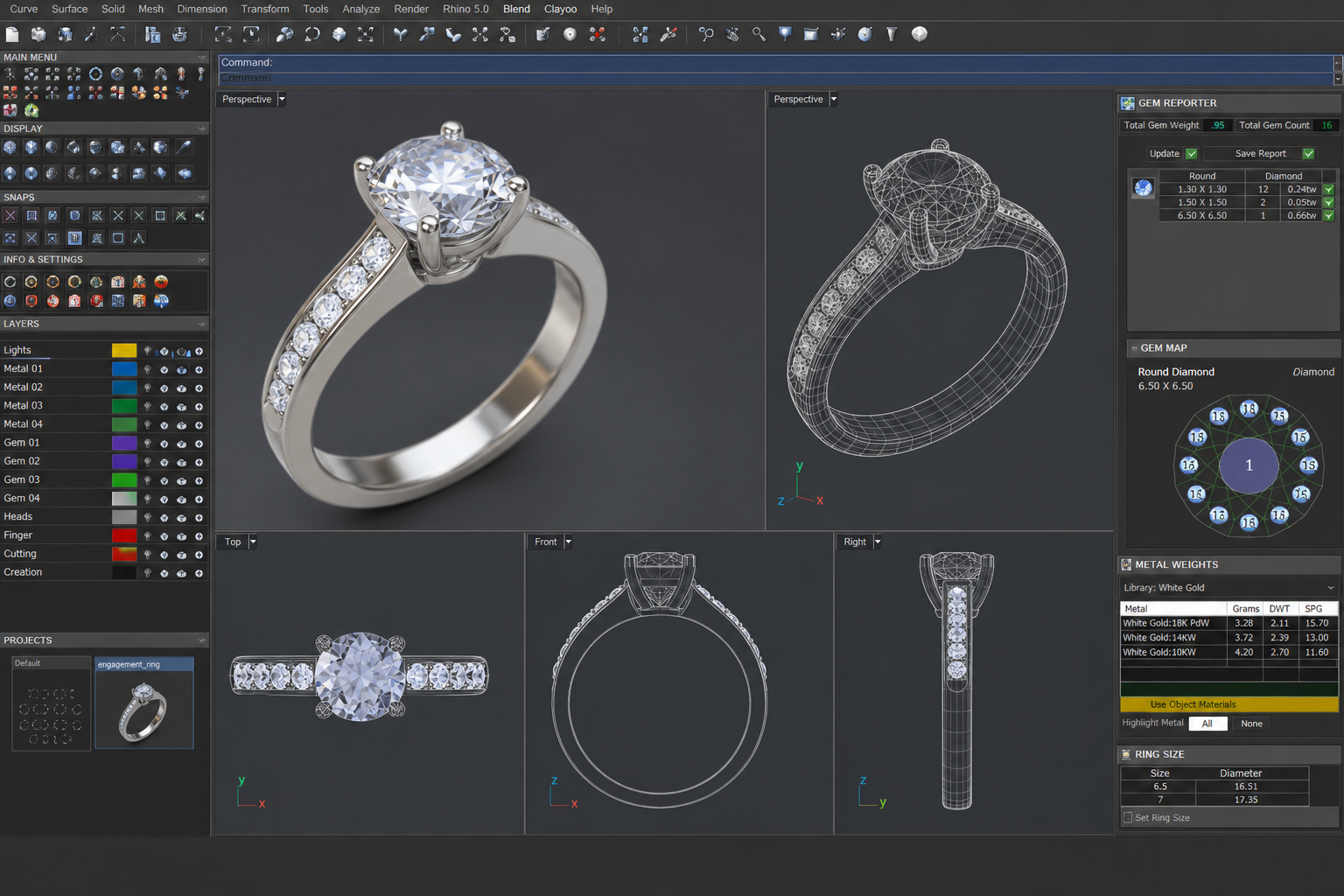
A 3D preview is a photorealistic digital mockup of your custom jewelry piece, created using CAD (Computer-Aided Design) software before any physical production begins. The jeweler translates your design brief, reference photos, measurements, metal and stone preferences, into a digital model that shows exactly what the recipient will receive.
CAD technology has revolutionized manufacturing across industries, from aerospace engineering to medical devices, and jewelry is no exception. Computer-Aided Design (wikipedia. org) allows designers to create precise three-dimensional models with measurements accurate to fractions of a millimeter.
This is transformative for gift buyers because it closes the gap between imagination and reality. You can rotate the model to see the piece from the back, check how light interacts with the stones, zoom in on prong details, and compare the scale against a familiar object like a coin or finger.
If the band looks too thin or the pendant sits too high on the chain, you request revisions on the screen instead of discovering the problem when the box opens.
The old way was verbal. You said "I want a floral pendant with emeralds," and the jeweler sketched something on paper.
The sketch might capture the basic shape, but it couldn't show you the exact shade of the gold, the weight distribution, or how the clasp mechanism works. You approved it on faith. The 3D render leaves nothing to faith.
This matters even more when you're shopping for someone else. You can't try the piece on. You can't gauge whether the proportions will suit their hand or neck.
The 3D preview lets you share the file with a friend who knows the recipient's style, or even with the recipient themselves if it's not a complete surprise. One revision round on a digital model costs nothing. One remake of a finished piece costs hundreds of dollars and weeks of time.
For gift buyers, the core anxiety is always "What if it doesn't match what I imagined?" A 3D preview eliminates that risk. You approve the exact piece that gets made.
When you design custom jewelry 3d, you're not hoping, you're confirming.
Most reputable jewelers now offer this service as standard for custom orders. Some provide a video consultation where they walk you through the 3D model live, answering questions and rotating it on screen while you watch.
Others send you a file you can open in a browser, spinning it yourself on your phone or laptop. The format varies, but the value is universal: you see what you're buying before money and materials are committed.
Also Read!
Best Custom Jewelry Design with 3D Preview for Jewelry Gifts in 2026
Best Gold Jewelry with Lifetime Exchange and Buyback for NRIs in 2026
Step-by-Step: How to Commission a Custom Jewelry Gift with 3D Preview
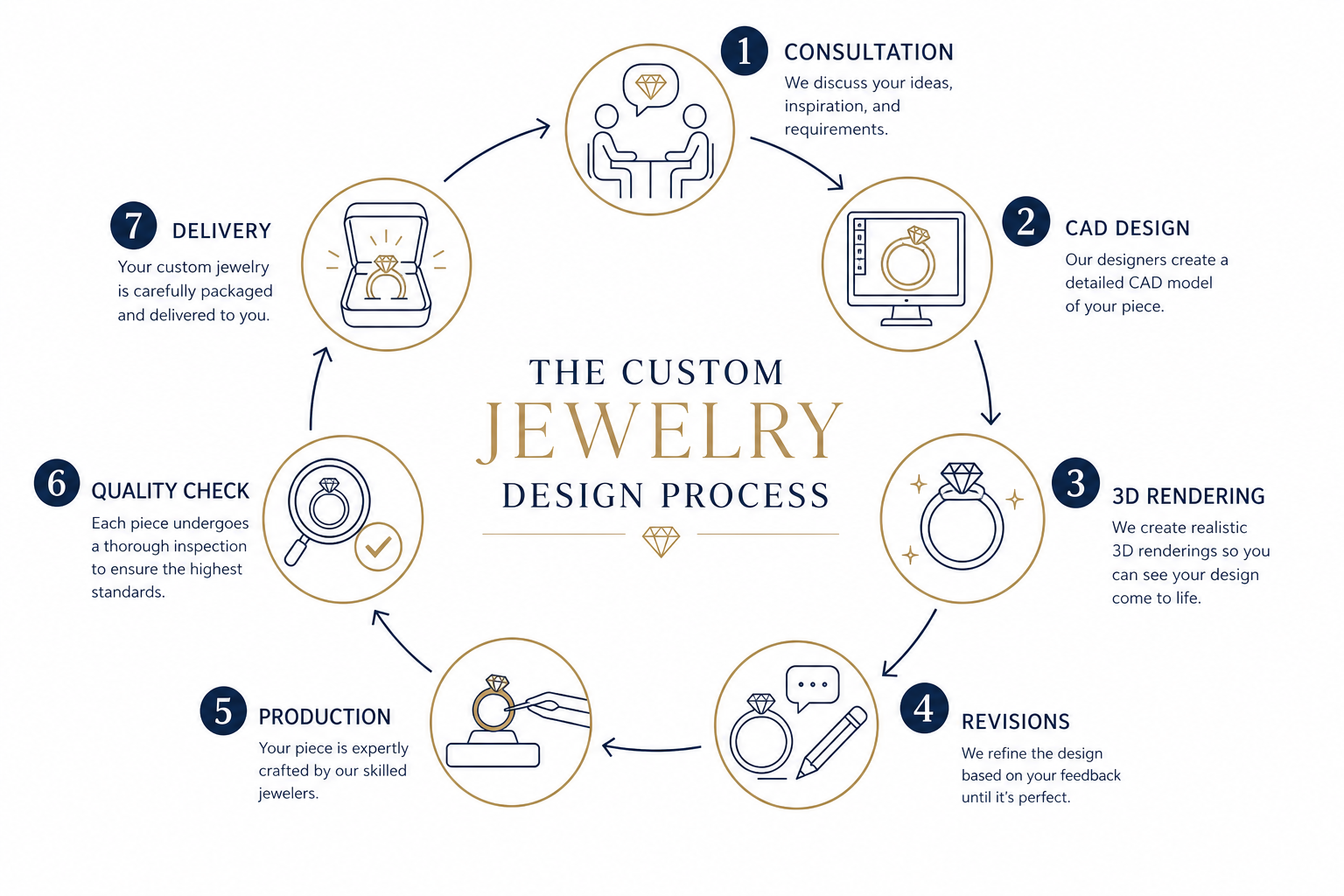
Commissioning custom jewelry feels overwhelming if you've never done it before. Here's the exact process any gift buyer can follow, regardless of which jeweler you choose.
Define the occasion and recipient's style. Start by collecting evidence. Photograph their existing jewelry when they're not wearing it.
Note whether they prefer yellow gold or white, chunky statement pieces or delicate chains, modern geometric shapes or traditional floral motifs. Check their Pinterest boards or Instagram saves if you have access.
If you're designing an engagement ring, ask their friends what they've mentioned admiring. The more reference images you gather, the more precise your brief will be.
Document everything in a digital folder you can easily share with potential jewelers during your consultation calls.
Set a realistic budget. Custom jewelry pricing follows a formula: Total = Metal value (live rate × net weight) + Making charges + Stone charges + 3% GST on jewelry + 5% GST on making charges.
Live gold rates fluctuate daily, so build a 10-15% buffer into your budget. As of early 2026, 22K gold runs approximately ₹6,673 per gram and 18K gold runs ₹5,464 per gram.
If you're budgeting ₹50,000 for a pendant, expect ₹35,000-40,000 for metal and stones and ₹10,000-15,000 for craftsmanship and taxes. Confirm transparent pricing upfront, reputable jewelers break down every component rather than quoting a single opaque number.
Request a written estimate before committing to the design phase so you know exactly where your money goes.
Choose your metal purity. You have two main options for gold: 22K (916 purity) and 18K (750 purity).
22K is softer with a richer, more traditional yellow color, ideal for plain gold bangles, chains, or traditional bridal jewelry. It bends more easily, which makes intricate stone settings risky.
18K is harder, better for holding diamonds and gemstones securely, and comes in yellow, white, and rose finishes. It's the modern choice for engagement rings and everyday wear pieces.
If you're gifting a piece with multiple stones or a complex design, choose 18K. If you're honoring tradition or designing a simple chain, 22K works beautifully.
Verify BIS hallmarking (the government-backed purity certification in India) before you commit, every piece should have a unique 6-digit HUID that you can verify via the BIS CARE app. This protects you from impure metal that looks identical to the real thing but contains filler alloys.
Select stones. For diamonds above 0.18 carats, insist on IGI (International Gemological Institute) or GIA (Gemological Institute of America) certification.
These third-party labs grade the stone's cut, clarity, color, and carat weight, giving you proof of what you're paying for. Smaller diamonds (called melee diamonds) are often graded in-house rather than individually certified.
For gemstones like emeralds, sapphires, or rubies, ask whether they're natural or lab-created and request an origin report if the stone is significant. Stone selection affects your timeline, common diamonds ship quickly, while rare gemstones or fancy cuts can add 2-4 weeks to production.
Discuss stone availability with your jeweler early so you can adjust your timeline expectations or choose alternative options if needed.
Share your design brief with the jeweler. Compile everything into a single document or email: reference photos, measurements (ring size, bracelet length, or chain length), engraving text if applicable, preferred metal finish (high polish, matte, brushed, or hammered).
Include the occasion and deadline. If you're unsure about proportions, say so, a good jeweler will offer guidance.
Many now offer live video consultations where you walk through your ideas together. Book one if it's available.
Seeing a designer's face and hearing their questions clarifies your vision faster than a dozen emails. During the call, ask them to sketch ideas on camera or share their screen to show similar pieces they've created, this helps you understand whether they grasp your aesthetic.
Review the 3D render carefully. This is the most critical step. When you design custom jewelry 3d, you'll receive a file or link showing your piece from multiple angles.
Request at least three views: front, side, and back. Zoom in on the prongs or clasp mechanism, these are the failure points if they're too thin or poorly positioned.
Check the scale by asking for a comparison render next to a common object like a coin or finger. Does the pendant look too large for a delicate chain?
Is the band thick enough to feel substantial but not bulky? Share the render with someone whose taste you trust before approving it.
This is your chance to request changes without penalty. Ask questions about every detail you're uncertain about: How secure are the prong settings?
Will the clasp stay closed during daily wear? Does the chain thickness match the pendant weight?
A reputable jeweler welcomes these questions and will revise the render until you're completely confident.
Approve and track production. Once you sign off on the 3D render, the jeweler casts the piece, sets the stones, polishes, and hallmarks it.
Typical timelines are 2-3 weeks for simple designs (a solitaire pendant, a plain band with engraving) and 4-6 weeks for complex pieces (a bridal set with pavé work, a custom charm bracelet). International shipping via insured couriers like Brinks adds another 5-10 days.
Pro tip: start the process at least 8 weeks before your celebration date. If the first render needs revisions, you'll need that buffer.
This process works whether you're ordering from a local jeweler with CAD software or an online retailer with a custom design service. The key is asking the right questions at each stage and using the 3D preview as your decision checkpoint, not just a nice-to-have visual.
Request weekly production updates once you've approved the design so you know exactly when to expect delivery and can plan accordingly.
5 Costly Mistakes Gift Buyers Make When Ordering Custom Jewelry
Most disappointments with custom jewelry stem from the same five mistakes. Here's what to watch for.
Skipping the 3D approval step. Some buyers rush production without carefully reviewing the render, trusting the jeweler to interpret their brief perfectly.
Then the piece arrives and the proportions feel off, the pendant is larger than they imagined, or the ring band looks too delicate. Always rotate the 3D model and check from the back and side, not just the hero angle.
Request a scale comparison if you're uncertain. This step exists so you catch problems before casting, not after.
Take screenshots of the approved render from multiple angles and save them to your device. If there's any discrepancy between the final piece and what you approved, you'll have documentation to support an exchange or refund request.
Ignoring metal purity verification. In India, BIS hallmarking is the only government-backed proof that your gold is actually 22K or 18K.
A hallmarked piece has a small stamp showing the BIS logo, the purity number (916 for 22K, 750 for 18K), and a unique 6-digit HUID. You can verify that HUID on the BIS portal or BIS CARE app to confirm the piece is registered.
A gift without hallmark certification could contain impure metal, and you won't know until it's too late. Reputable jewelers hallmark every piece automatically and will refund twice the difference if purity tests below standard.
If a jeweler says hallmarking is optional or charges extra for it, walk away. Legitimate operations consider BIS certification a baseline requirement, not an upsell opportunity.
Not asking about return and exchange policies. Custom doesn't mean non-returnable at all reputable jewelers.
Look for these policies: a 365-day insured returns window, a lifetime exchange policy at prevailing gold rates, and a buy-back guarantee. These protect you if the recipient's taste changes or the piece doesn't fit.
Clarify the terms before you pay. Some jewelers offer full refunds within 30 days, while others offer credit or exchange only.
Insured returns matter for high-value pieces, if the shipment is lost or damaged in transit, you need a policy that covers the full replacement cost. Get the return policy in writing via email so there's no confusion if you need to use it later.
Choosing the wrong ring size or chain length. This is fixable but annoying.
For rings, use the string method: wrap a piece of string around the recipient's finger (or borrow a ring they already wear), mark where it overlaps, and measure the length in millimeters. Compare that to a ring size chart.
For chains, measure an existing necklace they wear often and note where it falls on their neck. If you're unsure, go slightly larger, a chain that's too long can be shortened, but a ring that doesn't fit can't be worn at all until it's resized.
Resizing adds another 1-2 weeks to your timeline. Some jewelers offer a free one-time resizing within the first 90 days, ask about this service when you place your order so you're covered if your measurements were slightly off.
Underestimating the timeline. The biggest timeline killer is underestimating how long the 3D preview stage takes.
Most jewelers need 3-7 days to create the initial render after you submit your brief. If you request revisions, add another 3-5 days per round.
Production itself takes 2-6 weeks depending on complexity. A simple pendant with one gemstone? Two weeks.
An elaborate bridal set with 40 pavé diamonds and milgrain detailing? Six weeks minimum.
Then add shipping time, domestic shipments take 3-5 days, international shipments via Brinks take 7-10 days.
Map this backward from your celebration date and start at least 8 weeks in advance. If you're ordering for a December wedding, begin by early October at the latest.
Build in extra buffer time around major holidays when jewelers face higher order volumes and longer production queues.
These mistakes are easy to avoid once you know they exist. The common thread is asking questions upfront rather than assuming. A good jeweler welcomes detailed questions, it's a sign you care about getting the piece right.
Also Read!
First-Time Buyer’s Guide to GIA Certified Diamond Jewelry Online
Tools and Services That Offer 3D Preview for Custom Jewelry Gifts
You have several options for commissioning a custom piece with 3D rendering. Here's how they compare.
Online jewelry retailers with built-in customization tools. Platforms like Blue Nile and James Allen pioneered the 3D ring configurator.
You select a diamond from their inventory, choose a setting style, and see a real-time 3D render as you adjust prong height, band width, and metal type. These tools work brilliantly for engagement rings and classic diamond jewelry, but they're less flexible for truly unique designs.
You're constrained by their preset templates. If you want a custom charm bracelet or a pendant shaped like your grandmother's handwriting, you'll need a different service.
The advantage of configurators is instant gratification, you see the design change in real time as you make selections. The disadvantage is limited creativity, you're mixing and matching existing components rather than designing something from scratch.
Local jewelers with CAD software. Many local goldsmiths now use software like RhinoGold or MatrixGold to create custom pieces.
The advantage here is personalization, you work directly with the craftsperson who will make your piece, and you can discuss design changes face-to-face. The downside is inconsistent quality.
Some jewelers are skilled CAD designers; others outsource the rendering to a freelancer and don't review it carefully.
Ask to see the 3D file, not just a screenshot. A proper file can be rotated and zoomed. A screenshot is static and might hide proportion issues.
Visit the jeweler's workshop if possible to see finished custom pieces they've created previously. This gives you a realistic sense of their craftsmanship quality and whether they can execute complex designs accurately.
Specialty custom design services with consultation. Some jewelers combine video consultations with 3D mockup workflows, offering a middle path between online configurators and local shops.
These services typically handle everything remotely, you book a video call, share your vision, and receive a render within a week. They often provide additional assurances like BIS hallmarked jewelry, IGI or GIA certified diamonds above 0.18 carats, and international shipping to 30+ countries via Brinks for overseas gift delivery.
You get the flexibility of full customization without needing to visit a physical store. Look for services that let you do a live consultation with a designer before purchase, not just an email exchange.
The best consultation-based services assign you a dedicated designer who stays with your project from concept to delivery, ensuring continuity and reducing miscommunication. Ask whether you'll work with one person or multiple team members throughout the process.
3D jewelry design marketplaces. Platforms like Shapeways or Sculpteo are for tech-savvy buyers who want to upload their own CAD files.
If you have experience with 3D modeling software, you can design a piece yourself, upload the file, and have it printed in metal. This gives you total creative control but requires technical skill most gift buyers don't have.
It's also slower, 3D printing in precious metals can take 4-6 weeks, and you'll still need to source and set stones separately unless you're designing a plain band.
These marketplaces work well for simple geometric designs like signet rings or plain pendants. For anything involving gemstone settings or complex curves, you're better off working with a jeweler who has the expertise to optimize the design for wearability and durability.
Evaluate any service using these criteria: Does it offer BIS hallmarked metals with verifiable 6-digit HUIDs? Can you do a live video consultation?
Is there an insured return policy with a 365-day window? Do they provide the 3D file for your records?
Is the shipping fully insured for the jewelry's value? These aren't nice-to-haves, they're the baseline for a reputable custom jewelry service.
If a jeweler can't answer these questions clearly, you're taking unnecessary risk. Request references from previous custom clients if the jeweler is new to you, any reputable business will happily connect you with satisfied customers who can vouch for the quality and service.
When you design custom jewelry 3d, the service you choose matters as much as the design itself. A beautiful render is worthless if the jeweler ships an uninsured package or refuses returns on custom orders. Vet the company before you share your credit card number.
Also Read!
What to Do Next: Your Custom Jewelry Gift Action Plan
You now understand the process and the pitfalls. Here's your week-by-week action plan for commissioning a custom jewelry gift with confidence.
Weeks 1-2: Research the recipient's style. Photograph their current jewelry when they're not home. Measure an existing ring or bracelet using the string method.
Screenshot their Pinterest boards or Instagram saves. Ask their close friends what they've admired recently.
Compile this into a folder, you'll share it with the jeweler in week 3. If you're designing a piece that requires their input (like a birthstone for a child or an engraving), have that conversation early.
Don't wait until week 4 to realize you need information only they can provide.
Pay attention to what they wear most often versus what sits in their jewelry box untouched. Frequency of wear tells you more about their true preferences than the pieces they own, some jewelry is received as gifts and kept out of obligation rather than love.
Week 3: Shortlist jewelers. Focus on those who offer custom design with 3D mockup services.
Verify they provide BIS hallmarked gold with 6-digit HUIDs, IGI or GIA certified diamonds above 0.18 carats, and transparent pricing that breaks down metal, stones, and making charges separately. Read reviews that mention custom orders specifically, general product reviews won't tell you whether their 3D rendering is accurate.
Check their return and exchange policies. Can you return the piece within 365 days?
Do they offer lifetime exchange at prevailing gold rates? Is their shipping fully insured via a carrier like Brinks?
Create a comparison spreadsheet with your shortlisted jewelers so you can evaluate pricing, policies, and timelines side by side. This makes it easier to spot which services offer the best value and protections for your specific project.
Week 4: Submit your design brief and schedule a consultation. Contact your shortlisted jewelers. Many offer free video consultations, book one with each.
During the call, share your reference folder and ask how they'd interpret your vision. Request an initial 3D render within 5-7 days.
Confirm the timeline for revisions and production. Ask for a written quote that includes all costs: metal at current live rates, stones, making charges, taxes, and shipping.
Avoid jewelers who quote a single lump sum without a breakdown.
During consultations, ask about their revision policy. How many rounds of changes are included in the quoted price?
What happens if you need a third or fourth revision? Understanding this upfront prevents surprise charges later in the process.
Weeks 5-6: Review and approve the 3D render. When the 3D renders arrive, open them on a large screen if possible.
Rotate each model and check from all angles, front, side, back, and three-quarter views. Zoom in on the clasp, prongs, or hinge mechanism.
Does the scale look right? Share the file with a friend whose taste you trust.
Request revisions if anything feels off. Don't approve a render you're uncertain about just to stay on schedule, a few extra days now saves weeks of disappointment later.
Once you approve the final design, the jeweler begins production.
Some offer a video walk-through of the final render before casting, say yes if they offer it. The video call lets you ask last-minute questions and see the designer manipulate the 3D model in real time, catching any details you might miss in static images.
Weeks 7-10: Production and delivery. The jeweler casts the metal, sets the stones, polishes, and hallmarks the piece.
Typical timelines are 2-3 weeks for simple designs and 4-6 weeks for complex ones. Track the production status weekly.
Once complete, the piece ships via insured courier. Domestic deliveries take 3-5 days; international shipments via Brinks take 7-10 days.
If you're sending the gift abroad, confirm the customs paperwork is included, jewelry shipments sometimes get delayed at customs without proper declarations. Request a tracking number immediately when the piece ships so you can monitor its progress and coordinate delivery timing with your celebration date.
Before you start week 1, use this checklist:
☐ Budget set with 10-15% buffer for gold rate fluctuations
☐ Recipient's measurements secured (ring size, chain length, or bracelet size)
☐ Reference photos collected (minimum 5 examples of their existing jewelry or Pinterest saves)
☐ Jeweler's certification verified (BIS hallmark, IGI/GIA for diamonds, transparent pricing)
☐ Return and exchange policy confirmed in writing
☐ 3D render approved from all angles, including back and side views
☐ Delivery date confirmed with at least 1 week buffer before the celebration
The process feels less overwhelming when you break it into weekly tasks. Start 8 weeks before your celebration date and you'll have time for revisions without stress.
If you're ordering close to a major holiday like Diwali, add an extra 2 weeks, jewelers get backlogged in October and November.
Print this checklist and keep it somewhere visible throughout the commissioning process. Check off each item as you complete it to maintain momentum and ensure nothing critical falls through the cracks.
Book a free video consultation to start your design →
Key Takeaways
- Custom jewelry with 3D preview lets you see and approve the exact piece before production, eliminating the risk of disappointment on gift day.
- Start the process at least 8 weeks before your celebration date to allow time for rendering, revisions, and production.
- Verify BIS hallmarking with a unique 6-digit HUID for all gold and silver pieces — it's the only government-backed purity guarantee in India.
- Insist on IGI or GIA certification for diamonds above 0.18 carats and confirm transparent pricing that separates metal, stones, and making charges.
- Review the 3D render from all angles (front, side, back, and three-quarter views), zoom in on clasp and prong details, and request a scale comparison before approving.
This week, photograph the recipient's existing jewelry and measure one piece they wear often. That's your starting research.
By next week, you'll have shortlisted jewelers who offer video consultations and 3D rendering.
Eight weeks from now, you'll hold a piece that feels like it took months to plan, because you followed a process that works.