
[Book a Free Video Consult →] If you’re planning to choose bis hallmarked gold online for a gift, start by anchoring your expectations to the live rate and a clear verification plan. At 06:44 am, 22K (916) was ₹6,673/g. 18K (750) was ₹5,464/g.
In 2026, a small change in weight or making charges can swing your bill by thousands. That feels fine when you’re buying for yourself. It is risky when the piece is a surprise.
I’ve bought gold jewelry online for weddings, milestone birthdays, and casual “just because” days. When it’s for you, you can check the finish, feel the weight, and decide on the spot. However, gifts add pressure.
You want the right style. You also want a receipt that stands up to scrutiny later. That’s where a trust framework saves you.
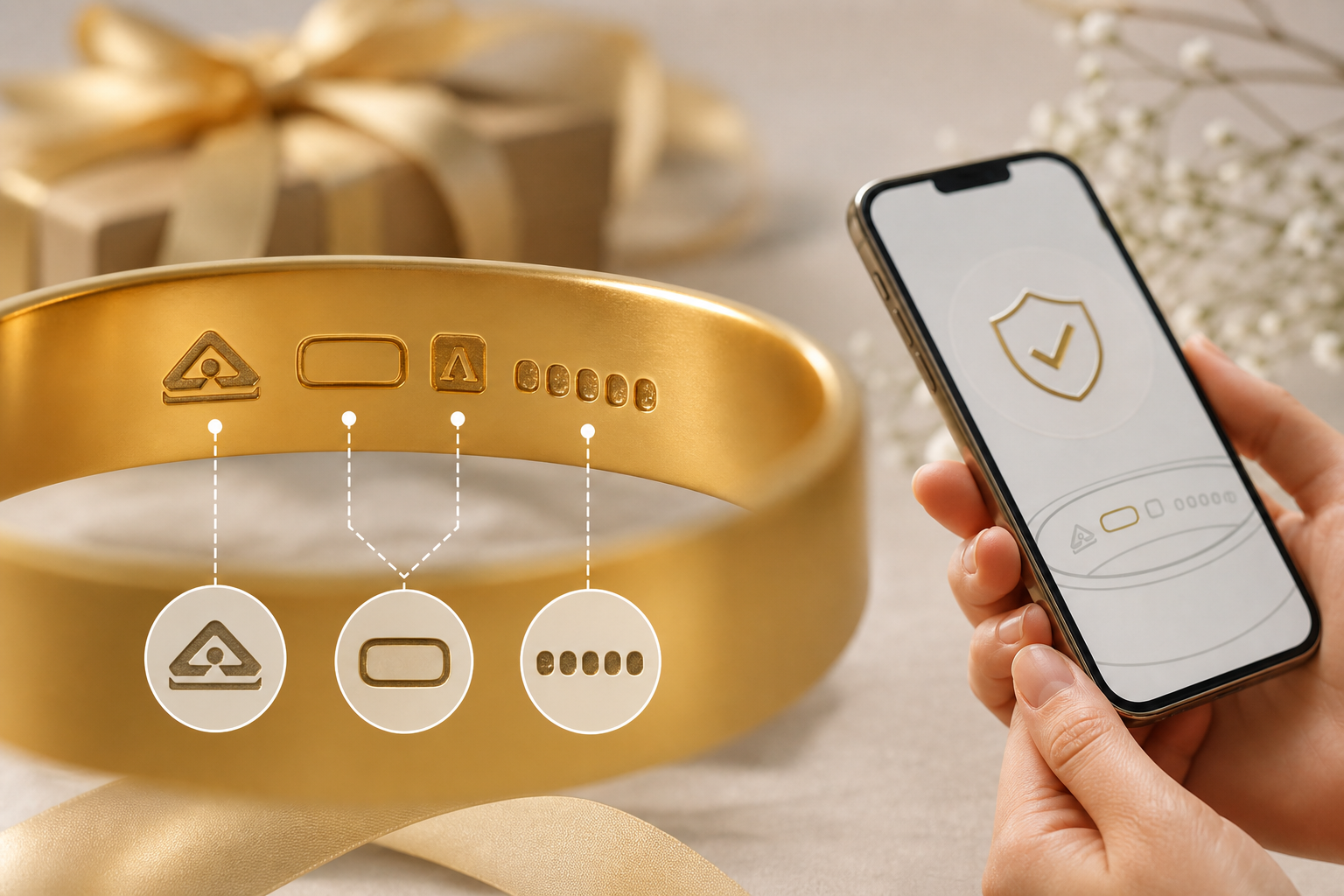
Specifically, BIS hallmarking gives you a government-backed purity guarantee in India. The Bureau of Indian Standards certifies that the gold in a piece meets the declared karat purity. The hallmark has three parts you can spot quickly: the BIS logo, a purity grade (like 916 for 22K or 750 for 18K), and a 6‑digit (alphanumeric) HUID (Hallmark Unique Identification Number). Because anyone can verify the HUID on the BIS CARE app or the BIS portal, the person you gift it to can independently confirm authenticity. No awkward calls to the seller needed.
Picture this: you’re sending a 22K temple-style necklace for a cousin’s wedding. Or an 18K diamond pendant for a parent’s 60th. You won’t be there when they unbox it. But you can give them a piece with a verifiable HUID and a clear invoice that shows purity, weight, and charges. That’s peace of mind in a small velvet box.
Why Gold Purity Matters More When You're Buying a Gift
When you buy for yourself, you can spot-check polish, clasp strength, and how a piece sits on your skin. However, a gift needs proof, not just a promise. That’s why purity is non‑negotiable. If you plan to choose bis hallmarked gold, you’re tying your gift to a standard that holds up in 2026 and years from now.
Purity also shapes comfort and longevity. Higher karats like 22K have that rich yellow hue, but the alloy is softer. Lower karats like 18K are tougher and often better for stone settings. The right pick blends beauty with real-life wear.
22K vs 18K for Gifting: Quick Context
For many families, 22K (916) is synonymous with that rich, traditional yellow glow that looks perfect in ceremonial photos and heirloom albums. It’s slightly softer than lower karats and excels in motifs that don’t require intensive stone-setting, such as filigree necklaces, temple pendants, and classic bangles. By contrast, 18K (750) balances beauty and durability. That is why it’s the preferred base for diamond- or gemstone‑set pieces.
Prongs, bezels, and channels stay snug through years of daily wear. Matching to lifestyle is straightforward. Pick 22K for ceremonial or heirloom-leaning gifts. Choose 18K when modern style, everyday mileage, and secure settings matter most.
Resale and exchange considerations are also simple when you choose bis hallmarked gold from reputable jewelers. Both 22K and 18K can be exchanged or bought back against prevailing rates, with the clarity of net weight and stated purity preserving your value. If you’re considering 14K (585) because the recipient is very active or prefers an international aesthetic, it can be a fine choice for daily durability in many markets. In India, however, 18K and 22K dominate fine gold gifting norms. So if you do pick 14K, insist on BIS hallmarking and transparent disclosure of fineness on the invoice to avoid confusion later.
What BIS Hallmarking Actually Is
BIS hallmarking is India’s government-backed purity certification. The Bureau of Indian Standards tests jewelry and certifies that the metal meets the declared karat.
-
- BIS logo: Confirms the piece has passed through a BIS-authorized Assaying & Hallmarking Centre.
-
- Purity mark: Fineness grade such as 916 (22K) or 750 (18K), indicating purity by parts per thousand.
-
- HUID: A unique 6‑digit (alphanumeric) Hallmark Unique Identification Number laser‑inscribed on each piece.
HUID, a unique 6‑digit (alphanumeric) code, can be verified on the BIS CARE app or the BIS hallmark verification page on bis. gov. in. The portal/app displays hallmark data, karat, jeweler registration, and the Assaying & Hallmarking Centre details. The recipient can cross‑check without contacting the seller.
For a 60th‑birthday diamond pendant, 18K (750) is a smart pick. It’s more durable for daily wear and holds diamond settings securely. For traditional wedding sets, 22K (916) gives that rich yellow glow many families love. Either way, the hallmark and HUID travel with the gift.
“Ordered a diamond pendant for my mother’s 60th. It arrived beautifully packaged, with a certificate and a personal handwritten note.” — Ananya Iyer, Bengaluru
Moreover, look for sellers that state 100% BIS hallmarked inventory and put the HUID on product pages and invoices. In addition, some offer a risk‑reversal promise, like a commitment to refund twice the difference if purity is below standard. That adds a financial backstop to your gift. When you choose bis hallmarked gold with this level of transparency, you are not only buying a beautiful object but also delivering verifiable assurance that stands up in an appraisal, an exchange counter, or an insurance claim.
BIS Hallmark vs Store Stamp vs “22K Micro”
- Store stamp: A brand logo or “22K” mark alone is not a BIS hallmark. It is self-declared and not third‑party tested.
- BIS hallmark: Independent testing plus registration. It includes BIS logo, purity, and HUID. That triad is your audit trail.
- “22K micro” or “micron” language: Often refers to gold plating thickness. That is not the same as solid gold. Treat it as costume unless the invoice states BIS‑hallmarked 22K or 18K for the actual metal in the piece.
Also Read!
Best GIA Certified Diamond Jewelry for First Time Buying Jewelry Online in 2026
Step-by-Step: How to Buy BIS Hallmarked Gold Jewelry Online as a Gift
A clear plan keeps you from scrolling for hours or guessing at bills. Use these seven steps the next time you choose bis hallmarked gold for someone you love.
Step 1) Decide on karat
- 22K (916): Rich yellow. Traditional look. Slightly softer. Great for wedding sets, bangles, temple motifs, Diwali gifts.
- 18K (750): More durable. Holds stones better. Common for diamond‑set pieces. Ideal for everyday wear and contemporary designs.
- Practical tip: If the recipient is very active or works with their hands, 18K tends to resist dings and keeps prongs secure better than 22K.
In practice, this first decision shapes every other line item on your bill and how the piece will age. A 22K necklace in a temple motif will shimmer with a saturated hue. You’ll want to avoid delicate, tall prongs that can bend with frequent wear. An 18K pendant with a diamond halo, on the other hand, will stay stable under daily wear-and-tear.
That makes it a safer pick for someone who rarely takes their jewelry off. Think about the recipient’s wardrobe and routine. Then let karat follow function so you deliver beauty that lasts beyond the unboxing moment.
Example: Match Style to Karat
- Minimal daily wearer → 18K diamond pendant or huggie hoops.
- Festival or wedding gift → 22K filigree bangle or temple‑style pendant.
- Office chic → 18K geometric necklace with small diamonds.
- Heirloom vibe → 22K antique‑finish kada with intricate work.
- Sporty/utility lifestyle → 18K bezel‑set studs or channel‑set bands to avoid snagging.
Not sure which direction to lean? Visualize how the recipient dresses for a typical weekday and a typical family event, then map the style accordingly. A minimal daily wearer will get more mileage from 18K huggie hoops or a petite diamond pendant that plays well with T‑shirts and blazers.
If the gift is meant to shine at a festival or wedding, a 22K filigree bangle or temple‑style pendant evokes tradition and photographs beautifully. For an heirloom feel, a 22K antique‑finish kada with intricate work will feel substantial. A sporty or utility-driven lifestyle calls for 18K bezel‑set studs or channel‑set bands. Those keep edges smooth and snag‑free during active days. When you choose bis hallmarked gold with this lifestyle lens, your gift becomes a fixture, not just a momentary accent.
Step 2) Set a realistic budget
Online gold jewelry pricing is not just “gold price x weight.” A clean breakdown is a green flag.
Total = Metal value (live rate × net weight) + Making charges + Stone charges + 3% GST on jewelry + 5% GST on making charges.
Therefore, compare net metal weight and making charges line by line. Transparent making charges show respect for your budget.
Most jewelers will quote making charges either as a percentage of the metal value or as a per‑gram fee. A few still mention “wastage,” which effectively increases total making. Whatever the format, insist that the invoice lists each component separately. Metal, making, stones, and GST should be visible.
That makes comparisons easy and fair. Intricate filigree or antique finishes typically command higher labor charges because they demand more bench time. Casting‑heavy, simple designs cost less to produce for the same net weight. If two similar designs differ sharply in price, the explanation is almost always hiding in those line items.
Budget Math, Worked Example
- Assume a 22K (916) pendant, net gold weight 6.00 g, live rate ₹6,673/g.
- Metal value: 6.00 × 6,673 = ₹40,038.
- Making charges: say 12% of metal value = ₹4,804.56.
- Stones: none for this example = ₹0.
- GST on jewelry (3% of metal value): ₹1,201.14.
- GST on making (5% of making charges): ₹240.23.
- Estimated total: ₹40,038 + ₹4,804.56 + ₹0 + ₹1,201.14 + ₹240.23 ≈ ₹46,284.
- Pro tip: If two similar pendants differ by ₹3,000–₹5,000, check whether one is simply lighter or has higher making charges.
- Bonus check: Ask for the “net gold weight” (excluding stones, enamel, and findings not in the stated karat) and confirm the karat of chains, hooks, and backs—occasionally these differ from the pendant/base and should be disclosed.
This kind of worked example makes it easier to sanity‑check a quote in seconds. If you’re browsing multiple tabs, jot down the live rate and net weight to compute a quick metal value. Then see whether making charges feel aligned with the complexity of the design. Don’t forget stones and GST.
Even a modest making‑charge difference can be offset by a higher stone markup or vice versa. For a clean comparison, ask each seller to confirm the net gold weight (excluding stones, enamel, and any non‑gold components). Also clarify the karat of chains, hooks, and screw‑backs. Findings occasionally differ from the headline karat and should be disclosed on the invoice to protect your recipient’s long‑term value.
Step 3) Verify BIS hallmark
Check the product page for:
- The BIS hallmark icon
- The purity grade (916 or 750)
- A note that every piece has a unique 6‑digit (alphanumeric) HUID
After delivery, match the HUID on the jewel to your invoice. Ideally, the seller states 100% hallmarked inventory across gold and silver.
When you’re evaluating a listing, pause at the hallmark photo and scrutinize it the way you would a logo on a passport. Avoid vague phrases like “gold finish,” “gold‑tone,” or “vermeil” when the piece is presented as fine jewelry. Those terms indicate plating rather than solid gold.
Be cautious if there is no mention of the HUID or if the seller refuses to share it after delivery. A hallmark photo that looks inconsistent with the product’s finish, or a HUID that doesn’t return a valid result on BIS CARE (or shows a different karat/article type than what you bought), are all reasons to slow down. Verify independently and escalate with the seller before you cut any tag.
Mini Checklist: Verify in 90 Seconds
- Zoom into the hallmark photo. Identify BIS logo, purity, and HUID.
- Confirm the same HUID appears on the physical tag and the invoice.
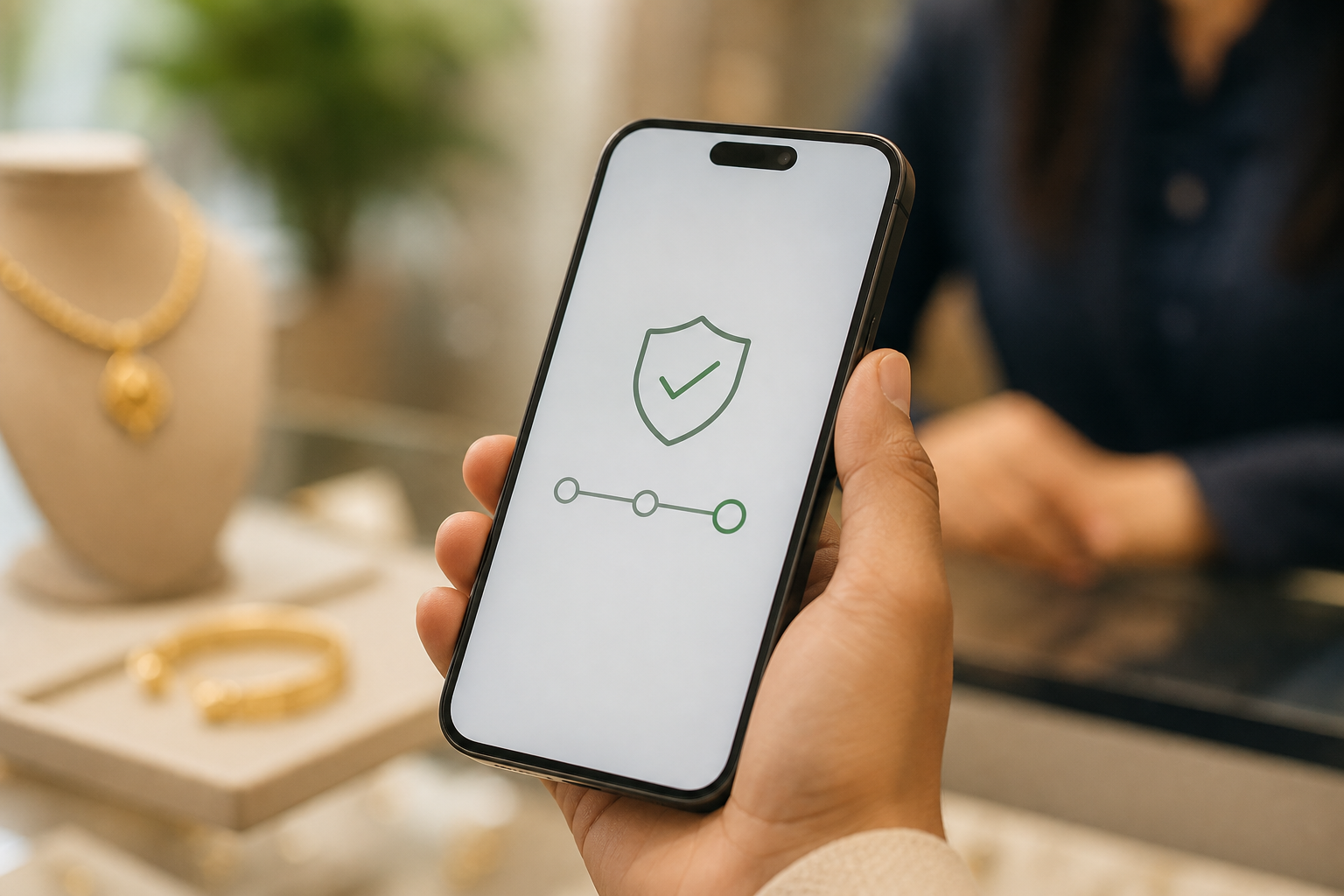
- Open BIS CARE. Scan or type the HUID. Save a screenshot of the result.
- If details mismatch, pause. Do not remove tags. Contact support with screenshots.
Step 4) Check diamond and gemstone certification
18 ct. These are independent grading bodies; their reports help the piece hold value and reduce disputes later. 18 ct should have IGI or GIA documents. 18 ct, ask for IGI or GIA certificates and verify the report number online before the return window closes.
30 ct (and up), examine the stone closely, ideally with a loupe during unboxing, and cross‑match the laser inscription on the girdle (if present) with the report number. Disclosure matters: Lab‑grown diamonds can be excellent value when clearly labeled and priced accordingly. Ensure the invoice and certificate explicitly say “lab‑grown” if that’s what you’re choosing, and save PDFs of every report alongside your invoice.
To make this guidance precise and easy to act on, use the following specific checks:
- For diamond centers above 0.18 ct: Ask for IGI or GIA certificates. Verify the report number online before the return window closes. This aligns the “18 ct” note above with a practical rule of thumb for certification.
- For diamond centers at 0.30 ct (and up): Examine the stone closely during unboxing. Use a loupe if you have one. Cross‑match the laser inscription on the girdle (when present) to the report number.
- For side stones and melee: Reputable sellers disclose total carat weight and color/clarity ranges. They may not certify each tiny stone, which is normal. Ensure the invoice lists total stone weight clearly.
- For colored gemstones: Ask for origin and treatment disclosure. For higher‑value gems like emerald, ruby, and sapphire, consider lab reports from IGI, GRS, AGL, GIA, or SSEF when feasible.
- For lab‑grown diamonds: They are great value when clearly disclosed. Ensure the invoice and certificate explicitly say “lab‑grown.” Save PDF copies of every report with your invoice. Verify the report online just like you would for natural stones.
Step 5) Evaluate return and exchange policy
Gifts need time. A 30+ day window is decent. A 365‑day free insured return policy is even better for long‑distance gifting. Furthermore, a lifetime exchange policy and a buy‑back guarantee at the prevailing rate add long‑term flexibility if the recipient wants to resize, restyle, or trade up years later.
Take a few minutes to read the fine print so there are no surprises after the occasion. Confirm whether customized engravings or made‑to‑order lengths affect return eligibility. Check who pays for return shipping. Understand how refunds are processed.
Store credit versus the original payment method can matter a lot for a gift. Ask whether first‑time resizing is complimentary. Clarify maintenance policies such as prong tightening or periodic rhodium replating for 18K white gold. If you choose bis hallmarked gold from a jeweler that treats returns and exchanges as part of customer care rather than an exception, your recipient will feel supported long after the gift wrap is recycled.
Return windows, exchange terms, and buy‑back policies are part of your trust framework. Think of them as “insurance you do not pay for.”
Step 6) Inspect packaging and presentation options
Gift‑ready packaging matters. Look for options to add a personal note, protected boxes, and insured shipping. FSC‑certified packaging signals care for materials.
Thoughtful presentation upgrades a beautiful object into a memorable ritual. Ask for a discreet gift card with your message. Request a protective inner box that prevents scuffs in transit. Look for clear labeling so the recipient knows which way to open the package.
Many brands can exclude pricing from the in‑box slip for surprise gifting or split shipping so the invoice goes to you while the jewel ships to the recipient. Just request it at checkout. Storage and care extras, such as a microfiber pouch and an anti‑tarnish strip (especially for 18K white gold), help keep the piece looking fresh for months. They encourage everyday wear without worry.
Step 7) Read shipping and insurance details
High‑value pieces should ship insured. For global gifts, check if the brand ships to 30+ countries and uses secure logistics (for example, Brinks) with end‑to‑end insurance. Also confirm duties and delivery timelines so the gift arrives before the event.
- Status tracking: Look for proactive tracking links and OTP/ID verification at delivery for added security.
- Event deadlines: If you’re up against a date, ask for ship‑by and deliver‑by guarantees in writing on your order confirmation.
Logistics are the last mile of trust, and they matter as much as purity when you’re sending a surprise. Ensure your order includes end‑to‑end insurance and that the courier requires OTP or ID verification on delivery, reducing the chance of mis‑routing. For interstate or international gifts, clarify whether duties are prepaid to avoid awkward doorstep charges for the recipient. Ask for clear ship‑by and deliver‑by dates in your order confirmation if you’re up against an event deadline. Proactive tracking links and signature requirements create a documented chain of custody that protects both you and your recipient if anything goes off‑schedule.
[Get Instant Hallmark Guidance →] at checkout. If the listing updates later, you’ll still have proof of what you agreed to.
Also Read!
5 Common Mistakes Gift Buyers Make with Online Gold Jewelry
You can avoid 90% of headaches if you spot these five traps early. Use this list the next time you choose bis hallmarked gold so your gift delights without doubt.
-
Ignoring the hallmark and trusting “gold‑plated” listings
Plated, vermeil, or “gold‑tone” pieces are not solid gold. They can be lovely costume jewelry, but they don’t carry metal value like hallmarked 22K or 18K. Therefore, if purity and resale value matter, insist on BIS hallmarking with a visible HUID. -
Choosing by photos alone, not weight and charges
Two necklaces can look identical on screen but differ by ₹20,000+ once you compare net weight and making charges. Always check the metal weight, the gold rate used, and making charges on the invoice. As a result, you won’t pay a premium for a lighter piece with fancy photography. -
Buying diamond jewelry without third‑party certification
Uncertified stones may be treated, over‑graded, or even lab‑grown without clear disclosure. For any center stone above 0.18 ct, ask for IGI or GIA certificates and verify the report number online. This keeps the gift’s value transparent and helps with future upgrades. -
Forgetting the recipient’s style
A heavy traditional choker may impress at a wedding but gather dust for someone who wears minimal pieces daily. However, many retailers offer video consultations or even a 3D mockup for custom designs. Use those tools to match their daily style, not just the event vibe. -
Not verifying the HUID after delivery
Always scan or enter the 6‑digit HUID in the BIS CARE app the day the gift arrives. Moreover, teach the recipient to check it as well. That two‑minute step gives both of you an independent record of purity and registration.
Quick Fixes
- Ask for a live video or 3D preview before you buy.
- Confirm IGI & GIA certification for diamond centers above 0.18 ct.
- Verify the unique HUID on the BIS portal or BIS CARE app.
- Keep an eye on weight and making charges, not just photos.
- Save the invoice PDF and unboxing photos for easy returns or exchanges.
- Record a short video during unboxing that shows the hallmark area, tag with HUID, and the sealed package label—this supports any claim swiftly.
Tools and Resources for Verifying Gold Jewelry Online
You don’t need industry contacts to buy smart. These free or low‑effort tools help you choose bis hallmarked gold with confidence in 2026. Start with the BIS CARE app, a government‑issued tool that lets you scan or manually enter the 6‑digit (alphanumeric) HUID to view hallmark details, purity grade, and jeweler registration. If you prefer a desktop, the BIS hallmark verification portal offers the same checks from a larger screen. That is useful when you’re planning a gift at your desk and want to save screenshots.
When diamonds are involved, use the IGI and GIA report lookup tools to verify a stone’s certificate number before you buy. Entering the report ID takes seconds and immediately confirms whether the grade, measurements, and inscription align with what’s advertised. This habit keeps the gift’s value transparent. It also eases future exchanges and reduces disputes if you ever need an appraisal.
To stay anchored on price, consult gold rate trackers such as the India Bullion and Jewellers Association (IBJA) published daily rates. Compare that benchmark against any retailer’s quoted rate so your metal pricing makes sense. Small deviations should not snowball into big overpayments.
Online jewelers with transparent pricing and hallmark assurance, platforms like Caratflow, can simplify the experience by displaying live gold rates, itemized costs (metal + making + stones + GST), and BIS‑hallmarked pieces with HUID verification. Many also bundle thoughtful perks like lifetime free polishing and re‑plating, FSC‑certified packaging, and insured international shipping to 30+ countries via Brinks. Those perks collectively make gifting easier and more predictable.
Finally, adopt a consumer protection habit. Save PDFs of your BIS CARE results and diamond report lookups alongside your invoice. Keeping every document in a single folder speeds up exchanges, returns, or insurance claims.
It also provides a clean paper trail if you ever need to prove the piece’s specifications. When in doubt, take one more screenshot than you think you need. Your future self will thank you.
Pro move: Create a “Gold Gift” folder in your cloud drive with subfolders for Invoices, BIS CARE screenshots, Certificates, and Unboxing Videos. Share it with the recipient after the event.

How to Read a HUID in the BIS CARE App
- Find the HUID: It’s laser‑inscribed on the piece and usually printed on the tag/invoice.
- Open BIS CARE and choose “Verify HUID,” then scan or type the 6‑digit (alphanumeric) code.
- Confirm the purity grade (916/750), jeweler’s registration, and Assaying & Hallmarking Centre.
- Cross‑check that brand name, karat, and article type match your invoice and product page.
- Save a screenshot of the result in your gift folder for future reference.
If the app shows “invalid” or mismatched details, contact the seller immediately and do not remove any tags until resolved.
What to Do Before Your Next Gold Jewelry Gift Purchase
If you have a gift date on the calendar, take these actions this week to choose bis hallmarked gold without last‑minute stress.
Begin with style research. Scan their Instagram. Notice what they wear to work and on weekends. If needed, ask a mutual friend for a discreet hint so your pick feels personal.
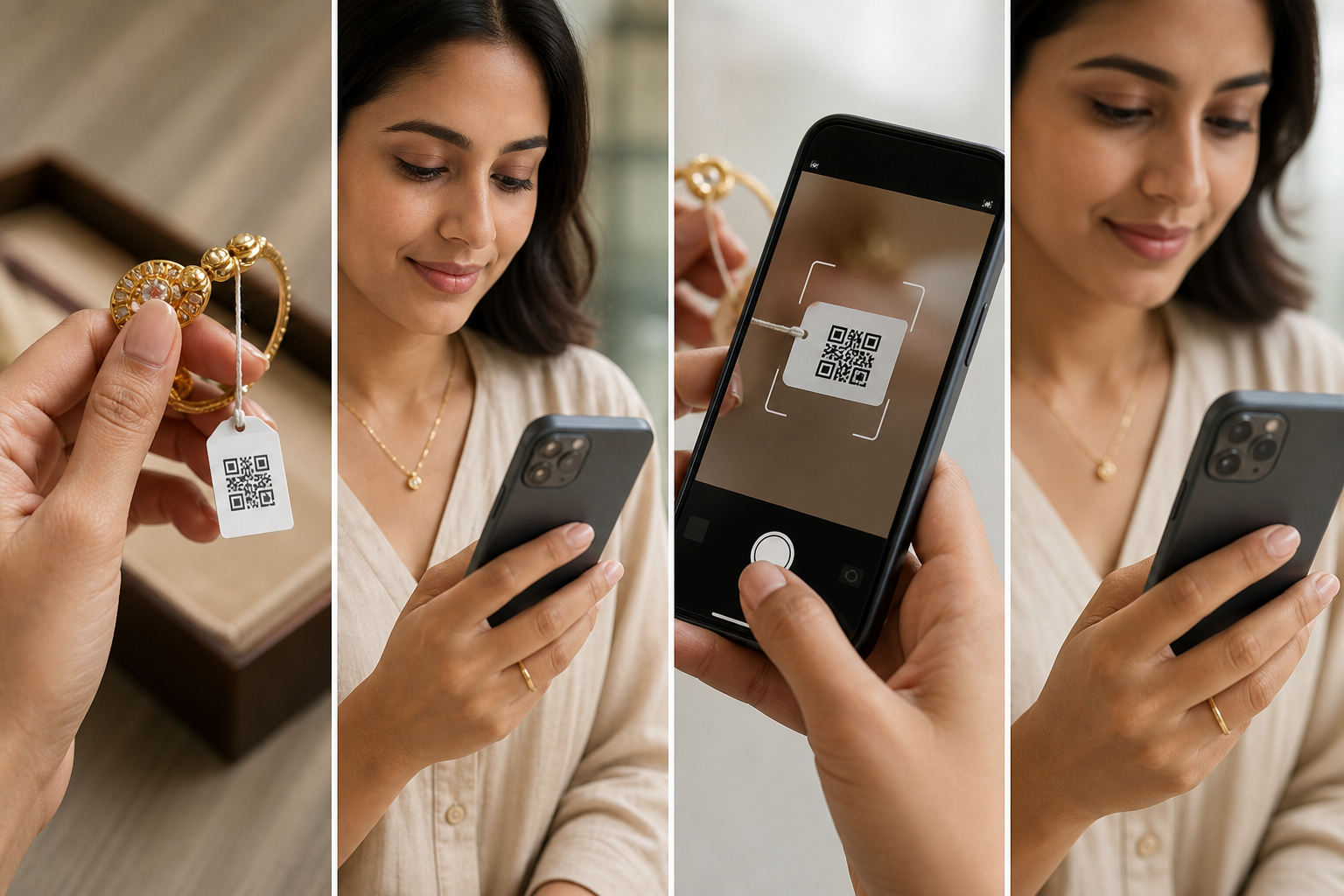
Download the BIS CARE app and practice by entering a sample HUID from a product page. That way you’re fluent on delivery day. Anchor your budget by checking today’s gold rate on IBJA and writing down a target net weight. A target range keeps you focused while browsing.
Shortlist two or three BIS‑hallmarked online jewelers and compare their making charges, return windows (aim for 30+ days or 365‑day free insured returns), lifetime exchange terms, and buy‑back at the prevailing rate. 18 ct include IGI or GIA certificates and pre‑verify report numbers online.
Double‑verify shipping details if the gift will cross state or national borders. Confirm insured transit. Require signature or OTP/ID verification on delivery.
Ask whether duties are prepaid to avoid surprise charges for the recipient. Finally, put every relevant screenshot, product page, invoice draft, BIS CARE result, diamond certificate lookup, into a single folder. That five‑minute prep step eliminates anxiety and keeps all your proof in reach if you need a fast return, resize, or exchange.
Mini Pre‑Purchase Checklist
- Define the occasion, style vibe, and daily wear level.
- Choose 22K for ceremonial warmth or 18K for durable daily wear.
- Check IBJA rate and set a target net weight in grams.
- Confirm BIS hallmark and plan to verify HUID on delivery.
- For diamonds >0.18 ct, collect and verify IGI/GIA report numbers.
- Read return, exchange, and buy‑back terms line by line.
- Lock in insured shipping, OTP/ID delivery, and prepaid duties if abroad.
Quick Gifting Scenarios (What to Pick)
2L, a 22K (916) choker or long haar with modest making charges is a timeless win; just insist on the HUID and a detailed invoice so the family can verify purity later. 30 ct and make sure the IGI or GIA report is included and verified; don’t forget insured shipping so the surprise arrives intact. College graduation feels right with an 18K minimalist bracelet or initial pendant in the ₹20k–₹35k range, and it’s wise to confirm the return window in case sizing needs a swap after convocation day.
For Raksha Bandhan or Diwali tokens at ₹10k–₹20k, a 22K coin or small charm is joyful and simple, verify the HUID and opt for FSC‑certified gift packaging to round out the experience. New parents will appreciate 18K rounded‑edge studs or a smooth pendant in the ₹15k–₹30k range; prioritize secure screw‑backs that won’t snag baby clothes during those first hectic months.
To make these scenarios easier to act on, see the formatted picks below:
- Wedding gift (Budget ~₹2L): Choose a 22K (916) choker or long haar with modest making charges. Keep the invoice detailed with net gold weight and purity. Verify the HUID on BIS CARE before the ceremony. The sentence “2L, a 22K (916) choker or long haar with modest making charges is a timeless win” above captures the spirit. This bullet adds structure and a quick action plan.
- Milestone birthday with a diamond center (~0.30 ct and up): Opt for 18K gold for stronger settings. Verify the IGI or GIA report. Match the laser inscription when possible. Use insured shipping to protect the surprise. The shorthand “30 ct and make sure the IGI or GIA report is included and verified” above emphasizes this threshold. Now you have a checklist to go with it.
- College graduation (₹20k–₹35k): Pick an 18K minimalist bracelet or an initial pendant. Confirm the return window so a size swap is simple. Save the invoice PDF and delivery photos.
- Festive tokens (₹10k–₹20k): A 22K coin or small charm is perfect. Verify the HUID and add FSC‑certified gift packaging. Schedule delivery two to three days before the festival.
- New parents (₹15k–₹30k): Go for 18K rounded‑edge studs or a smooth pendant. Prioritize secure screw‑backs and snag‑free profiles.
Care and Maintenance Tips to Include in the Gift
- 22K yellows: Wipe with a soft cloth after each wear. Avoid abrasive cleaners and harsh chemicals.
- 18K white gold: Expect rhodium replating every 12–24 months with frequent wear. Ask the brand about complimentary maintenance.
- Diamond care: Soak in lukewarm water with a drop of mild dish soap. Brush gently with a soft toothbrush. Rinse and dry.
- Storage: Use the provided pouch. Keep pieces separate to prevent scratches. Add an anti‑tarnish strip if the brand includes one.
- Service records: Save any resizing, polishing, or prong‑check receipts in your “Gold Gift” folder to build a service history.
Also Read!
Key Takeaways
- BIS hallmarking and a verifiable 6‑digit (alphanumeric) HUID turn a pretty gift into a documented, authentic one.
- Budget with the full formula: Metal (live rate × net weight) + Making + Stones + 3% GST on jewelry + 5% GST on making charges.
- Pick 22K (916) for classic, rich yellow gifts, and 18K (750) for durable, stone‑set, or modern styles.
- For diamond centers above 0.18 ct, ask for IGI or GIA certification and verify the report number online.
- Safer gifting includes insured shipping, a 30+ day return window (ideally 365 days), lifetime exchange, and buy‑back at the prevailing rate.
- Before checkout, confirm the HUID is listed on the product page and will appear on your invoice; after delivery, verify it on BIS CARE.
What to Do This Week
Set your shortlist, download the BIS CARE app, and note today’s gold rate. Then book a quick consult to validate HUID, pricing, and shipping before you buy. In 2026, a 10‑minute pre‑check saves you hours of doubt and gives your recipient certainty on day one.
Start Your Free Gift Plan → HUID laser‑inscribed. If a seller declines to share or can’t show it on delivery, treat that as a red flag and pause the transaction.
FAQs: Fast Answers for Confident Gifting
What if the HUID result shows a different karat than the product page?
Do not cut tags or wear the item. Take screenshots of the BIS CARE result and your order page, then contact support for a resolution or return. A reputable jeweler will correct the error or refund you promptly, and having both the product page and the BIS CARE screen in your file will make the conversation smooth.
Do coins and bars also need BIS hallmarking?
Many do carry hallmarking, and the same verification principles apply. If you’re gifting a coin, request the fineness mark, HUID, and clear invoicing that states net weight and purity. For bars or coins that are not hallmarked, consider whether the issuer’s brand and buy‑back policy provide comparable confidence for the recipient.
How do I gift white gold or rose gold confidently?
Choose 18K with BIS hallmarking, confirm rhodium plating details for white gold, and include care instructions in the box so the recipient knows when to expect gentle replating. Ensure the invoice states the karat and that any diamond center has IGI/GIA certification, and store a copy of the certificate in your digital folder. These quick steps keep the romance of color golds intact without sacrificing verification.
Can I customize a design without losing return rights?
Light customizations, an engraving or a specific chain length, often remain returnable if the piece isn’t heavily personalized, but policies vary by brand. Read the return clause before approving custom work and save all email confirmations so you have a written record. If a retailer will not confirm customization terms in writing, pause the order until they do.
What’s the safest way to ship directly to the recipient?
Use insured shipping with OTP/ID verification, request tamper‑evident packaging, and ask the brand to exclude pricing on the in‑box slip (send the full invoice PDF to your email instead). For international deliveries, confirm that duties are prepaid and pin down a delivery window so the gift arrives before the occasion. Add the tracking link to your calendar reminders to nudge you if anything stalls, then celebrate knowing you chose bis hallmarked gold that’s secure from checkout to unwrapping.
Extra: Myths vs Facts When You Choose BIS Hallmarked Gold
- Myth: “22K is always better than 18K because it is purer.
Fact: 22K is purer and richer in color, but 18K is stronger for stone settings and daily wear. Match karat to lifestyle, not just purity. - Myth: “If a piece looks yellow, it must be 22K.
Fact: Plated brass can look yellow too. Only BIS hallmark plus HUID verification confirms purity. - Myth: “Hallmarking increases price unfairly.
Fact: Hallmarking adds nominal cost but protects value. It deters under‑karating and supports fair buy‑back. - Myth: “Lab‑grown diamonds are fake.
Fact: Lab‑grown diamonds are real diamonds with identical optics and hardness. They must be clearly disclosed and priced accordingly.
Glossary for Fast Reference
- BIS: Bureau of Indian Standards, India’s national standards body. Oversees hallmarking.
- HUID: Hallmark Unique Identification Number. A 6‑digit (alphanumeric) code laser‑inscribed on each hallmarked item.
- 916/750/585: Fineness numbers for 22K, 18K, and 14K respectively. Expressed as parts per thousand.
- Making charges: Labor and design costs to manufacture the piece. Quoted as a percent or per‑gram fee.
- Wastage: An older invoicing term that inflates effective making charges. Ask for transparent line items instead.
- IGI/GIA: Independent diamond grading laboratories used for report verification.
- IBJA: India Bullion and Jewellers Association. Publishes benchmark daily gold rates.
Bonus Table: Quick Comparison of 22K vs 18K for Gifts
- Color
- 22K: Deep, traditional yellow.
- 18K: Balanced warmth. Works well with diamonds and modern styles.
- Durability
- 22K: Softer. Best for non‑stone, sculpted motifs.
- 18K: Harder. Better for prongs, bezels, and active wearers.
- Typical Use
- 22K: Wedding sets, bangles, temple designs, coins.
- 18K: Daily pendants, bracelets, diamond studs, engagement gifts.
- Resale and Exchange
- 22K: Strong in traditional markets. BIS hallmark aids buy‑back.
- 18K: Strong for diamond jewelry with certificate support.
- Care
- 22K: Simple wipe‑downs. Avoid bending thin motifs.
- 18K: May need rhodium replating for white gold. Routine prong checks for stone‑set pieces.
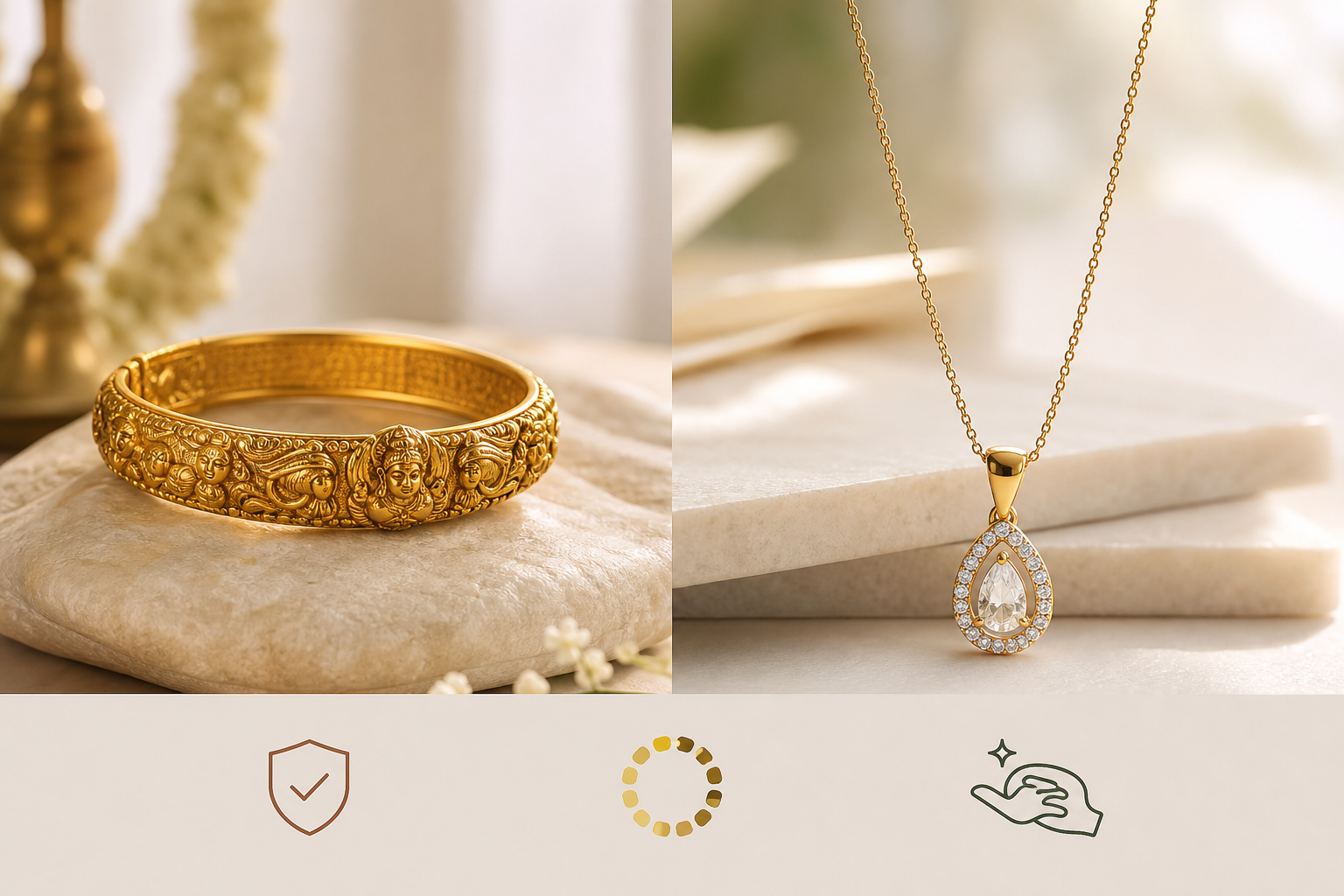
Final Confidence Loop Before You Checkout
- Reconfirm today’s IBJA rate and your target net weight.
- Ensure BIS hallmark icon, purity, and HUID are visible on the product page.
- Ask support to confirm the exact HUID will appear on your invoice and tag.
- Validate any diamond center with IGI/GIA lookup. Save the PDFs.
- Read returns, exchange, and buy‑back once more. Screenshot key lines.
- Choose insured, OTP/ID-verified shipping. Prepay duties if gifting abroad.
- Prepare a short unboxing video plan. Focus on the hallmark area and tag.
With these steps, you choose bis hallmarked gold that is beautiful, documented, and easy to love—for the event day and every day after.