In 2026, insured international jewelry shipping is the non-negotiable pillar of a safe cross-border jewelry purchase. Book a free video consult →, IGI or GIA certification for qualifying diamonds, and insured shipping with a specialist like Brinks to 30+ countries. When a store is transparent about all three, you’re not guessing, you’re protecting your money and your moment.
Emotionally, you’re honoring high-stakes moments such as weddings, festivals, family gifts, and personal milestones, so peace of mind matters as much as price. Practically, you’re managing a matrix of purity checks, transit insurance, customs processes, returns logistics, currency conversion, and time-zone lag.
Any one of these can introduce delay or cost. And the signals to insist on are clear: BIS hallmark plus HUID on gold, IGI/GIA certificates where relevant for diamonds, and insured shipping via a valuables carrier so the parcel’s value is protected door to door. Ask sellers to show how they meet each signal.
You’ll convert doubt into documentation that travels with your jewelry and satisfies customs when it counts. That way, you reduce friction at every step and keep focus on the celebration, not the shipping anxiety.
At-a-glance safety checklist (print this)
- BIS hallmark stamp visible on the piece, with HUID read aloud on video and verified on BIS CARE.
- IGI or GIA certificate number for qualifying diamonds, matched to lab database before payment.
- Full price formula in writing: metal value (live rate × net weight) + making charges + stone charges + 3% GST on jewelry + 5% GST on making charges.
- Insured international jewelry shipping via a valuables carrier (e. g., Brinks) with insured value equal to your invoice total.
- Duty/tax pre-check with HS code noted, plus DAP vs DDP clarified in writing on the invoice or pro forma.
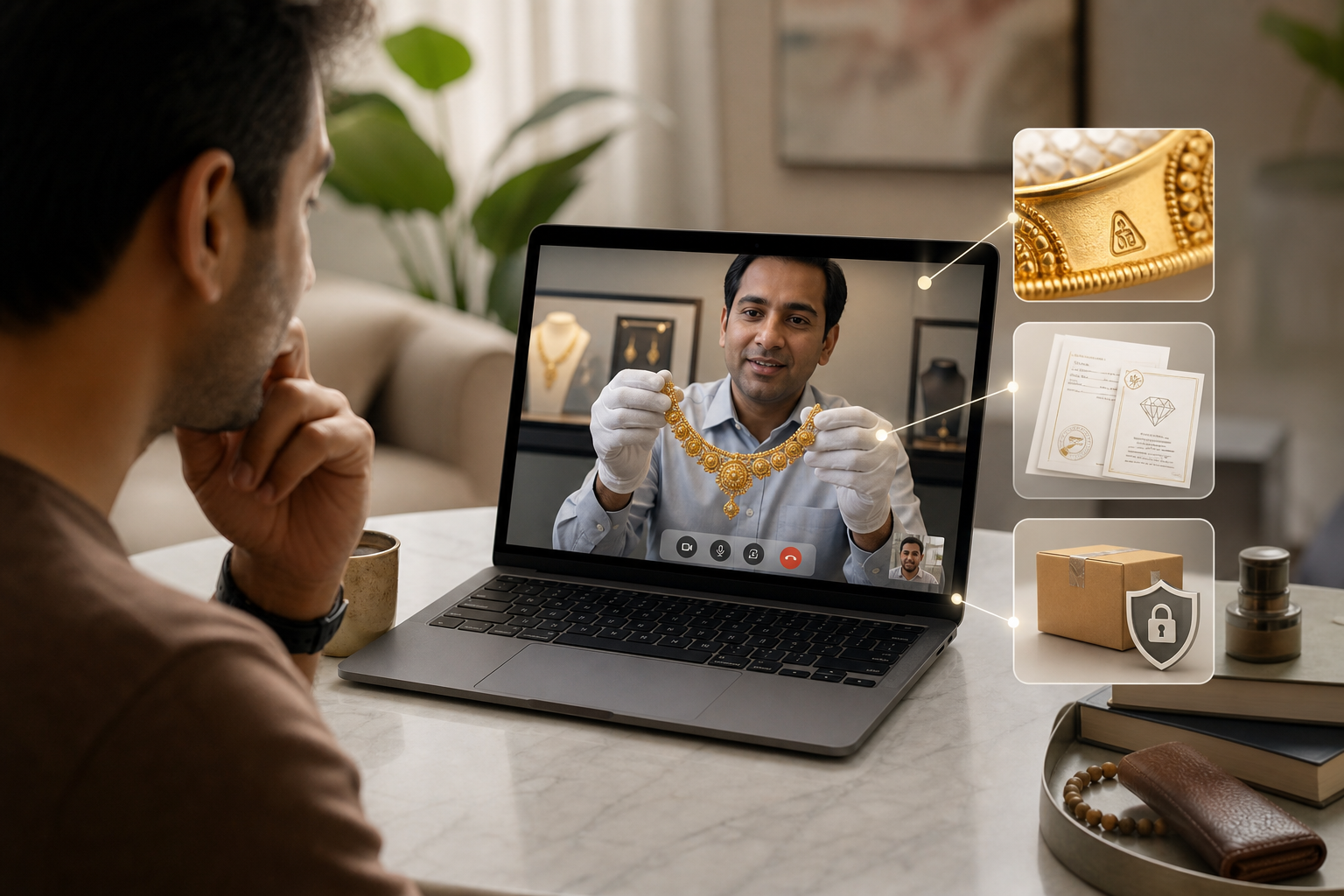
“I booked a video consult, saw the hallmark up close, and the parcel arrived fully insured. Smooth.” — Kavita Reddy, Hyderabad
Also Read!
NRI’s Guide to Gold Jewelry with Lifetime Exchange and Buyback
BKO Jewellery vs Tanishq for NRIs: Which Is Better for Lifetime Exchange and Buyback?
Step-by-Step: How to Safely Buy Indian Jewelry Online and Ship It Internationally
Buying from abroad feels calmer with a plan. Use this 7-step framework. It keeps you focused and builds the paper trail shippers and customs love. And yes, it bakes in insured international jewelry shipping as a standard, not a surprise.
Why this plan works
- It turns big, vague risks into small, specific checks you can do in minutes.
- It produces records that insurers and customs officers actually accept.
- It slows you down at the right moments and speeds you up once the facts are verified.
Before you start: quick budget worksheet
- Define the event (wedding, festival, milestone) and timeline (need-by date + a 7–10 day buffer).
- Choose metal and format: 22K gold for traditional pieces; 18K for diamond-intensive designs; note ring/bangle sizes.
- Set a ceiling in your local currency, then add a 15% buffer for shipping, insurance, and duties.
- Pre-list must-have documentation: BIS hallmark + HUID, IGI/GIA where relevant, and insured international jewelry shipping via a valuables carrier.
Phase 1: Define and verify early
-
Define what you need
Write your brief before you browse. Note the occasion, preferred metal (22K for traditional gold glow; 18K for diamond strength), size, and a target budget in your local currency so you’re not mentally converting under pressure. Build in a 15% buffer for duty and shipping because even well-estimated landed costs vary with exchange rates and carrier surcharges. A crisp brief stops impulse buys. It also helps the seller tailor options that actually fit. -
Verify seller credentials
Ask for BIS hallmark photos and the HUID (a unique 6-digit code) tied to the piece you’re considering, then check it on the BIS CARE app or the BIS portal while you’re still on the call. BIS hallmarking confirms the claimed metal purity, and the HUID links that hallmark to a unique ID.
For diamonds of 0.18 ct or larger, request IGI or GIA certification and confirm the number against the lab’s database. IGI/GIA reports document the 4Cs and identify natural versus lab-grown stones. These checks take minutes and can save you thousands. They can also save weeks of frustration if something goes wrong.
Quick win: Ask the associate to show the hallmark and read the HUID aloud while you verify on BIS CARE. Screenshot the result with date/time for your shipment dossier.
Phase 2: Price clarity and insured transit
-
Understand the price math
Request the full, line-item breakdown in writing so you can see exactly what you’re paying for and compare sellers fairly. Total = Metal value (live rate × net weight) + Making charges + Stone charges + 3% GST on jewelry + 5% GST on making charges. If a seller can’t or won’t provide this breakdown, treat it as a red flag and pause the transaction. Transparent math is your lie detector. It also becomes part of your documentation should you need to file an insurance claim or answer a customs query. -
Confirm shipping method and insurance
Choose a valuables carrier (e. g., Brinks) with full-value insurance to your country, not standard post. Get the insured value in writing on the invoice or shipping confirmation. This matters because most parcel services cap standard liability at a few hundred dollars, while specialist coverage is designed to insure the full invoice value of precious goods.
Ask whether the shipment will be handled under DAP (Delivered At Place) or DDP (Delivered Duty Paid). Clarify who handles brokerage fees and tax payments so no one is surprised at delivery.
Also confirm signature-on-delivery, discreet packaging with no “jewelry” wording on the label, and whether tamper-evident seals are used from pickup to delivery.
Insurance wording to confirm (copy/paste these asks)
- Please confirm the insured value equals the full commercial invoice value, not carrier default liability.
- Is coverage door to door, including last-mile handoff and any return shipment if needed?
- Will the airway bill list a neutral description (e. g., “fashion accessory, HS 7113”)?
- Is an adult signature required at delivery, and are tamper-evident seals used throughout?
- If DDP is offered, how are taxes calculated, paid, and reconciled post-clearance?
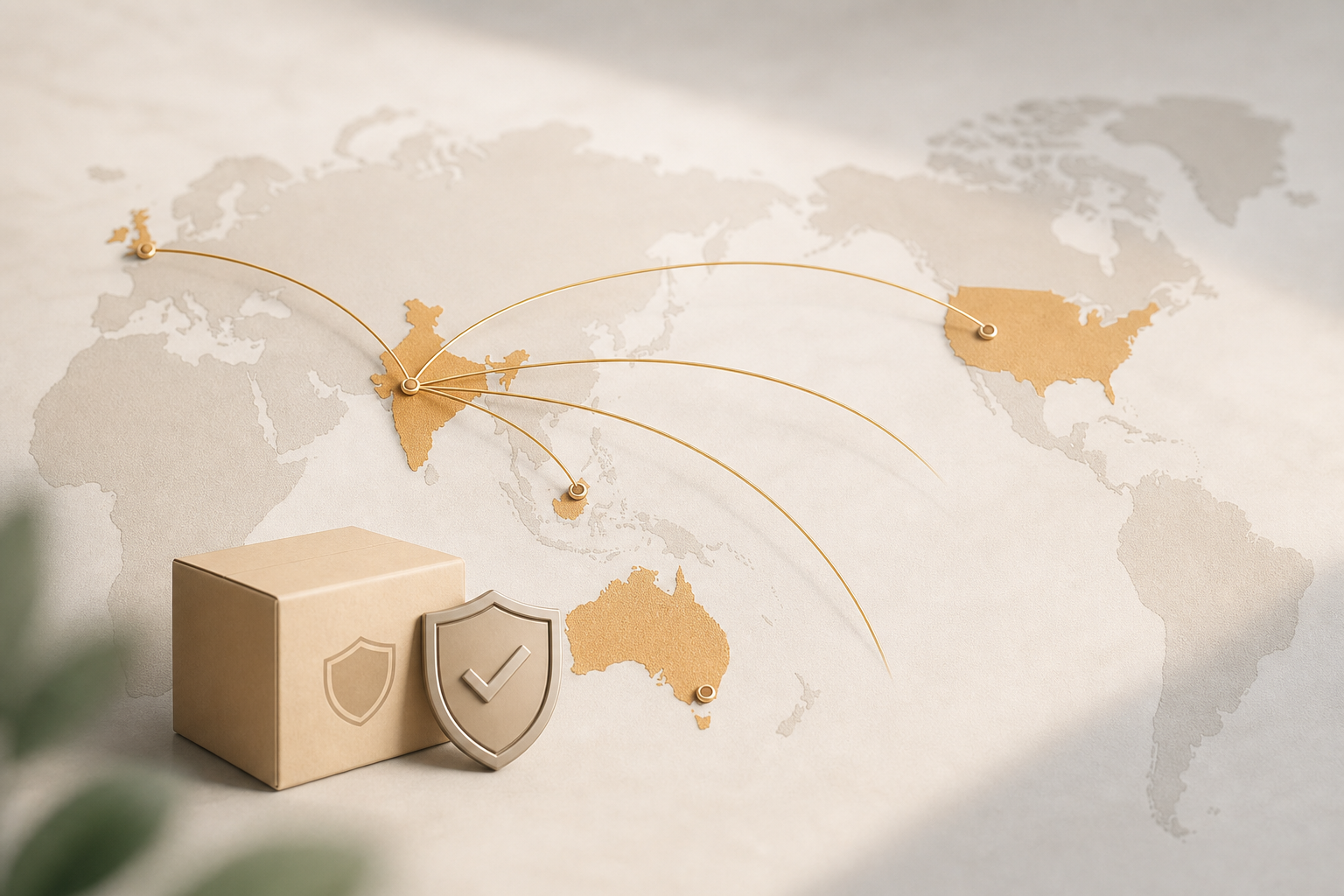
Incoterms in practice (DAP vs DDP examples)
- DAP example: Seller ships via Brinks to your U. S. address, you pay duties and any state use tax on arrival; the carrier or a broker bills you directly before delivery.
- DDP example: Seller charges you a consolidated price that covers duties and taxes up front; the parcel clears with minimal interaction on your side, and you receive a tax breakdown post-clearance for records.
- Hybrid traps to avoid: “DDP-like” offers that under-declare to make the fee look small. Accurate declared value must match the commercial invoice and insured value for compliance and coverage.
Phase 3: Duty, returns, and final inspection
- Research import duty and taxes in your country
Check your corridor. – United States: See U. S. Customs and Border Protection duty guidance at cbp. gov. – United Kingdom: Review HMRC import duty and VAT rules at gov. uk. – Australia: See the Australian Border Force at abf. gov. au. – India hallmarking reference: Learn about BIS hallmarking at bis. gov. in. – Canada: Check CBSA (Government of Canada) guidance. – UAE, Singapore: Check official customs portals.
Rule of thumb: Duties and taxes combined can run 0–12% based on country and declared value. Go a level deeper by noting the HS code your shipper will use (most precious-metal jewelry sits under HS Chapter 71) and whether your country has a de minimis threshold under which duty/tax are waived. Ask your seller for a pro forma invoice so you can run a realistic landed-cost estimate before you commit.
If your seller offers DDP service, ask how taxes are calculated and reconciled. If it’s DAP, plan for payment on delivery or via your broker. Document your assumptions so reconciliation is fast after clearance.
-
Australia import declarations and GST: https://www.- Canada CBSA duty estimator and HS lookup: https://www.cbsa-asfc.gc.ca/menu-eng.
-
UAE Federal Customs Authority: https://www.fca.- U. S. CBP de minimis and Section 321: https://www.-UKHMRCVAT and duty: https://www.- Australian Border Force duties and GST: https://www.abf.- Canada CBSA duty rates and HS: https://www.cbsa-asfc.-UAE Federal Customs Authority: https://www.fca.gov.
Clean quick links (working in 2026; keep the legacy lines above for reference)
- U. S. Customs and Border Protection: https://www.cbp.-UKHMRC import VAT and duty: https://www.gov.- Australian Border Force imports and GST: https://www.abf.gov.- Canada CBSA duty rates and HS codes: https://www.cbsa-asfc.gc.ca/trade-commerce/tariff-tarif-eng.
- UAE Federal Customs Authority: https://www.fca.gov.
Updated clean quick links (verified 2026 for faster reference)
- U. S. Customs and Border Protection (CBP): https://www.cbp.-UK HMRC import VAT and duty: https://www.gov.- Australian Border Force (imports and GST): https://www.abf.gov.- Canada CBSA tariff and HS codes: https://www.cbsa-asfc.gc.ca/trade-commerce/tariff-tarif/menu-eng.
- UAE Federal Customs Authority: https://www.fca.gov.- Singapore Customs eServices: ) Confirm return and exchange terms
Ask for the return window, any restocking fees, and who pays for insured return shipping, and get the step-by-step process in writing. Save PDFs or screenshots of the policy and any emails that confirm exceptions, because carriers and insurers will ask for them if the parcel is lost or damaged in either direction.
Some retailers offer 365-day free insured returns and a lifetime exchange policy. While generous, always verify what conditions apply (original tags, no wear, sealed bag intact). Clear terms reduce friction if you need to size, adjust, or swap after you receive the piece.
- See the piece before you commit
Book a live video consultation and ask the associate to show the BIS mark, read the HUID aloud, and tilt any diamonds so you can see inclusions match the lab plot on camera. For custom work, request a 3D mockup or CAD render before production and confirm estimated net weight so you understand how changes affect price.
A live consultation with a designer can adjust chain length, lock style, or weight to hit your budget without compromising durability. Treat the consult as your pre-shipment inspection. It’s where you catch surprises early.
For extra confidence in insured international jewelry shipping, ask how claims work. A thorough seller will explain notification timelines (often 24–48 hours for loss or damage reports), what photos to capture if packaging arrives tampered, and whether a local police report is needed for the insurer to proceed.
They should also confirm whether insurance covers door-to-door or only warehouse-to-airport legs. Ask if coverage extends during returns. Clarity here ensures you know exactly what to do if the unexpected happens.

HS code pointers (not legal advice)
- Gold jewelry: HS 7113.19 (articles of jewelry and parts thereof, of other precious metal, of gold).
- Silver jewelry: HS 7113.11 or 7113.20 (country-specific subheadings can differ; confirm with your broker).
- Lab-grown vs natural diamonds: classification may vary under HS 7104/7102 for loose stones; mounted jewelry typically remains in HS 7113 with material distinctions noted on invoice.
Worked example: landed-cost math
To make the duty math tangible, consider this example. Suppose your 22K gold bangle invoice is $2,800 including making charges and domestic GST, and insured shipping is $120. If your country levies 5% duty and 8% VAT calculated on the customs value (often item + shipping + insurance), you’d estimate duty at $146 and VAT at roughly $234 (on $2,920).
Your landed total would be about $3,300. That’s why the earlier 15% buffer prevents sticker shock. Document the calculation you used so you can reconcile it against the carrier’s final assessment.
Packaging and labeling deserve a quick mention too. Ask the seller to double-box with plain outer packaging, to use tamper-evident tape or seals, and to list a neutral description like “fashion accessory. HS 7113” on the airway bill rather than “diamond bracelet.” Discretion reduces target risk in transit. Correct HS labeling speeds customs processing without raising avoidable questions.
- Mini-check: Before dispatch, ask for a scan of the airway bill draft showing HS code, declared value, and neutral description. Confirm the insured value equals the commercial invoice total.
If your invoice is in INR
- Request the invoice in INR with a visible FX note if you will pay in USD/EUR/AUD/AED; save the mid-market conversion screenshot for that day.
- For customs in your country, calculate the customs value in the assessment currency using the carrier’s or customs’ official rate table rather than retail FX; this prevents minor reconciliation delays.
- If buying multiple items, label each line with net weight and material so a split assessment (by subheading) is quick and clean.
Multiple items or gifts: what changes
- Split line items on the invoice and match them to individual pouches in the parcel; insurers and customs prefer one-to-one mapping.
- If part of the order is a gift, clarify whether gift exemptions apply in your country; many do not for jewelry above low thresholds.
- For returns, confirm whether the seller can issue separate insured labels by line item to reduce confusion.
Avoid these pitfalls (real NRI mistakes)
Get insured shipping details → Skipping hallmark verification
The common pitfall is trusting a family referral and not verifying the HUID, assuming a familiar name equals guaranteed purity. Instead, ask for the 6-digit HUID up front and verify it on the BIS CARE app or BIS portal before you pay; take a screenshot of your verification for your records.
Sellers who expect verification are generally the ones doing everything else right. That single step filters for professionalism and protects your budget.
- Micro-checks for this pitfall:
- Ask the associate to place the hallmark under bright light and steady the camera for 5 seconds so you can read it.
- Have the seller read the HUID aloud while you type it into BIS CARE.
- Save the verification screenshot with the seller’s name in the filename.
- Ignoring shipping insurance
Many buyers send a $3,000 necklace via regular post with little to no coverage and learn too late that capped liability won’t make them whole. Use a specialist like Brinks, get full-value insurance stated in writing, and insist on end-to-end tracking with adult signature so every handoff is logged.
If your seller resists, that’s your cue to find one who treats precious goods with the seriousness they deserve. You’re paying for certainty, not hope.
- Insurance must-haves:
- Insured value equals the full commercial invoice; no “carrier default” caps.
- Door-to-door coverage, including bonded transfers and last-mile handoff.
- Tamper-evident seals and neutral descriptions on labels and airway bill.
- Not budgeting for customs duty
A surprise 8–12% bill at the door ruins the “good deal.” Pre-calc your landed cost with a simple formula: jewelry + shipping + duty/VAT, then add a 15% buffer so small rate changes or new fees don’t derail your plan.
Doing this before you fall in love with a piece keeps price comparisons honest. It also prevents last-minute scrambles with couriers.
- Duty prep steps:
- Get a pro forma invoice with HS code and shipping/insurance split out.
- Look up your country’s rate on the official portal linked earlier.
- Note de minimis thresholds and whether they apply to jewelry.
- Comparing prices without making-charge context
It’s easy to see an Indian price and assume it beats local retail by default, but that skips crucial inputs. Ask for the exact price formula used, the live metal rate and timestamp, the net weight, and transparent making charges; then add shipping and duty to compare apples to apples.
If one quote looks suspiciously cheaper, it’s often because weight or making charges were under-disclosed. Write down each seller’s math to make oversights obvious.
- Price-comparison tips:
- Convert all quotes to one currency on the same day (save your FX source).
- Compare net weight and making charge structure (per gram vs fixed).
- Re-run the math if the live rate changes more than 1–2% before payment.
- Buying without seeing the piece
Committing on photos alone for a $2,000+ order invites mismatch risk on finish, size, or stone appearance. Book a video call and, for custom pieces, request a 3D mockup; confirm final weight and finish before they ship so your invoice and expectation match reality.
This small step eliminates most avoidable returns. It also reduces the associated re-shipping hassle.
- Video call checklist:
- Zoom in on the clasp, joints, and underside finishing.
- Verify ring/bangle inner diameter with a caliper on camera.
- Match diamond inclusions to the IGI/GIA plot, and capture a still.
Pro tip: Treat your pre-shipment video call like a formal inspection. Read the HUID aloud, match diamond inclusions to the lab plot, and screenshot everything you verify.
“The BIS mark and certificate sealed it for me. I’d buy again.” — Priya Sharma, Mumbai
Red flags to pause immediately
- The seller refuses to share HUID or claims “video later after payment.
- The insured value on paper is lower than your invoice “to save duty.
- The airway bill description reads “gold/diamond jewelry” in plain text.
- Return policy is verbal only or “case by case.
- The quote lacks a timestamped metal rate or net weight.
Moreover, strong sellers back purity claims with teeth, like a commitment to refund twice the difference if purity is below standard and a buy-back guarantee at the prevailing rate. Furthermore, transparent making charges build trust. As a result, your audit trail looks solid to both customs and your future self.
If things go wrong: action plan
If something does go wrong in transit, knowing the claims path saves time. Immediately photograph the packaging before opening if it appears tampered, retain all materials, and notify the seller and carrier within the insurer’s time window.
Provide the commercial invoice, airway bill, and any hallmark or certificate copies you saved. Be ready for an investigation period during which the parcel’s scan history is reviewed. Good documentation shortens the cycle from incident to refund or replacement. It also helps your seller advocate on your behalf with the insurer.
Claims timeline example:
- Day 0: Email seller and carrier within 24–48 hours; attach photos of outer box, seals, labels, and any damage.
- Day 1–3: File formal claim with insured value proof, invoice, and ID; request GPS timestamp and signature image for “delivered/not received” events.
- Day 3–10: Carrier investigation and depot search; you may be asked for a police report depending on jurisdiction.
- Day 10–20: Insurer adjudication; if approved, refund or replacement authorized via seller.
- Day 21+: Closeout documents issued; keep PDFs with your shipment dossier.
Keep your claim message short, factual, and timestamped. List attachments clearly: “Attached: 7 photos, invoice PDF, airway bill, ID.”
Also Read!
How to Design Custom Jewelry with 3D Preview for the Perfect Gift
Best Custom Jewelry Design with 3D Preview for Jewelry Gifts in 2026
Tools and Resources for NRIs Buying Jewelry from India
Good tools save hours and prevent avoidable costs. Here’s a curated list I keep on hand in 2026. Use these to check hallmarks, estimate duties, and pick safer carriers so insured international jewelry shipping isn’t an afterthought.
A) Certification verification tools
Before you transfer funds, validate the metal and stones attached to your order number. These quick checks create a bridge between what you saw on camera and what’s written on your invoice.
- BIS CARE app: Free HUID verification for BIS-hallmarked gold in India (search “BIS CARE” on your app store). Learn more about hallmarking at bis. gov. in.
- GIA Report Check: Validate a GIA diamond report at gia. edu.
- IGI verification: Use the IGI portal to confirm report numbers (site name only here; no link provided).
What to capture during checks:
- Screenshot the BIS CARE result with date and time.
- Save the lab report PDF or report number verification page.
- Note any inscriptions on stones and ask to see them on video.
Tip: Ask the jeweler to show the diamond’s laser inscription under a loupe on camera. Capture a still image for your records.
B) Customs duty calculators and guidance
Treat official customs pages as the single source of truth because third-party blogs go out of date. Bookmark your country’s portal and skim the jewelry HS categories once so the vocabulary and thresholds feel familiar.
- United States: Duty and de minimis guidance at U. S. Customs and Border Protection — cbp. gov.
- United Kingdom: Import duty and VAT rules at HMRC — gov. uk.
- Australia: Import rules and duty at Australian Border Force — abf. gov. au.
- Canada, UAE, Singapore: Check each country’s official customs website for jewelry-specific thresholds and HS codes.
If you prefer to pre-calc:
- Ask for a pro forma invoice with item price, shipping, and insurance separated.
- Identify the HS subheading likely used (e. g., 7113.19 for gold articles).
- Apply your country’s VAT on the customs value if applicable.

C) Gold price trackers
Premium jewelers should show the live rate they priced against; you should still cross-check the seller’s figure with an international spot price you trust. If the quote is in INR but you’re paying in USD, EUR, AUD, or AED, convert using the day’s mid-market FX and see if the totals are consistent within a reasonable spread.
In India, sellers show live rates (e. g., 22K ₹6,673/g, 18K ₹5,464/g, Silver ₹89/g as of a recent listing). Confirm the exact timestamp and rate used on your invoice, especially for heavier items where small per-gram deltas compound. Keep a screenshot of the rate the seller used to anchor future questions.
Signals your price is fair:
- The metal rate timestamp appears on the quote or invoice.
- The net weight aligns with the style and size you saw on video.
- Making charges are stated per gram or as a fixed design fee, not hidden.
Confidence check: If two quotes differ by more than 5–8% on the same day and design, ask each seller to share their live rate, net weight, and making-charge math in writing.
D) Trusted shipping carriers for valuables
Logistics for precious goods is a specialty niche; using the right carrier dramatically improves outcomes. Ask who physically moves the parcel at each stage, whether the route avoids known delay hubs, and how insurance attaches to each leg.
- Brinks, Malca-Amit, Ferrari Group: These specialize in precious goods logistics, insured end-to-end. Ask the seller which they use and at what insured value.
Extra questions to ask carriers or sellers:
- What is the declared value versus the insured value on the airway bill?
- Which city does customs clearance occur in, and can I pre-pay duties?
- How are exceptions handled if weather or security events delay a leg?
E) Online jewelers with international shipping
Shortlist retailers who design their operations around cross-border buyers rather than treating international orders as exceptions. That means they proactively disclose hallmarking, certification, insured shipping, and return mechanics, and they offer pre-sale video consults so you can validate details live.
- Look for retailers offering BIS-hallmarked pieces, IGI/GIA diamond certification, and insured international shipping via Brinks to 30+ countries. Tools like Caratflow fit this profile, and some also offer video consultations, 365-day free insured returns, lifetime exchange, and custom 3D design.
- Ask whether they can ship under DDP for your country, what the surcharge is, and how they reconcile duties after clearance.
- Prioritize sellers that send a pre-dispatch “shipment dossier” PDF without being asked; it’s a strong signal of maturity.
How to test fit fast:
- Ask each jeweler to send one short video showing the hallmark, the HUID, and the clasp.
- Request a CAD still with annotated net weight estimates for custom work.
- Compare two quotes using the exact same price formula.
Green flags: Dated live-rate screenshots on quotes, written insurance confirmations, and neutral airway bill descriptions shared before dispatch.
F) Community resources
Real-world timelines help you calibrate expectations. Skim recent discussions to spot carrier trends, seasonal customs slowdowns, and model scripts others used to get better documentation from sellers.
- Reddit: r/ABCDesis, r/india — search for recent threads on jewelry shipping, duty, and returns.
- NRI forums: Look for first-hand timelines and carrier tips for your corridor.
Posting guidelines for better answers:
- Share your corridor (city-to-city), item type, weight, and declared value.
- Note the carrier and Incoterm (DAP vs DDP).
- Ask others for their insured timelines and what documents cleared fastest.
G) Insurance and shipping glossary (2026 quick reference)
- DAP (Delivered At Place): Seller ships to you; you pay duties, taxes, and brokerage.
- DDP (Delivered Duty Paid): Seller pays duties and taxes up front; costs are usually embedded in your invoice.
- Declared value: What appears on customs forms; can differ from insured value with some carriers.
- Insured value: The amount the insurer will cover if lost or damaged; should match the commercial invoice total.
- Tamper-evident seal: A seal or tape that shows visible damage if opened; photograph on arrival before breaking it.
- De minimis: A value threshold under which duties or taxes may be waived; varies by country and can change.
- HS Code (Harmonized System): Classification used by customs; most jewelry is under Chapter 71.
- Incoterms: International rules that define buyer/seller responsibilities; confirm in writing which term applies to your shipment.
- Proof of delivery (POD): Delivery confirmation, often with timestamp, GPS, and signature image; request it if anything is amiss.
Beyond the lists above, keep a basic “shipment dossier” template on your drive. Include fields for seller contact, item description with net weights, BIS hallmark/HUID screenshots, IGI/GIA report numbers, invoice totals with formula breakdown, insured value confirmation, airway bill, HS code, and the duty/VAT estimate you calculated.
Each time you order, duplicate it and save the filled file; after two or three purchases you’ll have a personal playbook that anticipates 90% of questions from customs or insurers. Your future self will thank you when you need to retrieve a document fast.
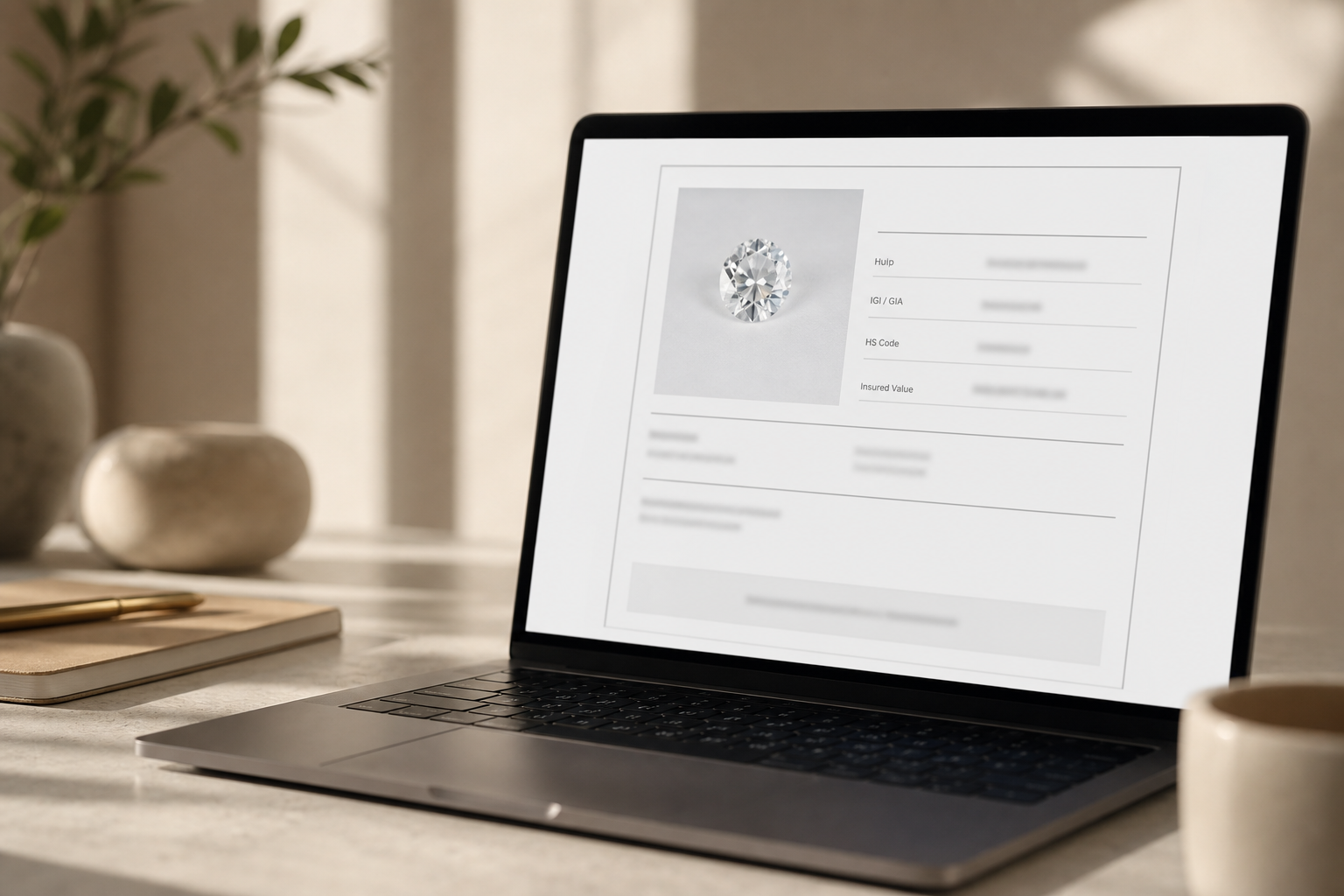
H) Country snapshots (2026 quick notes)
-
United States: De minimis under Section 321 may apply; jewelry often requires formal entry above thresholds. Expect 0–5.5% duty depending on material and a state-level use tax in some cases. Ensure the carrier clarifies whether they will act as broker or if you need your own, and confirm if your state requires you to self-report use tax after delivery.
-
United Kingdom: VAT applies on the customs value; clearance is smoother with accurate HS codes and clear invoices for gold karat and stone details. Keep EORI and UK contact details handy if a broker asks. If using DDP, request a tax breakdown post-clearance for your records.
-
Australia: GST commonly applies; ensure the customs value includes shipping and insurance for accurate assessment and keep pro forma handy. Some carriers ask for an ABN if importing for business; for personal imports, make sure your ID and contact are correct to avoid warehouse holds.
-
Canada: Duty rates vary; CBSA may request additional detail on gold fineness and diamond origin, so keep certificates easy to share. If you receive a casual goods assessment (B15), store it with your dossier for future resales or insurance updates.
-
UAE: Lower duty environment; still declare accurately and ensure airway bill descriptions remain neutral and aligned with HS 71. Weekend timing differs; factor Friday/Saturday office hours into delivery expectations.
-
Singapore: GST applies; paperwork precision leads to fast clearance, especially when Incoterms are clear and invoices list net weights. Many shipments clear within a day when documents are clean; ask your seller to pre-share invoice and HS code with the carrier.
I) Sample email templates you can copy
- Insurance confirmation request: “Hello, please confirm in writing that the insured value on the shipment equals the full commercial invoice total and that coverage is door to door, including last-mile handoff and any insured return if required.
- HUID verification request: “Before payment, kindly share a close-up photo of the BIS hallmark and the HUID. During our video call, please read the HUID aloud so I can verify it live on the BIS CARE app.
- DDP vs DAP clarity: “Can you confirm whether you ship under DAP or DDP to my address? If DDP, please outline how duties and taxes are calculated and reconciled post-clearance.
Bonus lines you can append:
- “Please share the airway bill draft showing HS code and neutral item description before dispatch.
- “Kindly include the live gold rate timestamp and net weight on the invoice.
J) Paperwork and photo checklist for claims
- Commercial invoice with full price formula and currency.
- Airway bill with declared value and HS code.
- Photos: outer box on all sides, tamper-evident seals, inner packaging before opening, and the item upon unboxing.
- Screenshots: BIS CARE HUID verification and IGI/GIA report check page.
- Email confirmations: insured value, carrier name, DAP/DDP terms, and return policy.
K) Handy app-and-docs preflight (save to your phone)
- BIS CARE, GIA Report Check bookmarks, your country’s customs portal, and a spot price app.
- A cloud folder template named “Shipment Dossier – [Seller] – [Date]”.
- A notes template with arrival checks and the seller’s emergency contact.
- Your government ID scan, ready if a broker requests it securely.
Also Read!
Best Gold Jewelry with Lifetime Exchange and Buyback for NRIs in 2026
What to Do Next: Your First (or Next) International Jewelry Purchase
Take a breath. This is a personal buy, and it deserves care. A simple plan turns stress into progress, and it makes insured international jewelry shipping a box you check early, not late.
First, pick the occasion and set a ceiling. Put your budget in your local currency, then add a 15% buffer for shipping and duty. Next, shortlist two or three Indian jewelers that meet three tests: BIS hallmark with HUID, IGI/GIA where relevant, and insured shipping via a valuables carrier. Then, book video calls with each.
During each call, ask to see the BIS mark and read out the HUID for you to verify on the BIS CARE app. Request the full price formula in writing: metal value (live rate × net weight) + making charges + stone charges + 3% GST on jewelry + 5% GST on making charges. After that, estimate your landed cost for each option.
Instead of juggling a to-do list across sticky notes, move through the actions in a smooth sequence. Start by shortlisting 2–3 sellers that clearly meet the hallmark/cert/insurance bar and get a live video consult on the calendar to inspect the actual piece. As you talk, verify the HUID on BIS CARE before paying, and ask for insured shipping terms and the exact declared and insured values in writing. Finally, pre-calculate duty for your country and compare total landed costs rather than just sticker prices so you choose the piece you love with eyes wide open.
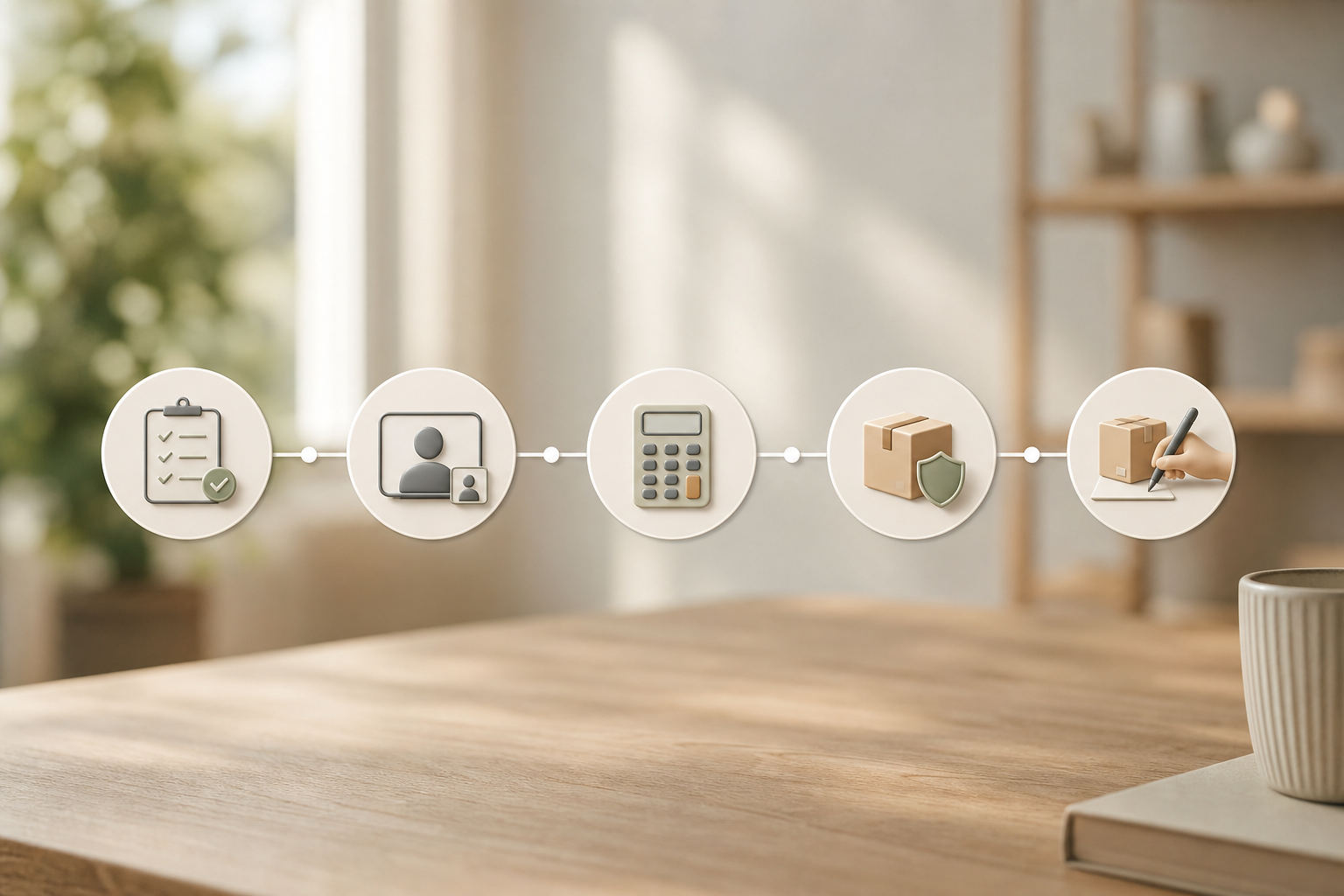
Quick path from browse to buy
- Shortlist 2–3 sellers with BIS+HUID, IGI/GIA, and insured carrier proof.
- Book back-to-back video calls and verify hallmarks live.
- Collect written quotes with the full formula and a pro forma invoice.
- Run landed-cost math and confirm DAP or DDP in writing.
- Place the order with insured shipping and build your shipment dossier.
Finally, give yourself time. If you’re shopping for a 2026 wedding or a parent’s milestone, a week more for checks beats a year of regret. The cross-border process is safer and more transparent than ever, once you know what to ask for.
**Schedule a free design consult → + making charges + stone charges + 3% GST on jewelry + 5% GST on making charges. If the seller can’t show it, walk.
-
Ship like it’s worth what you paid. Standard post rarely covers high-value items. Use a valuables carrier (e. g., Brinks) and get full-value coverage in writing so insured international jewelry shipping actually protects you.
-
Pre-calc duty to avoid “great deal” whiplash. Add 0–12% for duty and taxes depending on country and declared value. Then compare total landed costs, not just sticker prices.
-
Demand modern service. Video consultations, custom 3D mockups, 365-day free insured returns, lifetime exchange, and buy-back guarantees at the prevailing rate all reduce risk and raise your confidence in 2026 and beyond.
What to Do This Week
Block 90 minutes. On day one, write your brief (occasion, 22K vs 18K, size, target budget + 15%). On day two, shortlist three sellers that pass the hallmark/cert/insurance test and request the full price formula. On day three, book video calls; verify HUIDs on the BIS CARE app during the call; note weights, making charges, and diamond certificates.
On day four, email each seller for shipping terms that state the carrier (e., Brinks), insured value, and delivery window. On day five, check your country’s official customs site for duty and tax rates, and build a simple landed-cost sheet for each option.
Take the weekend to sleep on it. If everything checks out and you still love the piece, place the order on Monday with the insured shipping method confirmed in writing. You will enjoy the unboxing more knowing the details are squared away ahead of time.
Before you hit send on payment, assemble your dossier. Create a single folder that includes a PDF of the invoice with the pricing formula, screenshots of the BIS hallmark and HUID verification, IGI/GIA checks if applicable, and the email where the seller confirms the insured value and carrier.
Add the airway bill draft if available, plus your duty estimate with HS code. Make a one-page “arrival checklist” that includes what to inspect first (seal intact, outer damage photos, weight on a home scale for reference) and who to contact if anything looks off. These tiny habits take minutes now and save days later if an insurer or customs officer asks for proof.
Arrival checklist ideas you can paste into your phone notes:
-
Photograph outer box on all sides before opening. – Capture close-ups of tamper-evident tape and seals. – Weigh the item and compare to invoice net weight (allow for packaging).
-
Match HUID on the piece to your BIS CARE screenshot. – Verify diamond inscription and report number where applicable. – Save delivery confirmation and signature record.
-
Photograph outer box on all sides before opening. – Capture close-ups of tamper-evident tape and seals. – Weigh the item and compare to invoice net weight (allow for packaging).
-
Match HUID on the piece to your BIS CARE screenshot. – Verify diamond inscription and report number where applicable. – Save delivery confirmation and signature record.

Get your insured shipping plan started
- Decide DAP vs DDP and get it on the invoice.
- Confirm insured value equals invoice total in writing.
- Save airway bill and neutral description details before dispatch.
Get your insured shipping plan →
FAQ set 1: Shipping and insurance basics
Q: What exactly does insured international jewelry shipping cover?
A: It should cover loss, theft, and damage from pickup to delivery, including any bonded transfers and the last-mile courier handoff. Ask whether coverage also applies to insured returns. The insured value should match your full commercial invoice.
Q: Is DDP always better than DAP for jewelry?
A: Not always. DDP is convenient because taxes are prepaid and clearance is smoother, but it can include service premiums. DAP can be cheaper if you prefer to manage duty and tax yourself. Choose based on transparency and your comfort with brokerage.
Q: Can I ship via regular postal services if I declare a lower value?
A: Avoid under-declaration. It is illegal and can void insurance, trigger seizures, or cause fines. Precious goods deserve a valuables carrier and accurate documentation so your purchase is protected and compliant.
Q: Do I need to be home to receive the package?
A: Yes, request adult signature on delivery. For high-value parcels, ask for photo-on-delivery or pickup-hold at a secure facility if your schedule is unpredictable.
Q: Can I use a PO box or parcel locker for delivery?
A: Most valuables carriers will not deliver high-value insured jewelry to PO boxes or unattended lockers. Opt for a staffed address, request adult signature, and consider carrier-held pickup at a secure facility if needed.
FAQ set 2: Duties, taxes, and documents
Q: How do I estimate duties before I buy?
A: Ask the seller for a pro forma invoice with HS code, price, shipping, and insurance listed. Look up your country’s rate on the official customs site. Then apply VAT, if applicable, on the customs value. Add a 15% buffer for exchange-rate drift and carrier fees.
Q: Do I need IGI or GIA for small diamonds?
A: For diamonds 0.18 ct and above, request IGI or GIA. For smaller melee, ask for a seller’s quality guarantee in writing and, if possible, a parcel-level memo. Still verify gold purity with BIS hallmark and HUID on the overall piece.
Q: What if my package shows “delivered” but I didn’t receive it?
A: Contact the seller and carrier immediately within the insurer’s reporting window, usually 24–48 hours. File a delivery dispute, request the GPS timestamp and signature image, and document your claim with photos of your premises. Your seller can escalate with the insurer.
Save the POD (proof of delivery) file and any GPS evidence; it’s often decisive in insurer adjudications.
Q: Will I be charged VAT/GST twice?
A: You should not pay domestic GST charged in India and then full VAT/GST again without adjustment in your country. For export orders, reputable sellers zero-rate or properly account for Indian GST on export. Your local VAT/GST is assessed at import on the customs value; keep both invoices to reconcile and avoid double taxation.
FAQ set 3: Parcel content and returns
Q: Can I include personal items in the same shipment to save on fees?
A: Mixing categories can complicate clearance. Keep jewelry on its own airway bill with clean HS codes. It reduces questions and keeps insurance terms simple.
Q: How do returns work across borders?
A: Ask the seller for an insured return label and a commercial invoice marked “return” referencing the original airway bill. Confirm whether duties are reclaimable under your country’s rules. Photograph the sealed parcel before handing it over.
Q: Will customs open my jewelry package?
A: They can. That’s why tamper-evident seals and neutral labeling matter. Insured shipments should remain protected even if inspected, provided documentation is accurate and the package is re-sealed per protocol.
Q: How do international resizes or exchanges work?
A: Confirm whether the seller offers local resizing partners or a return-to-base insured service. Clarify who pays insured return shipping, whether duty can be waived for repair/return goods, and the timeline for re-dispatch after sizing.
FAQ set 4: Timelines, lab-grown, and records
Q: How long should I expect delivery to take?
A: For valuables carriers, 3–7 business days is typical door to door once dispatched, excluding custom-made lead time. Seasonal peaks and security holds can extend timelines. Ask for a route plan and clearance city to set expectations.
Q: Is lab-grown diamond jewelry treated differently at customs?
A: Classification can differ based on material and HS code, but the import process is similar. Always declare accurately, list correct HS codes, and carry invoices and certificates. Insurance coverage should still match the invoice value.
Q: What documents should I store after delivery?
A: Keep the commercial invoice, HUID verification screenshot, lab report checks, airway bill, duty/tax receipt, and delivery confirmation. This file helps with appraisals, insurance renewals, and any future resale or exchange.
Q: Are there holiday blackout dates I should avoid?
A: Customs and carriers can slow around major holidays in both origin and destination countries. Build in extra buffer around Diwali, Christmas/New Year, Eid, and national holidays, and ask the seller for their cut-off schedule.
FAQ set 5: Country-specific insurance questions
Q: Does insurance coverage change by country?
A: Sometimes. Certain carriers exclude or limit coverage in sanctioned or high-risk regions, and some countries require local partners for last-mile handoff. Ask the seller which underwriter backs the policy and request a short coverage summary by corridor.
Q: Will my homeowner’s or renter’s insurance cover the piece once delivered?
A: It may, but often only after you add a rider or schedule the item with an appraisal. Use your shipment dossier to obtain a post-delivery appraisal, then confirm coverage limits, deductibles, and travel coverage with your insurer.
Q: Can insurers require a post-delivery appraisal?
A: Yes. Many personal jewelry policies need an appraisal or valuation within a set period after purchase. Share your invoice, photos, HUID, and IGI/GIA details with a qualified appraiser and upload the appraisal to your insurer to avoid coverage gaps.
By approaching your purchase with these steps, tools, and checks, you transform a stressful cross-border buy into a documented, confident process. You also make insured international jewelry shipping do the job you expect it to do in 2026: protect your money, your moment, and the piece you’ll enjoy for years.