The phrase “lifetime exchange and buyback guarantee” sounds great, but you’re right to press for proof. In 2026, gold at ₹6,673/g for 22K means a 20g bangle holds ₹133,460 in metal value alone. One vague clause can shave thousands off that. As a gift buyer, the stakes feel higher. You want the joy of the gift without the future shock of fine print that bites later.
Here’s the real fear: you pay full price now, yet years later the store offers a weak “prevailing rate,” refuses to refund making charges, or says the piece “doesn’t qualify” because a tag is missing. Worse, purity disputes pop up just when you need liquidity. This guide treats your skepticism as healthy. You will see how to read policies, verify purity with BIS hallmarking and HUID, and benchmark rates so you can judge any jeweler’s promise on its merits.
Why Gift Buyers Are Right to Question Lifetime Exchange and Buyback Promises
You’re buying something precious, not just in price but in meaning. Yet a policy that looks generous at purchase can shrink at buyback. For example, making charges that were 10–15% of your bill are usually non-refundable. That alone can be the difference between feeling protected and feeling short-changed.
Moreover, exchange and buyback are not the same. An exchange usually lets the recipient swap the piece for another, but the original making charges remain sunk. A buyback returns the metal value at the jeweler’s “prevailing rate,” often with a 5–20% deduction. If the “prevailing rate” isn’t tied to a public benchmark like IBJA or a posted live-rate page, it can become an internal number that moves against you.
Purity fights are another pain point. You may bring in a 22K piece, but if the store says it tests under 916 at intake, they’ll cut the value. Without BIS hallmarking and the piece’s HUID, you have less use. Finally, some stores quietly retire policies or change terms, leaving gift recipients to argue years after the sale.
“The bridal set I bought for my wedding was breathtaking. Craftsmanship is top and the BIS hallmark gave me total peace of mind.” — Priya Sharma, Mumbai
Real pain points gift buyers report
- Hidden deductions on making charges that were never obvious at checkout.
- “Depreciation” clauses that skim 5–20% off the metal value at buyback.
- Purity disputes if the piece lacks a verifiable HUID or has damage.
- “Policy discontinued” or “this SKU doesn’t qualify” years later.
- Store uses an internal rate far below public market references.
Your doubts are fair. A strong lifetime exchange and buyback guarantee puts numbers, sources, and verification steps in writing. Anything else is marketing bait.
How Lifetime Exchange and Buyback Policies Actually Work in the Gold Jewelry Industry
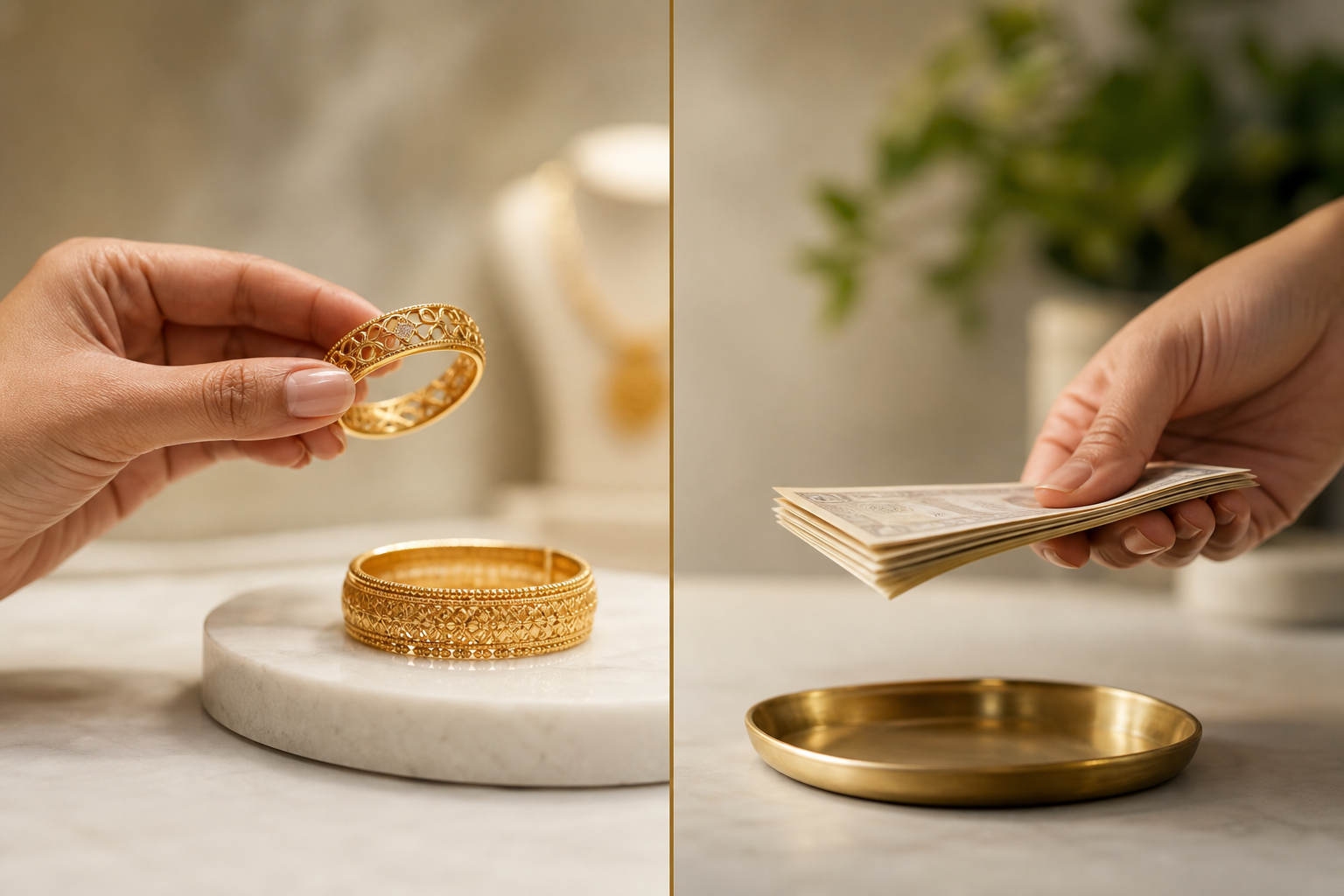
A good policy is clear on mechanics. An exchange lets the recipient trade the piece for one of equal or higher value. You pay only the new making charges and any difference in metal or stone value. The original making charges are not refunded. A buyback, by contrast, means the jeweler repurchases the piece for its net metal value at the prevailing rate, minus a deduction that’s usually in the 5–20% band.
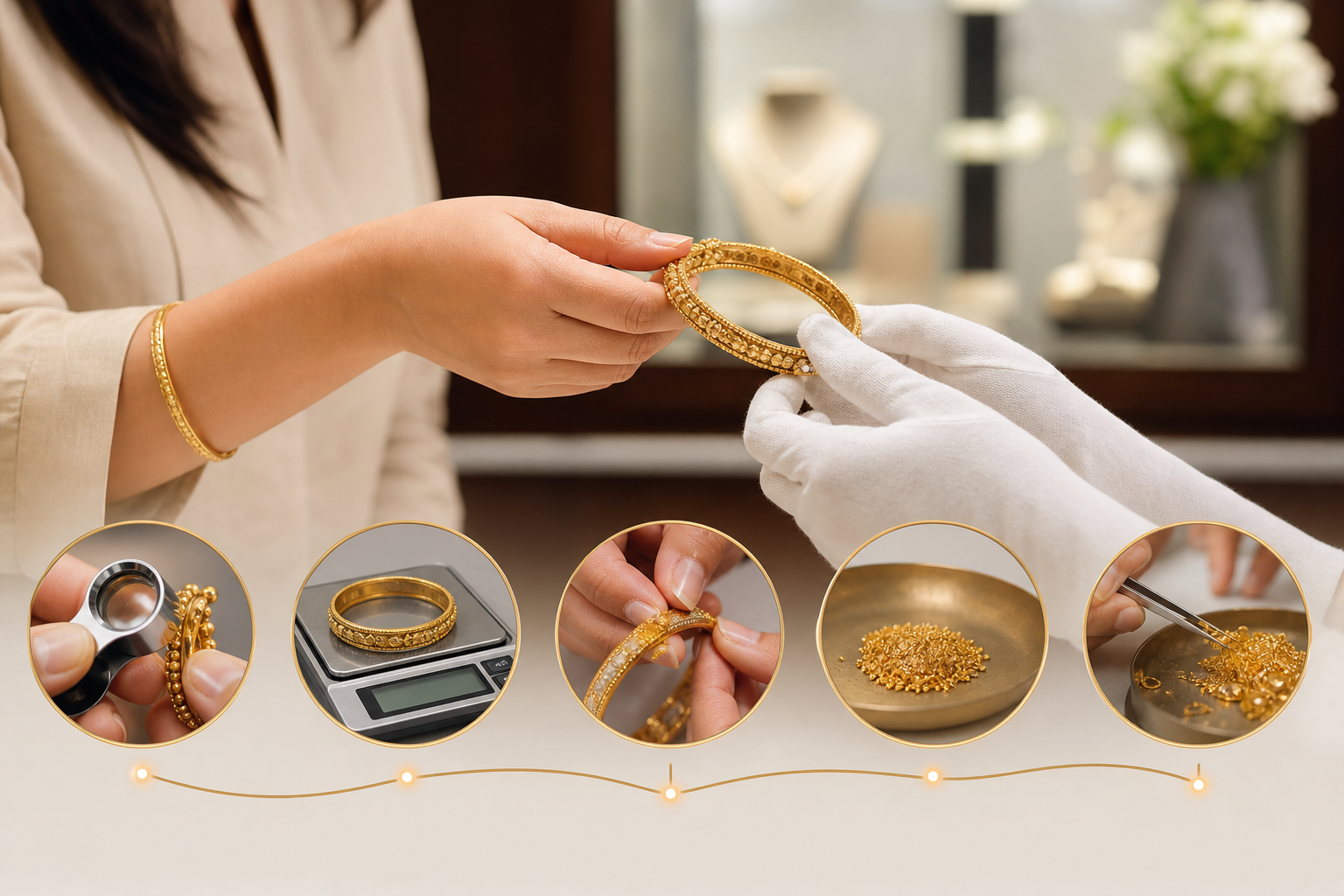
In both cases, the store will verify purity, weigh the item, and inspect for damage. For gold, the BIS hallmark and its HUID are checked. Then, the net metal weight is multiplied by the live rate for that purity, and deductions are applied per policy.
What “prevailing rate” should mean
A credible “prevailing rate” tracks a public benchmark, such as IBJA rates, or a jeweler’s live-rate page that updates against market feeds. It’s not a static tag in a drawer. For orientation, live rates listed in the BKO show 22K at ₹6,673/g and 18K at ₹5,464/g. If a store quotes a “house rate” far off those references without reason, that’s a red flag.
The price formula you should expect
Transparent pricing at purchase and return uses a consistent structure:
- Total price at purchase = Metal value (live rate × net weight) + Making charges + Stone charges + 3% GST on jewelry + 5% GST on making charges.
At buyback, you usually recover the metal value at the live rate (less any stated deduction). Making and stone charges are generally not refunded. For diamond pieces, certified stones may be valued separately; uncertified melee is often priced conservatively.
A simple worked example
- Purchase: 22K bracelet, 20g. Metal value at ₹6,673/g = ₹133,460. Making charges 12% = ₹16,015. Stones ₹0. GST on jewelry (3% of metal + stones) ≈ ₹4,004. GST on making (5% of ₹16,015) ≈ ₹801. Total paid ≈ ₹154,280.
- Buyback later: If the store offers metal value at the prevailing rate with a 10% deduction on metal value only, you might receive: ₹133,460 − ₹13,346 ≈ ₹120,114. The ₹16,015 making and prior GST were sunk costs.
Therefore, a clear lifetime exchange policy plus a buy-back guarantee at the prevailing rate, backed by a public benchmark, is what protects you. Without those anchors, “lifetime” can mean little.
Also Read!
Best GIA Certified Diamond Jewelry for Bridal Jewelry in 2026
Bride’s Guide to Choosing GIA Certified Diamond Jewelry for Your Wedding
Certifications and Standards That Make Exchange and Buyback Policies Credible
Purity verification is the hinge on which every exchange/buyback swings. If the gold isn’t what it says, the rest of the policy is moot. In India, BIS hallmarking is the legal standard under the BIS (Hallmarking of Gold Jewellery) Order 2020. Each hallmarked piece carries a 6-digit HUID (Hallmark Unique Identification) that you, or your gift recipient, can check with the BIS CARE app or the BIS portal. This makes purity evidence portable and independent of the selling store.
In practice, HUID speeds intake and dampens disputes. The store scans or notes the HUID, confirms the marked purity (e. , 916 for 22K or 750 for 18K), and proceeds to weigh and inspect.
If their test claims a shortfall, a strong jeweler policy will accept accountability. For instance, some retailers publish a “refund twice the difference if purity is below standard” promise. That’s real skin in the game.
For diamond-set gold, stone documentation matters. IGI and GIA are the reference standards. Pieces with natural diamonds above 0.18ct should come with IGI or GIA reports that fix the 4Cs on record. At exchange, that paper trail stabilizes the stone’s assessed value. Melee diamonds are often graded in-house, which is normal, but look for a transparent method statement.
Finally, operational rigor shows up in small details. FSC-certified packaging may sound like a box issue, yet it signals audited processes and material traceability. If a jeweler brings that discipline to packaging, they’re more likely to run disciplined intake and policy execution.
“I love that I can book a video consultation before buying. The designer walked me through three options over a call. Bought on the spot.” — Kavita Reddy, Hyderabad
How to verify HUID before you trust a promise
- Find the HUID stamped on the piece or noted on the invoice.
- Open the BIS CARE app or visit the BIS portal (see Government of India at https://bis.gov.in).
- Enter the 6-digit HUID to view purity, metal type, and assaying center.
- Match the result to your invoice and the piece’s markings.
A policy backed by 100% BIS hallmarked gold and silver jewelry, unique 6-digit HUID on each piece, IGI & GIA certified diamonds, and a stated commitment to refund twice the difference if purity is below standard is far more credible than one that relies on verbal assurances.
What a Gift-Friendly Exchange and Buyback Policy Should Include
As a gift buyer, you need the policy to follow the piece, not just you. That means the recipient should be able to use exchange or buyback with the invoice and certificates, even if their name isn’t on the original order. The jeweler should spell this out.
Documentation is the lifeline. The gift box or email should include the invoice, BIS hallmark details with the HUID, and any diamond certificates (IGI/GIA). Without these, the recipient may face reduced valuations or delays. For gifts, time-buffered protection helps too. Retailers that pair lifetime exchange and buyback at prevailing rates with 365-day free insured returns give the recipient a full year to decide, then a lifetime to fine-tune.
Upfront support reduces the chance you’ll need to exchange. Video consultation and live sessions with a designer let you confirm style, size, and budget. For bespoke gifts, custom jewelry design with a 3D mockup shows exactly what will ship. Add lifetime free polishing and re-plating, and the piece keeps its best look, which helps preserve exchange value years later.
Moreover, consider logistics. Fully insured international shipping via Brinks to 30+ countries signals that returns and buybacks can be handled safely from abroad. If you’re gifting to someone outside India, you’ll also find the NRI angle explored in-depth in the internal resources: see the Best Gold Jewelry with Lifetime Exchange and Buyback for NRIs in 2026 and this candid BKO Jewellery vs Tanishq for NRIs: Which Is Better for Lifetime Exchange and Buyback?.
Documents a recipient should have on hand
- Original invoice with item details and rates.
- Hallmark/HUID information tied to the piece.
- IGI or GIA diamond certificates for stones ≥0.18ct.
- Any care, maintenance, or warranty notes.
A gift-friendly lifetime exchange policy plus a buy-back guarantee at the prevailing rate turns a moment of joy into long-term confidence.
Also Read!
Best Insured International Jewelry Shipping for NRIs in 2026
A Checklist for Evaluating Any Jeweler's Exchange and Buyback Terms
Use this vendor-neutral list before you buy for someone else. Share it with them, too. It will help you judge any lifetime exchange and buyback guarantee on clear, testable points.
The 10-point check
- Is the gold BIS hallmarked with a verifiable 6-digit HUID?
- Does the buyback rate reference a public benchmark (e. g., IBJA) or a posted live-rate page?
- Are making charges disclosed in writing, with what happens at exchange/buyback?
- Does the policy attach to the piece (via invoice/HUID), not only the original buyer?
- What is the time limit on returns vs. lifetime exchange, and how are they different?
- For diamond pieces, are stones independently certified (IGI/GIA) if above 0.18ct?
- Is return shipping fully insured, with tracking and on-camera intake?
- Is the full policy posted online or printed on your invoice, not just verbal?
- What happens to stone charges at buyback — refunded, partially credited, or forfeited?
- Does the jeweler offer lifetime free polishing and re-plating to help preserve value?
As a bonus, if you’re gifting overseas, ask whether they support international shipping to 30+ countries via Brinks, fully insured. Clarity on logistics is part of value protection.
FAQ: Exchange and Buyback Questions, Answered
Do I get full value back when I use a lifetime buyback on gold jewelry?
No. Buyback usually returns the prevailing gold rate for the net metal weight, minus a stated deduction. Making charges, stone charges, and GST paid at purchase aren’t refunded.
If making charges were 10–15% of your bill, expect to forfeit that share. This is industry standard. Anyone promising “100% of what you paid” is likely burying terms elsewhere.
To sanity-check, use the transparent model: Total = Metal value (live rate × net weight) + Making charges + Stone charges + 3% GST on jewelry + 5% GST on making charges. Only the metal value portion, less any deduction, is typically recoverable.
Can the person I gift the jewelry to use the exchange or buyback policy themselves?
Usually, yes, if the jeweler ties the policy to the piece via the invoice and hallmark certificate, not the original buyer’s ID. Your recipient should bring the invoice, the BIS hallmark/HUID, and any diamond certificates for larger stones. Some stores do ask for the original purchaser’s details, so ask before you buy. For gifts, a 365-day free insured return window is ideal. It gives your recipient time to decide without pressure.
How do I verify the gold purity of a piece before trusting a buyback promise?
Check the HUID. Every BIS hallmarked piece carries a unique 6-digit code. Use the BIS CARE app or the BIS portal to verify metal type, purity (e.
, 916 for 22K, 750 for 18K), and the assaying center. If there’s no HUID, the piece isn’t properly hallmarked under current rules. Some jewelers also publish a double-refund purity guarantee, refunding twice the difference if purity is below standard, as added accountability.
What happens to the diamond value during a gold jewelry exchange?
Diamonds are not valued like metal. IGI or GIA certified stones above about 0.18ct retain traceable value because the report fixes color, clarity, cut, and carat. Uncertified melee is assessed in-house, which can lead to lower valuations. If you’re buying a diamond-forward gift, prioritize third-party certification for significant stones so the recipient isn’t at the mercy of subjective grading later.
Are lifetime exchange policies legally binding or just marketing promises?
They’re governed by the jeweler’s written terms rather than a single law that dictates “lifetime.” However, BIS hallmarking is a legal requirement under the BIS Act and related orders. Get the policy in writing, make sure it’s on the website or invoice, and look for verifiable commitments, like the twice-the-difference purity refund. A written policy creates a contractual obligation under the Indian Consumer Protection Act.
Is it safe to ship gold jewelry back for exchange or buyback?
It can be, if the jeweler uses fully insured carriers and has a documented intake process. For overseas returns, specialized services like Brinks provide fully insured international shipping to 30+ countries. Domestically, insist on insured labels, tracking, and on-camera or witnessed intake to record weight and condition at receipt. Confirm who pays for return insurance and how claims are handled before you ship.
Bottom Line for 2026 Gift Buyers
You don’t have to trust slogans. You can trust systems, numbers, and documents. A credible lifetime exchange and buyback guarantee does five things: it anchors rates to a public benchmark, spells out deductions and making-charge treatment, proves purity with BIS hallmarking and a verifiable HUID, preserves stone value with IGI/GIA certificates, and documents everything in writing on your invoice.
If you’re buying a gift, make sure the policy follows the piece, not only you. Share the invoice and certificates with the recipient. Ask how returns are insured for 365 days and how lifetime exchange works in year five or year ten. For buyers abroad, confirm fully insured shipping via Brinks so distance doesn’t dilute your protection.
Finally, think upkeep. Lifelong polishing and re-plating keep the piece in great shape, which supports stronger exchange value later. When a jeweler publishes a transparent pricing formula. Metal value (live rate × net weight) + Making charges + Stone charges + 3% GST + 5% GST on making, and promises buyback at a prevailing market rate rather than an arbitrary internal price, you have what you need to make a smart call.