
**Schedule a free video consult →
Your cousin’s wedding is next month, and you’re choosing the bridal set from 9,000 miles away. For peace of mind in 2026, buy bis hallmarked gold with purity guarantee, verify the HUID, and use insured shipping. Do this: choose 22K or 18K based on use, price the piece with the live rate, confirm the HUID in the BIS CARE app, and book door-to-door insured delivery.
As an NRI, you care about beauty and purity, not guesswork. I’ve been through this for a family shaadi and a newborn’s naming, and the stakes felt high. Hallmarking rules changed in India in 2021, and that’s good news for you. Live rates help you budget, and the HUID helps you verify each piece you can’t touch yet.
For context, live rates in India recently showed 22K at ₹6,673/g and 18K at ₹5,464/g at 06:44 am, with silver at ₹89/g (Source: IBJA live-rate bulletin). Prices move, but the buying method does not. If you want a quick primer on gifts, this breakdown is handy: How to Choose BIS Hallmarked Gold Jewelry Online for Gifts. If you’re weighing brands, this comparison asks the right questions: BIS Hallmarked Gold Jewelry Online vs Tanishq for Jewelry Gifts: Which Is Better for Purity-Guaranteed Gold?.
What Does BIS Hallmarking Actually Guarantee — and Why Should NRIs Care?
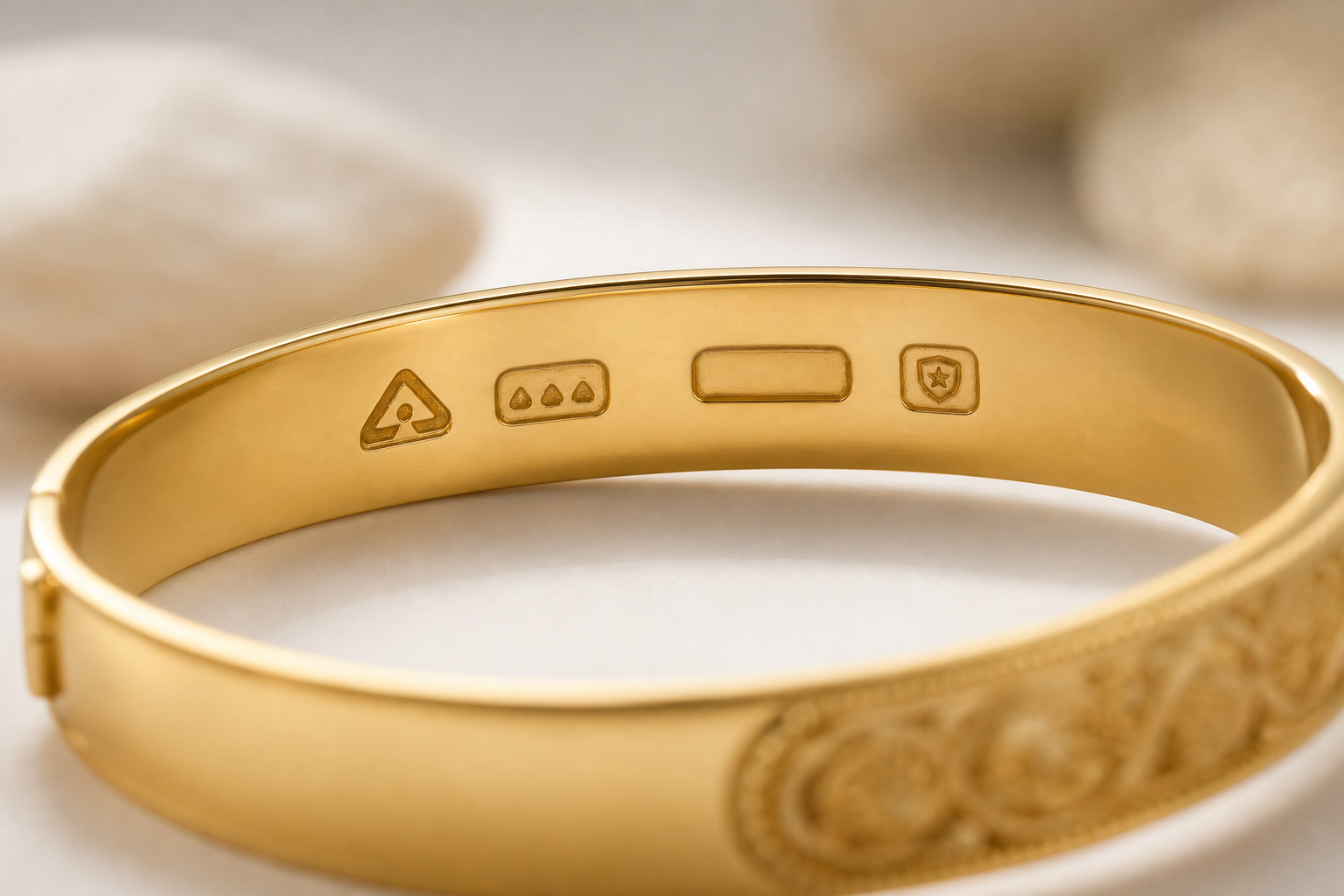
Here’s the plain-English version. BIS stands for Bureau of Indian Standards, India’s national standards body. Since 2021, hallmarking has been mandatory in phased districts for most gold jewelry sold in India. The hallmark is not a marketing sticker; it is an assay-backed stamp that confirms the fineness (purity) of the gold.
Each hallmarked piece now carries a 6-digit HUID, the Hallmark Unique Identification Number. Think of HUID as the jewelry’s license plate. It links the piece to a specific test record at a BIS-recognized assaying center. If you cannot hold the bangle in your palm before you buy, HUID is your remote verification tool.
Purity levels at a glance
- 999 is 24 karat fine gold and is too soft for most wear.
- 916 is 22 karat (91.6% pure) and is ideal for bridal and traditional pieces.
- 750 is 18 karat (75.0% pure) and is great for diamond-studded or daily wear.
How to read and verify the marks
A hallmarked piece shows four key marks: the BIS logo, purity (e.g., 916 or 750), the 6-digit HUID, and the jeweler/assay center code. You can verify the HUID in minutes using the BIS CARE app or the BIS portal from anywhere in the world. The portal lives on the official site here: BIS hallmarking overview. The app lets you enter the HUID and see if the record matches the piece’s purity and jeweler details.
You should insist on 100% BIS hallmarked gold and silver jewelry as your baseline. Each piece must carry a unique 6-digit HUID that you can verify via the BIS portal or BIS CARE app. Choose between 22K and 18K hallmarked options based on how the piece will be worn, and confirm that what you see on the stamp aligns with the app lookup. If anything doesn’t match, pause the purchase and seek clarification from the retailer.
Moreover, several reputable jewelers go further with a 2x refund promise if purity tests below the hallmark standard. That means they refund twice the difference in purity, which signals real confidence in their certification and their supply chain. As an NRI, that kind of risk reversal eases the nerves when the purchase is for a wedding or a once-in-a-decade family celebration.
“The bridal set I bought for my wedding was breathtaking. Craftsmanship is top and the BIS hallmark gave me total peace of mind.” — Priya Sharma, Mumbai
Also Read!
Step-by-Step: How to Buy BIS Hallmarked Gold Jewelry Online as an NRI
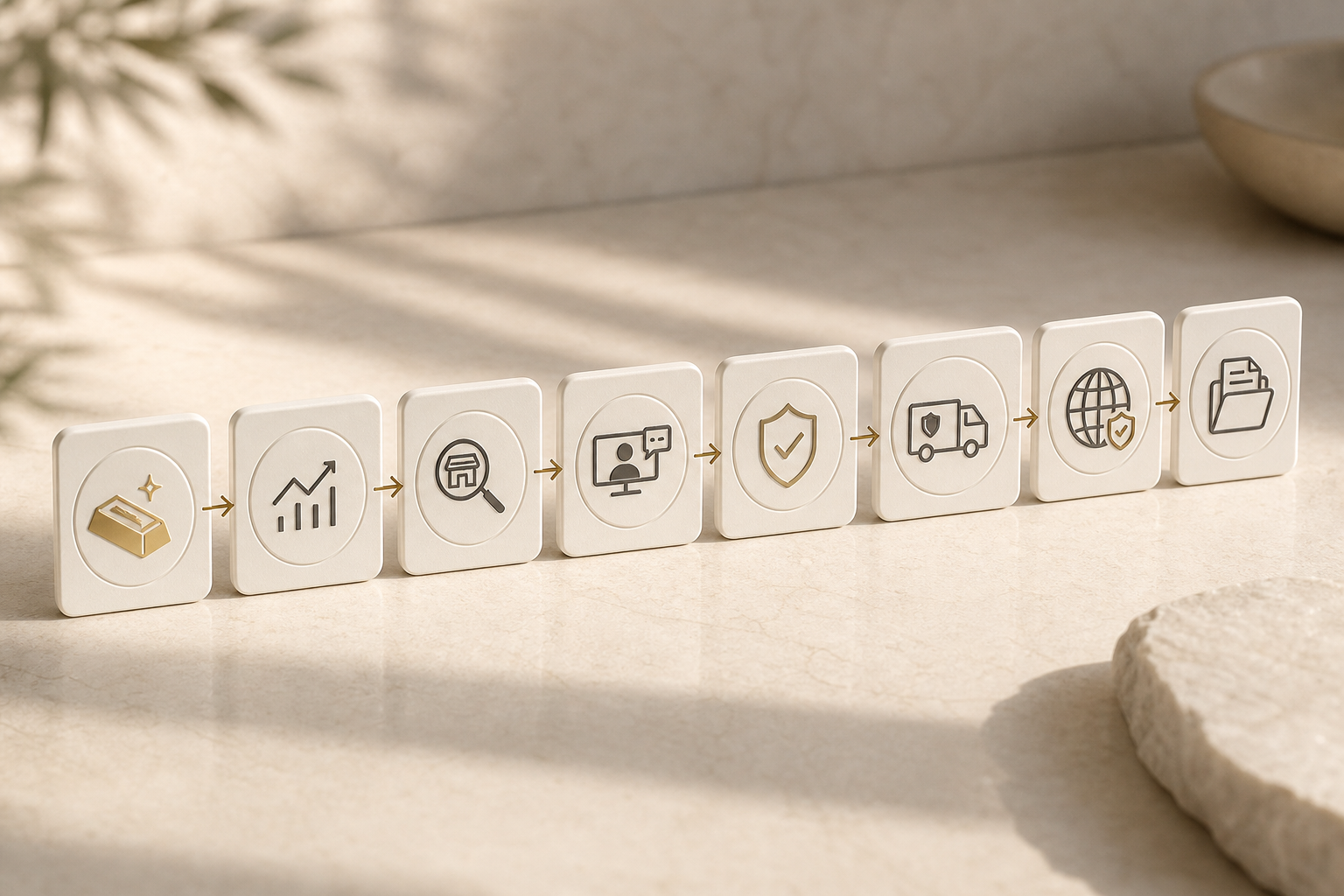
You can make a confident, audit-ready purchase in eight steps. Save this checklist.
- Decide on purity
- Choose 22K (916) for traditional and bridal sets. It looks richer and matches cultural heirlooms.
- Choose 18K (750) for diamond-studded designs or daily wear. It is harder and holds settings well.
- Mapping recap: 24K=999, 22K=916, 18K=750.
- Set your budget with the pricing formula
- Use a live gold rate calculator to anchor the metal value.
- Price is calculated as: Total = Metal value (live rate x net weight) + Making charges + Stone charges + 3% GST on jewelry + 5% GST on making charges.
- Example: If 22K is ₹6,673/g and your bangle’s net gold weight is 20g, the base metal value is ₹133,460. Add making charges (say 12%), stone charges if any, then GST as above. Transparent making charges matter more than haggling ₹20/g on the metal rate.
- Verify the retailer’s credentials
- Check the BIS license number on the site or invoice. It should match the seller name on the HUID lookup.
- For diamond-set pieces, look for IGI or GIA certification for natural diamonds above 0.18ct.
- Read the return/exchange policy for international orders. A clear policy beats a glossy banner.
- Use video consultation features
- Book a live consultation with a designer before purchase. Ask to see the exact piece in natural and studio light, on a wrist or neck, and on a digital scale.
- Request a close-up of the hallmark area and the HUID.
- Verify HUID before or right after paying
- Ask for the HUID in advance or verify as soon as you receive the invoice and unbox the item.
- Cross-check in the BIS CARE app or on the BIS portal. The piece, purity, and jeweler name should align.
- Confirm international shipping and insurance
- Look for international shipping to 30+ countries via Brinks, fully insured. Ask for end-to-end tracking and signature on delivery.
- Confirm packaging quality. Sturdy, tamper-evident packaging and FSC-certified boxes protect your piece in transit and at customs.
- Know your destination country’s import rules
-
United States: The de minimis value for most courier imports is $800 per shipment (Source: CBP internet purchases guidance). – United Kingdom: VAT is charged on imports; confirm valuation rules and thresholds (Source: HMRC guidance on tax and duty for goods from abroad). – Canada: Duties and taxes depend on origin and value; check CBSA’s calculator and guidance (Source: CBSA duties and taxes at import). – Australia: GST may apply to low-value imports; confirm jewelry rules (Source: ABF buying goods online).
-
UAE and Singapore: Rules vary by residency and channel (traveler vs. courier). Check official customs pages before you pay. – Keep in mind: some countries tax both the metal and the making; some tax shipping too.
- Retain every document
- Save invoices, HUID screenshots, diamond certificates, and shipping receipts. You will need these for customs clearance and for resale or exchange later. A buy-back guarantee at the prevailing rate works best when your paperwork is in order.
“I love that I can book a video consultation before buying. The designer walked me through three options over a call. Bought on the spot.” — Kavita Reddy, Hyderabad
**Get insured global shipping info →
5 Costly Mistakes NRIs Make When Buying Gold Jewelry from India
Verification and pricing pitfalls
Mistake 1: Skipping HUID verification
- Seeing “hallmarked” on a product page is not enough. The entire point of HUID is independent verification. Without it, you trust a label, not a record. Enter the 6-digit HUID in the BIS CARE app or portal and match the purity and jeweler details. That’s how you truly secure bis hallmarked gold with purity guarantee.
Mistake 2: Comparing only metal weight, not making and GST
- Two 22K necklaces at 30 grams can differ by 8–25% in making charges. That swing dwarfs small changes in the live metal rate. Use the full formula: Metal value (live rate x net weight) + Making charges + Stone charges + 3% GST on jewelry + 5% GST on making charges. Transparent making charges beat vague “special rates.
Shipping, sellers, and returns
Mistake 3: Misreading customs duty rules
- The U.S. allows $800 duty-free per shipment for many imports via courier (see CBP internet purchases guidance). The UK charges VAT on imports.
The UAE treats residents and tourists differently. If you guess, you pay twice: once to the seller, again at customs. Check your country’s official calculator or guidance before checkout.
Mistake 4: Buying from unverified social media sellers at “Dubai prices”
- Below-market pricing is a red flag. Rogue sellers cut purity, inflate weight with solder, or pass off low-carat alloys as 22K. Demand a HUID and verifiable certifications for any set with diamonds (IGI or GIA). If they dodge, walk away. Remember: 100% BIS hallmarked gold and silver jewelry plus verifiable IDs are non-negotiable.
Mistake 5: Ignoring international return and exchange policies
- Some retailers don’t accept returns from overseas at all. Look for 365-day free insured returns, a lifetime exchange policy, and a clear buy-back guarantee at the prevailing rate. These signals protect cross-border buyers. Lifetime free polishing and re-plating also save you money over the years.
Quick red-flag checklist
- No HUID on request.
- “No returns for international orders.
- Making charges not shown or “depends.
- Pressure tactics: “Book in the next 15 minutes.
- Cash-only deals via remittance with no invoice.
Also Read!
Tools and Resources for NRIs Buying Gold Online
You don’t need to guess. Use this toolkit to check purity, price, and paperwork from your sofa.
Verification tools
The BIS CARE app is free on iOS and Android, and it lets you type the 6-digit HUID to confirm purity, jeweler, and assaying center. If any detail doesn’t match the piece you’re considering, pause the deal and ask questions. If you prefer a desktop, use the BIS web portal to cross-check hallmarking records. Start here: BIS hallmarking overview.
Pricing and import tools
For live gold rates, cross-check your jeweler’s quote against the India Bullion and Jewellers Association (IBJA) site. Use it as a confidence check for 999, 916, and 750 quotes before you negotiate making charges. Search for “IBJA live gold rates” and compare time stamps to the rate shown by the retailer. Aligning on time helps you avoid misunderstandings.
For duties and taxes, consult official calculators and pages. United States: CBP internet purchases guidance. United Kingdom: HMRC tax and duty on goods from abroad.
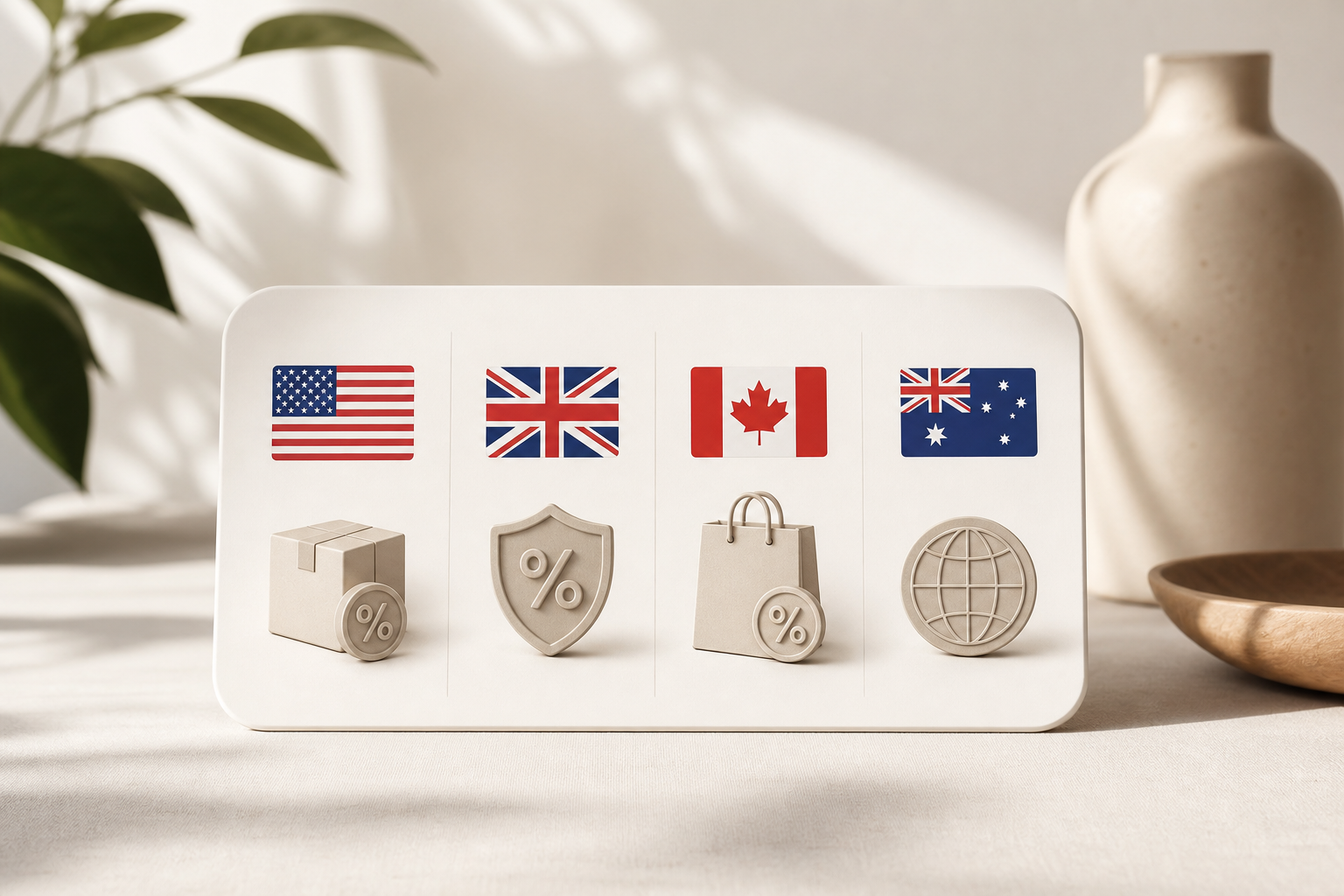
Canada: CBSA duty and tax estimator. Australia: ABF buying goods online. These sources help you estimate landed costs before you check out.
Certification and retailer features
-
For diamond certificate verification, use the GIA Report Check to validate natural stones via the report number: GIA Report Check. For IGI, use the IGI verification portal and enter the report number on their site. Confirming certificates upfront keeps quality claims honest.
-
When comparing retailers, look for IGI & GIA certified diamonds and custom jewelry design with a 3D mockup so you can approve details remotely. Insist on international shipping to 30+ countries via Brinks (fully insured) and transparent making charges you can see before paying. You should also be able to filter by metal type, purity, price, and weight. Tools like Caratflow offer video consultations and insured global shipping without pushing you to buy on the first call, that’s the posture you want.
Moreover, remember remittance rules. RBI’s FEMA guidelines describe how much you can send to India and for what. If you’re wiring funds for a big bridal order, confirm limits with your bank and an Indian AD-I bank in writing. Paper trails smooth both payment and customs.
**Book a free purity check walkthrough →
Key Takeaways
-
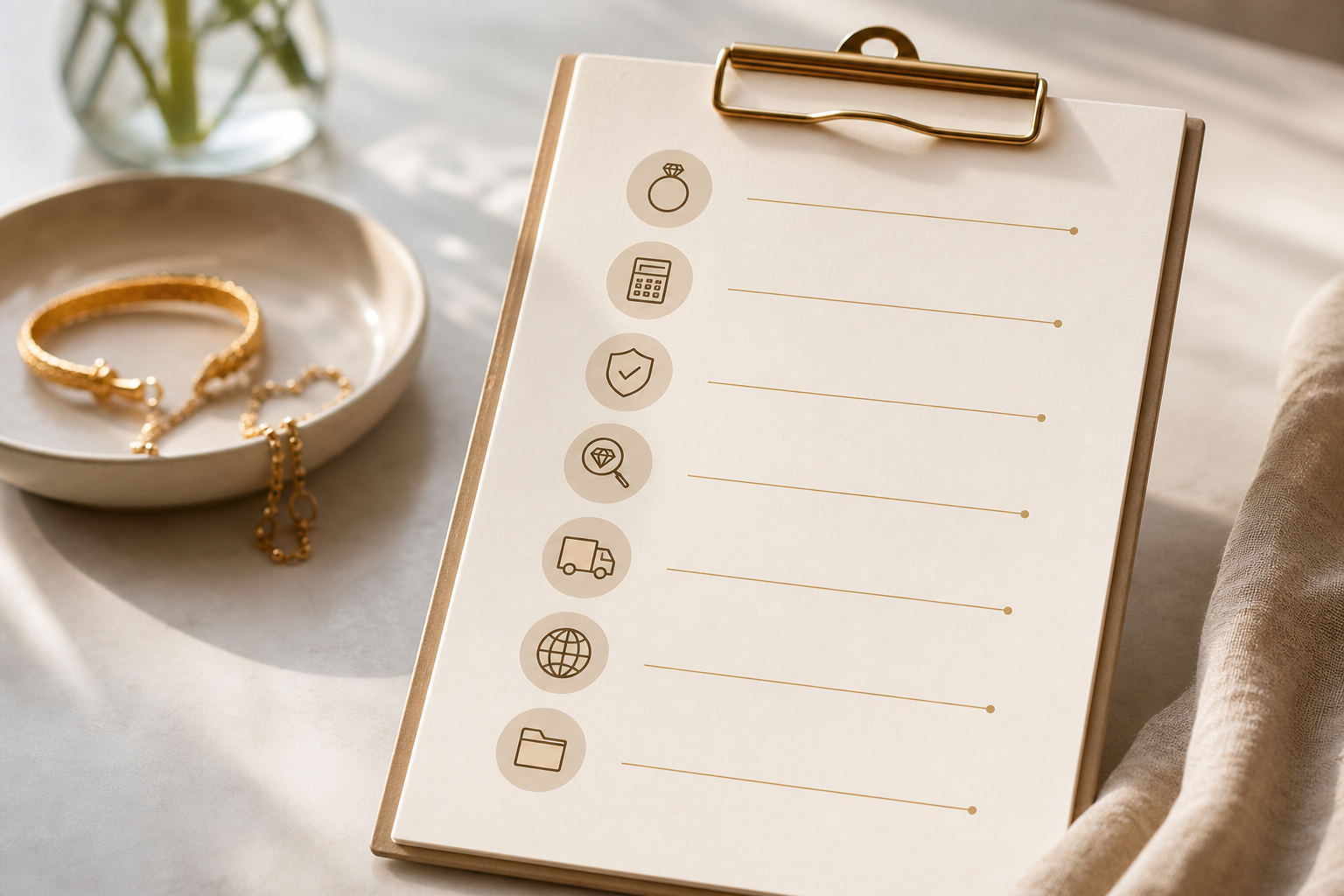
Verify purity with the HUID, not just a product label
-
The 6-digit HUID ties your piece to a BIS-assayed record. Use the BIS CARE app or portal to confirm 916 or 750 before or right after you pay. That is how you secure bis hallmarked gold with purity guarantee even from abroad.
-
Price it right using a clear formula
-
Total = Metal value (live rate x net weight) + Making charges + Stone charges + 3% GST on jewelry + 5% GST on making charges. Transparent making charges beat “discounted gold price” gimmicks.
-
Match purity to purpose
-
22K (916) shines for bridal and cultural wear. 18K (750) is stronger for diamond settings and daily wear. Both should be BIS hallmarked.
-
Ship with full insurance and track it
-
Ask for Brinks or an equivalent insured carrier to 30+ countries. Request tamper-evident, FSC-certified packaging and signature on delivery. Keep unboxing photos and all documents.
-
Protect your downside with strong policies
-
Favor sellers with 365-day free insured returns, a lifetime exchange policy, lifetime free polishing and re-plating, and a buy-back guarantee at the prevailing rate. Some add a 2x refund on any measured shortfall in purity — a powerful confidence signal.
What to Do This Week: Your NRI Gold Buying Action Plan
Action 1: Download BIS CARE and practice a HUID check
- Open the app, choose “Verify HUID,” and type a sample 6-digit number from a seller’s product page or invoice. Confirm that the purity (e.g., 916 or 750), jeweler name, and assaying center match the piece. If you can’t get a HUID in advance, plan to verify the moment your package arrives.
Action 2: Check your country’s duty threshold and do the math
- Declared value = Gold value (live rate x net weight) + Making charges + Shipping. If your country has a duty-free threshold, apply the duty rate only on the amount above that threshold. For example, the U.S.
de minimis is $800 per shipment (see CBP internet purchases guidance). UK buyers should check HMRC’s VAT rules. Canada and Australia have clear calculators and pages linked above.
Action 3: Shortlist and test the experience
- Pick 2–3 BIS-hallmarked retailers that ship to your country. Schedule at least one video consultation to compare service, hallmark transparency, and making charge clarity. Keep the HUID, invoice, IGI/GIA report, and tracking in one folder. The homework you do now turns a nervous buy into a confident gift.
Finally, remember why this matters. For weddings, naming ceremonies, and milestone gifts, you’re not just buying metal. You’re buying a story your family will wear for decades. Do the checks once, and enjoy it for years.