Start Your GIA Diamond Search Today →
You've saved for months. Your budget is set. But when you search for diamond jewelry online, you see thousands of listings with terms like "GIA certified," "IGI graded," and "4Cs." This first-time buyers guide gia certification walks you through exactly what to verify, which mistakes drain your budget, and how to buy confidently when you can't see the diamond in person. One retailer shows a 0.50ct diamond for ₹45,000. Another charges ₹72,000 for what looks identical.
Without holding the stone, how do you know what you're really buying? The stakes are real. A 2025 survey of 1,200 first-time diamond buyers found that 38% received stones that didn't match the advertised quality. Another 22% couldn't verify their certificate numbers.
As we move into 2026, online diamond purchasing continues to grow, making buyer education more critical than ever. The difference between a smart purchase and an expensive lesson often comes down to knowing which questions to ask before you click "buy.
What Does GIA Certification Actually Mean for Your Diamond?
GIA stands for Gemological Institute of America. It's a non-profit lab that grades diamonds but doesn't buy or sell them.
Think of a GIA report like a Carfax for your diamond. Just as Carfax provides an independent history report that a used car dealer can't manipulate, GIA provides an objective quality assessment that a jeweler can't alter.
Here's what that independence means for you. When a retailer sends a diamond to GIA, the lab analyzes it and issues a report with a unique number.
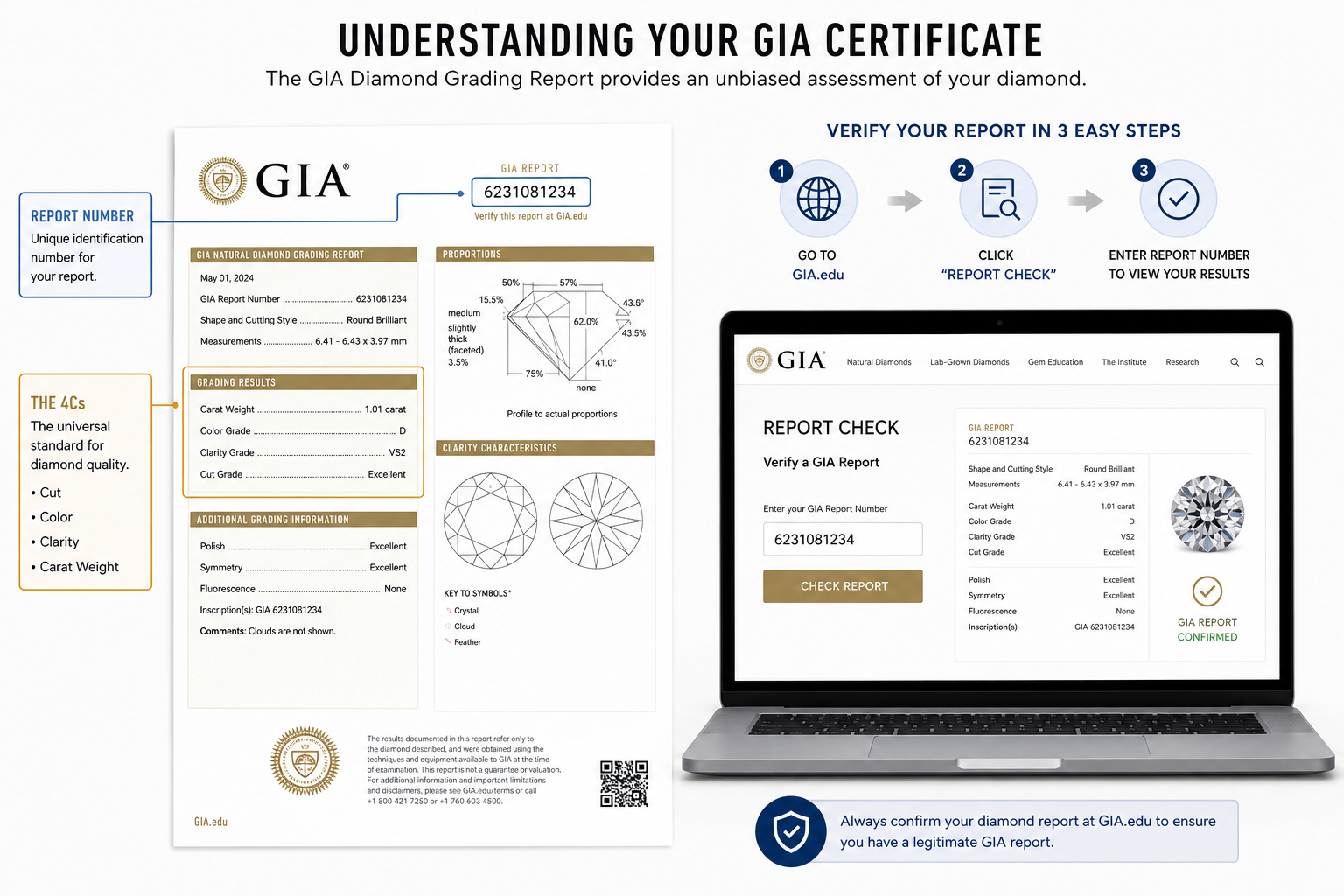
That report details the 4Cs: cut (how well the diamond reflects light), color (from D/colorless to Z/light yellow), clarity (internal flaws visible under 10x magnification), and carat weight (size measured in metric carats). The report also includes fluorescence (how the diamond reacts to UV light), symmetry (alignment of facets), and proportions (depth and table percentages that affect sparkle).
GIA doesn't work for the seller. They don't assign value or recommend prices.
They simply describe what they see under controlled lab conditions. That's why the industry considers GIA the gold standard.
When you buy online, you can't hold the diamond under a jeweler's loupe. The certificate becomes your eyes, which is why this first-time buyers guide gia emphasizes certificate verification as the foundation of safe online purchasing.
Now, you'll also see IGI certificates. IGI (International Gemological Institute) is another respected lab, particularly common for jewelry-set diamonds and internationally traded stones.
The key difference: GIA tends to grade slightly stricter. A diamond that GIA calls "VS2 clarity" might receive "VS1" from a more lenient lab.
For first-time buyers, this matters because you want consistency. Both GIA and IGI are legitimate, but GIA's stricter standards mean fewer surprises when you receive the piece.
Reputable retailers provide GIA or IGI certificates for natural diamonds above 0.18 carats. Below that threshold, stones are called "melee diamonds" (small accent diamonds used in halos or pavé settings), and retailers typically grade those in-house rather than paying for individual certificates.
When a retailer offers IGI or GIA certified diamonds for stones above 0.18ct and in-house grading for melee diamonds, that's standard practice, not a red flag.
One critical detail: the certificate accompanies the diamond, not the jewelry setting. If you buy a diamond ring, you get a certificate for the center stone (if it's above 0.18ct).
The gold or platinum band is verified separately through a hallmark, a stamped mark indicating metal purity. In India, that's the BIS hallmark with a unique 6-digit HUID (Hallmark Unique Identification) number.
Both certifications matter. A GIA-certified diamond set in uncertified metal is only half-verified, a key lesson in any full first-time buyers guide gia.
Step-by-Step: How to Buy GIA Certified Diamond Jewelry Online
Buying your first diamond online feels risky because you're making a high-value decision without physically seeing the product. Follow this framework to remove the guesswork.
Step 1: Set your budget BEFORE you browse.
Diamond jewelry pricing breaks down into four components: metal value (calculated as live gold/silver rate multiplied by net weight), making charges (the artisan's labor fee), stone charges (the cost of the diamond itself, determined by the 4Cs), and taxes (in India, that's 3% GST on jewelry plus 5% GST on making charges).
Understanding this breakdown helps you spot inflated pricing. If a retailer won't show you how they calculated each line item, that's a warning sign.
Transparent making charges and itemized pricing are non-negotiable.
Step 2: Learn the 4Cs prioritization.
For jewelry (as opposed to loose investment stones), prioritize cut first. A well-cut 0.40ct diamond will sparkle more than a poorly cut 0.60ct stone.
After cut, focus on color, aim for G to J range for the best value (near-colorless to the naked eye but significantly less expensive than D-F). Clarity comes third; VS2 to SI1 clarity grades have flaws invisible without magnification but cost far less than flawless stones.
Carat weight is your personal choice based on budget and style preference. Many first-time buyers reverse this order and fixate on carat size, then wonder why their diamond looks dull.
Step 3: Verify the GIA certificate number independently.
Every GIA report has a unique number engraved on the diamond's girdle (the widest part of the stone) and printed on the certificate.
Visit GIA's Report Check page and enter that number. You'll see the full report within seconds.
If the details don't match what the retailer advertised, different carat weight, wrong clarity grade, mismatched color, walk away immediately. Some fraudulent sellers use fake certificates or recycle old certificate numbers from different stones.
Independent verification through the official GIA website is the only way to be certain. This verification step is absolutely essential in any first-time buyers guide gia.
Step 4: Read the retailer's certification policy.
Look for retailers that specify which certification body they use and the size threshold for certification.
For example, a retailer offering IGI or GIA certification for natural diamonds above 0.18ct with in-house grading for melee diamonds is following industry standards. If a retailer is vague about certifications or promises "certified diamonds" without naming GIA or IGI, you're likely dealing with internal grading that carries no third-party accountability.
Step 5: Check the return and exchange policy BEFORE purchasing.
A generous return window is essential when buying jewelry you haven't seen in person.
Look for at least 30 days, ideally longer. A 365-day free insured return policy signals confidence in product quality.
Short return windows (7-14 days) suggest the retailer doesn't want you examining the piece closely. Also verify whether returns are free or if you'll pay return shipping, that can add ₹2,000-₹5,000 to your cost if you're unhappy with the purchase.
Step 6: Use video consultations if available.
Many online jewelers now offer live video calls where a designer walks you through options, shows you the actual piece under magnification, and answers questions in real time.
This is invaluable for first-time buyers. You can ask, "Why is this diamond priced higher than a similar one?" or "Can you show me the certificate under the camera?
A live consultation with a designer before purchase eliminates much of the anxiety of buying remotely.
Step 7: Confirm hallmarking for the metal setting.
In addition to the diamond certificate, ensure the gold or silver setting is independently hallmarked.
In India, that's the BIS hallmark with a unique 6-digit HUID on each piece, verifiable via the BIS portal or BIS CARE app. For buyers outside India, look for equivalent national standards (like the UK hallmark or US karat stamps).
A retailer that offers 100% BIS hallmarked gold and silver jewelry with a commitment to refund twice the difference if purity is below standard is putting their reputation behind their claims.
Step 8: Review shipping and insurance.
Ensure the retailer ships via insured, trackable carriers.
For high-value jewelry, look for specialized services like Brinks, which provides fully insured international shipping to 30+ countries. Standard courier services often have coverage limits that won't fully protect a ₹1,00,000+ purchase if the package is lost or stolen.
Also Read!
5 Mistakes First-Time Online Diamond Buyers Make
You can follow every verification step and still lose money if you fall into these common traps. This first-time buyers guide gia highlights the most costly errors.
Mistake 1: Confusing "certified" with "appraised."
An appraisal is a value estimate, often prepared by the retailer or a hired appraiser, and typically inflated to make you feel you're getting a deal. ("Appraised at ₹1,50,000, now yours for ₹90,000!
An appraisal has no standardized criteria and carries no third-party accountability. A GIA certificate, by contrast, is an objective quality assessment with no value estimate.
Never accept an appraisal as a substitute for a GIA or IGI certificate. If a seller says, "We provide an appraisal instead of a GIA report," you're being sold a story, not verified jewelry.
Mistake 2: Ignoring the diamond's cut grade.
First-timers often fixate on carat size and overlook cut quality.
A poorly cut 0.70ct diamond will look smaller and duller than a well-cut 0.50ct stone because cut determines how light reflects through the diamond. GIA grades cut from Excellent to Poor.
Always choose Excellent or Very Good cut grades. If the certificate doesn't list a cut grade (older GIA reports for fancy shapes sometimes omit it), ask the retailer for polish and symmetry grades as proxies, both should be Very Good or better.
Mistake 3: Not verifying the certificate number yourself.
Some fraudulent sellers use fake certificates with made-up report numbers.
Others recycle legitimate certificate numbers from different diamonds (they show you a real GIA report, but it's not for the stone you're buying). Always cross-check the GIA report number on gia. edu yourself.
Don't rely on the retailer to "verify" it for you. This takes 30 seconds and can save you tens of thousands, making it a cornerstone of any first-time buyers guide gia.
Mistake 4: Buying from retailers with no return policy or short windows.
Buying jewelry online without seeing it in person means you NEED a substantial return window.
Anything under 15 days is a red flag. Some retailers offer 7-day policies with conditions like "only if unworn" or "only in original packaging," which effectively prevents returns (because you need to try it on to know if you like it).
Look for 30-day or longer windows, ideally with free insured returns and no restocking fees. A lifetime exchange policy and buy-back guarantee at the prevailing rate demonstrate even greater confidence in product quality.
Mistake 5: Overlooking the metal quality.
A GIA-certified diamond set in uncertified or low-purity metal is a half-measure.
The certificate tells you the diamond is as described, but without a hallmark, you have no independent verification that the 18K gold setting is actually 18K. In India, look for BIS hallmarked pieces with a unique 6-digit HUID on each piece, verifiable via the BIS portal or BIS CARE app.
Outside India, confirm the equivalent national standard. A retailer that commits to refund twice the difference if purity is below standard is putting their money where their mouth is.
One final note on pricing: transparent making charges matter. Some retailers hide the real cost by bundling everything into a single price.
You end up paying ₹20,000 in making charges without realizing it. Reputable jewelers break down the price clearly: metal value at live rate, itemized making charges, stone charges, and applicable taxes.
If a retailer won't show you that breakdown, assume they're overcharging on hidden fees.
Tools and Resources for Verifying Your Purchase
You don't need to be a gemologist to buy diamonds confidently. Use these tools to verify quality independently, as recommended in this first-time buyers guide gia.
Resource 1: GIA Report Check.
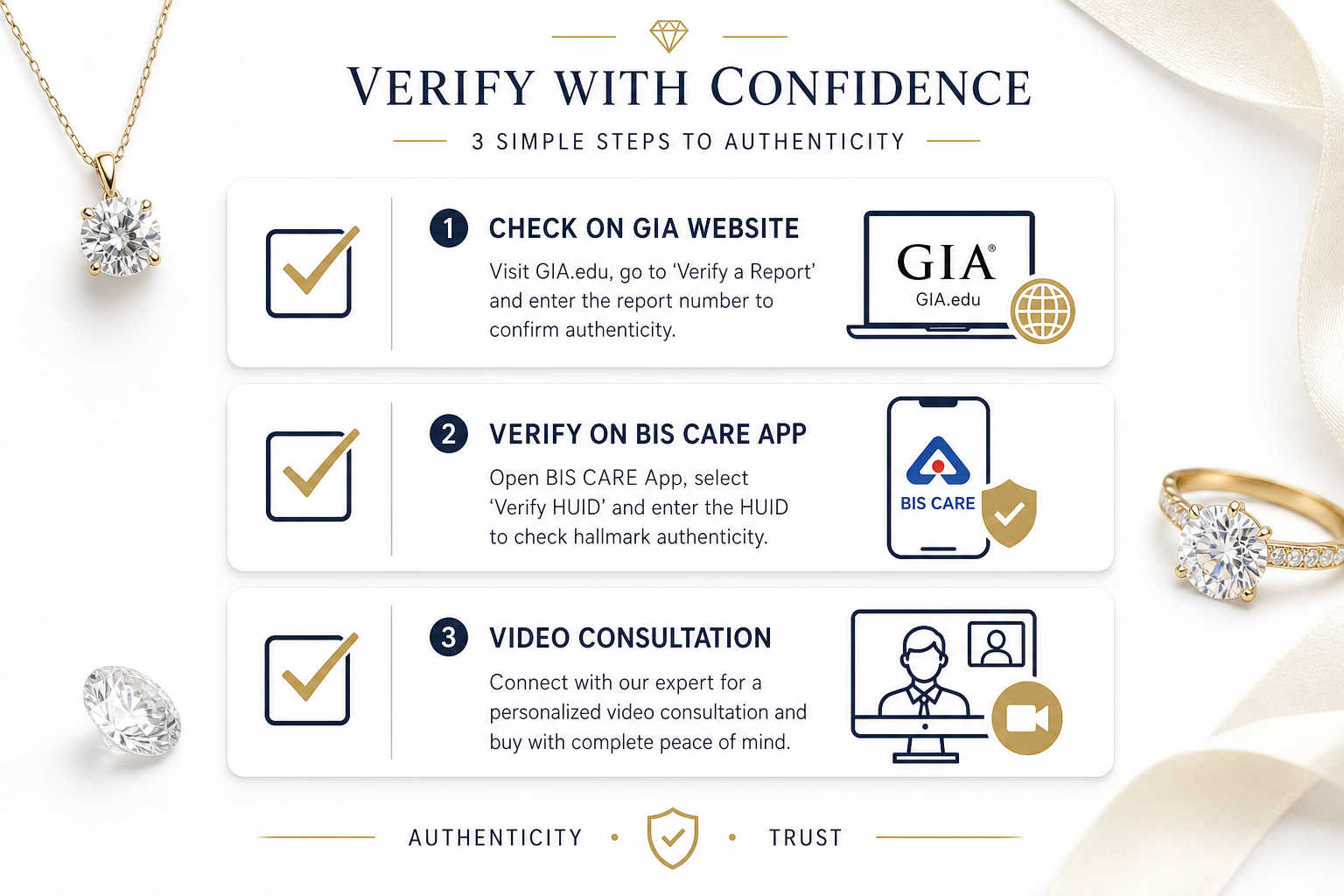
Visit gia. edu/report-check and enter the certificate number from your diamond's report.
You'll see the full GIA grading details within seconds. This is free, instant, and the single most important verification step.
If the report doesn't match what the retailer advertised, don't proceed with the purchase.
Resource 2: BIS CARE App.
For buyers in India, download the BIS CARE app (available on Android and iOS).
Every BIS-hallmarked piece has a unique 6-digit HUID stamped on it. Scan or enter that HUID in the app, and you'll see the official purity verification.
This confirms the metal is as described. You can also verify HUIDs through the BIS website portal if you prefer desktop access.
Resource 3: Rapaport Diamond Report.
The Rapaport Report is the industry benchmark for diamond pricing, a weekly publication listing wholesale price ranges for certified diamonds based on the 4Cs.
The full report requires a paid subscription, but knowing it exists helps you gauge whether a retail price is fair. If a retailer charges 3x the Rapaport list price for a similar stone, you're likely overpaying.
While you won't have direct access as a first-time buyer, mention Rapaport when asking retailers how they price their diamonds. Legitimate sellers will explain their markup transparently.
Resource 4: Online retailers with transparent certification policies.
Look for platforms that offer both IGI and GIA certified diamonds with transparent pricing breakdowns.
For example, retailers that separately list metal value (calculated at live gold/silver rates multiplied by net weight), making charges, stone charges, and taxes make it easy to understand exactly what you're paying for. This transparency eliminates the guesswork and lets you compare offerings across sellers on equal footing.
Some retailers now include pricing calculators on their websites so you can see how changing metal purity or stone quality affects the final price.
Resource 5: Video consultation services.
Many online jewelers now offer live video walkthroughs with designers, particularly valuable for first-time buyers who want to ask questions before committing.
During a video consultation, you can request to see the actual piece under magnification, ask the designer to show you the GIA certificate on camera, and discuss customization options. This bridges the gap between online convenience and in-store reassurance.
Retailers offering live consultation with a designer before purchase understand that education builds trust, which is the foundation of this first-time buyers guide gia.
One retailer that combines these resources is worth mentioning alongside the above tools. Platforms providing IGI or GIA certification for natural diamonds above 0.18ct, unique 6-digit HUID on each piece (verifiable via BIS portal or BIS CARE app), transparent making charges, and video consultation available demonstrate the kind of multi-layered verification first-time buyers need.
They also offer international shipping to 30+ countries via Brinks (fully insured), which matters if you're buying from abroad or sending a gift internationally. The key is to seek out retailers that don't just claim transparency, they provide the tools for you to verify it independently.
Book a Free Video Consultation →
What to Do Before You Place Your First Order
You've read the framework. Now turn it into action, following the steps outlined in this first-time buyers guide gia.
Here's your checklist for this week.
Action 1: Write down your budget and your non-negotiable requirements.
Be specific.
Example: "Budget ₹80,000. Must have GIA certificate. Minimum VS2 clarity. 18K gold setting with BIS hallmark. 30+ day return policy.
Writing this down prevents impulse purchases when you see a "limited-time offer" that doesn't meet your criteria.
Action 2: Visit gia. edu and familiarize yourself with what a GIA report looks like.
GIA provides sample reports on their website.
Study one so you know exactly what to look for: where the certificate number appears, how the 4Cs are listed, what the plotting diagram (showing inclusions) looks like. When you receive your certificate, you'll recognize immediately if something looks off.
Action 3: Shortlist 2-3 online retailers that provide GIA certification, hallmarked metals, transparent pricing, and a return window of 30+ days.
Don't settle for one option.
Comparing three retailers helps you understand market pricing and identify which offers the best combination of quality and service. Look for retailers offering 365-day free insured returns, lifetime exchange policies, and buy-back guarantees at the prevailing rate, these policies signal confidence in their product quality.
Action 4: Book a video consultation with at least one retailer.
Even if you feel awkward, asking questions before your first purchase saves money and builds confidence.
Prepare your questions in advance: "Can you show me the GIA certificate on camera?" "Why is this diamond priced differently than a similar one I saw elsewhere?" "How do you calculate making charges?
A knowledgeable designer will answer clearly and patiently. If they rush you or deflect, that's a red flag.
Action 5: Before clicking "buy," run the GIA report number through the GIA verification tool and check the metal hallmark number through the relevant authority.
This final double-check takes five minutes and eliminates the risk of fraud.
If either verification fails, contact the retailer immediately before completing the purchase. This step, emphasized throughout this first-time buyers guide gia, is your ultimate protection against fraud.
Buying diamond jewelry online is safe and often better value than in-store, but only when you're an informed buyer. Retailers operate with lower overhead than physical showrooms, and that savings can translate to better pricing for you.
However, you give up the ability to see and touch the piece before purchase. Certification exists precisely so first-time buyers don't have to be gemologists to make a smart purchase.
One more thing: don't let urgency pressure you into a decision. "Only 2 left in stock" and "Sale ends tonight" are marketing tactics.
Diamonds aren't seasonal produce, they'll still be available next week. Take the time to verify independently, following the guidance in this first-time buyers guide gia.
The right piece, purchased with confidence, will be worth the wait.
Also Read!
Best GIA Certified Diamond Jewelry for First Time Buying Jewelry Online in 2026
Understanding GIA Report Components in Detail
To truly master this first-time buyers guide gia, you need to understand what each section of a GIA report tells you. The report is divided into several key areas, each providing critical information about your diamond's characteristics.
The header section contains the report number, date, and a unique laser inscription registry. This number is micro-engraved on the diamond's girdle and serves as permanent identification.
Always verify this number matches between the physical diamond, the paper certificate, and the online GIA database.
The grading results section details the 4Cs. The color grade ranges from D (colorless) to Z (light yellow or brown).
The clarity grade describes internal characteristics (inclusions) and external characteristics (blemishes). Cut grade for round brilliants is assessed from Excellent to Poor based on proportions, symmetry, and polish.
Carat weight is measured to the hundredth of a carat. Understanding these grades helps you make informed comparisons between diamonds and recognize when you're getting genuine value.
The additional grading information section includes fluorescence, which describes how a diamond reacts under ultraviolet light. Strong fluorescence can affect a diamond's appearance in certain lighting conditions.
Polish and symmetry grades indicate the quality of the diamond's finish and facet alignment. These factors contribute significantly to the diamond's overall beauty and light performance.
The proportions diagram shows the diamond's measurements and angles. This includes table percentage (the flat top facet relative to the diamond's width), depth percentage (height relative to width), crown angle, and pavilion depth.
These proportions determine how light enters and exits the diamond, directly affecting its brilliance and fire. A well-proportioned diamond will sparkle intensely even at smaller carat weights.
The plotting diagram is a map of the diamond's internal and external characteristics. Inclusions are shown in red, blemishes in green.
This diagram is unique to your specific diamond, like a fingerprint. When you receive your diamond, a jeweler can use this diagram to positively identify your stone.
The comments section may include details about treatments, additional inscriptions, or other noteworthy features. Always read this section carefully, as it may contain information that affects the diamond's value or durability.
Some reports note "laser drilling" or "fracture filling," treatments that improve appearance but reduce value.
How to Compare Prices Across Multiple Retailers
Price comparison requires more than looking at the total amount. A full first-time buyers guide gia must address how to evaluate whether you're getting fair value for a GIA-certified diamond.
Start by comparing diamonds with identical 4Cs specifications. A 0.50ct, E color, VS1 clarity, Excellent cut round brilliant should be priced similarly across reputable retailers, with variations based on fluorescence, proportions, and business overhead.
If one retailer is significantly cheaper, investigate why. It may be a promotional sale, or the diamond may have qualities that lower its value (strong fluorescence, poor proportions, or shallow inclusion placement that affects light performance).
Request itemized pricing from each retailer. The breakdown should clearly show metal cost, making charges, stone cost, and applicable taxes.
Some retailers charge 20-25% making charges on the metal value, while others charge a flat fee. Neither model is inherently better, but transparency is essential.
If a retailer refuses to itemize costs, they're likely hiding excessive markups.
Compare certification bodies. A diamond certified by GIA may cost slightly more than a similar diamond certified by a less strict lab, but the GIA certification provides more reliable grading.
If you're comparing a GIA diamond to an IGI diamond with identical grades, the GIA stone is typically priced 5-10% higher due to GIA's reputation for stricter standards.
Evaluate value-added services. Does the retailer offer free resizing, lifetime maintenance, or free cleaning services?
A retailer charging ₹5,000 more but including lifetime free resizing, annual cleaning, and a full warranty may offer better long-term value than a cheaper competitor with no after-sale support.
Consider exchange and upgrade policies. Some retailers offer lifetime exchange at prevailing rates, meaning you can trade your diamond jewelry for new pieces as your tastes change.
Others offer upgrade policies where you can apply the full purchase price toward a higher-value diamond in the future. These policies add significant value for buyers who view diamond jewelry as both adornment and investment.
Maintaining Your GIA Certified Diamond Jewelry
Once you've made a purchase following this first-time buyers guide gia, proper maintenance ensures your diamond continues to sparkle and your investment is protected.
Professional cleaning is recommended every six months. While diamonds are the hardest natural substance, their settings can loosen over time.
A jeweler will inspect prongs, check for wear, tighten settings, and professionally clean the piece using ultrasonic cleaners and steam. This service is often free from the retailer where you purchased the jewelry.
Between professional cleanings, maintain your diamond at home with warm water, mild dish soap, and a soft toothbrush. Soak the piece for 20-30 minutes, gently scrub with the brush (especially under the setting where oils accumulate), and rinse thoroughly.
Avoid harsh chemicals like chlorine bleach or abrasives that can damage the metal setting.
Store your diamond jewelry separately from other pieces. Even though diamonds are extremely hard, they can scratch other jewelry and even other diamonds.
Use individual fabric pouches or lined jewelry boxes with compartments. Never toss diamond pieces together in a jewelry box.
Insure your diamond jewelry. Your homeowner's or renter's insurance may provide limited coverage, but a specialized jewelry insurance policy offers full protection against loss, theft, and damage.
The GIA certificate and purchase receipt serve as documentation for insurance claims. Store copies of these documents separately from the jewelry itself, ideally in a safe deposit box or secure digital storage.
Remove your diamond jewelry during physical activities. While diamonds are durable, sharp impacts can chip them, and settings can be damaged during exercise, household cleaning, or yard work.
Apply cosmetics, hairspray, and perfume before putting on diamond jewelry, as these products can create a film that dulls the diamond's sparkle.
Have your jewelry inspected annually even if it appears fine. Small problems like worn prongs or loose settings are easier and less expensive to repair when caught early.
An annual inspection also provides an opportunity to have the piece professionally cleaned and to update your insurance appraisal if the jewelry has appreciated significantly in value.
Also Read!
Understanding Diamond Pricing Trends for Smart Buying
A thorough first-time buyers guide gia should address market dynamics so you can time your purchase strategically and understand whether you're paying a fair market price.
Diamond prices fluctuate based on several factors. Global supply is controlled largely by a few major mining companies, and production levels affect wholesale prices.
Economic conditions in major consuming markets (India, China, the United States, and the Middle East) drive demand. When these economies are strong, diamond prices rise; during recessions, prices may soften.
Seasonal trends affect retail pricing. Demand peaks during wedding season (November through February in India) and major gift-giving holidays (Christmas, Valentine's Day, Diwali).
Retailers may offer better prices during off-peak months (June through August in most markets) when they're eager to move inventory. If your timeline is flexible, shopping during these slower periods can yield 10-15% savings.
The premium for certain characteristics varies over time. In recent years, consumers have increasingly prioritized cut quality over carat weight, leading to higher premiums for Excellent cut diamonds.
Color preferences also shift; while colorless (D-F) diamonds command the highest prices, there's growing appreciation for near-colorless (G-J) and even fancy color diamonds, affecting the premium structure across the color spectrum.
Lab-grown diamonds have entered the market at significantly lower prices than natural diamonds. A lab-grown diamond with identical 4Cs to a natural diamond typically costs 40-60% less.
However, this first-time buyers guide gia focuses on natural diamonds with GIA certification. If you're considering lab-grown diamonds, ensure they're certified by GIA or IGI, as these labs issue separate reports clearly identifying lab-grown stones.
Currency fluctuations affect international diamond prices. Diamonds are typically priced in US dollars globally, so when your local currency strengthens against the dollar, imported diamonds become less expensive.
If you're purchasing from an international retailer or a domestic retailer who imports diamonds, monitor exchange rates for potential savings opportunities.
Red Flags to Watch for When Shopping Online
Even armed with this full first-time buyers guide gia, you need to recognize warning signs that indicate a retailer may not be trustworthy.
Vague or missing certification information is the biggest red flag. If a retailer advertises "certified diamonds" without specifying GIA, IGI, or another recognized lab, they're likely using internal grading with no third-party verification.
Similarly, if they can't provide the certificate number before purchase, walk away.
Prices significantly below market rate often indicate problems. If a diamond is priced 30-40% below similar stones from other retailers, investigate thoroughly.
It may have been graded by a lenient lab (making the grades unreliable), have significant issues not disclosed in the listing (strong fluorescence, poor proportions, or strategically photographed inclusions), or be part of a bait-and-switch scheme where the advertised diamond "just sold" but they have a "similar" (inferior) alternative.
Pressure tactics like countdown timers, "only 1 left" warnings, or aggressive follow-up emails suggesting the diamond will be sold if you don't act immediately are manipulative marketing techniques. Reputable retailers educate buyers and give them time to make informed decisions.
If you feel rushed or pressured, that's a sign to look elsewhere.
Stock photos instead of actual diamond images are problematic. While small melee diamonds may be shown with stock photos, any certified center stone above 0.18ct should have actual photographs showing that specific diamond.
Some retailers even provide 360-degree video views. If a retailer won't show you the actual diamond you're buying, they may be hiding flaws or planning to substitute a different stone.
No return policy or extremely restrictive conditions (must be unworn, must be in original sealed packaging, restocking fees of 20-30%, or return windows under 15 days) suggest the retailer doesn't stand behind their products. Buying diamond jewelry online requires a meaningful return period because you can't evaluate the piece before purchase.
Look for at least 30 days with free returns.
Missing contact information or offshore business registration with no local presence makes it difficult to resolve issues. Verify the retailer has a physical address, phone number, and responsive customer service.
Check online reviews on independent platforms (not just testimonials on the retailer's website). A pattern of complaints about quality, certificate mismatches, or difficulty with returns is a clear warning sign.
Unwillingness to provide additional information or answer specific questions professionally indicates either lack of knowledge or intentional evasiveness. A reputable retailer will happily explain their pricing, show you the GIA certificate, discuss the diamond's characteristics, and connect you with a designer for a video consultation.
If they dodge questions or provide generic responses, they're not committed to customer education.
Advanced Diamond Selection Strategies for Maximum Value
Beyond the basic first-time buyers guide gia framework, these advanced strategies help you identify exceptional value opportunities that most buyers overlook.
Focus on "magic numbers" boundaries.
Diamond pricing jumps significantly at certain carat weights: 0.50ct, 0.75ct, 1.00ct, 1.50ct, and 2.00ct. A 0.49ct diamond may cost 15-20% less than a 0.50ct stone with identical color, clarity, and cut grades.
The size difference is imperceptible to the naked eye, but the price difference is substantial. When setting your budget, consider stones just below these thresholds for maximum value.
Understand clarity grade positioning.
Within each clarity grade, diamonds are positioned at the high, middle, or low end of that grade. A "high VS2" diamond nearly qualifies as VS1, while a "low VS2" barely avoided being graded SI1.
GIA reports don't explicitly state this positioning, but an experienced jeweler can assess it based on the plotting diagram and inclusion characteristics. During video consultations, ask specifically about grade positioning, it can mean the difference between a stone that faces up clean and one where inclusions are just barely invisible.
Evaluate fluorescence strategically.
Diamond fluorescence, how a stone reacts to ultraviolet light, is often misunderstood. Strong blue fluorescence can actually improve the appearance of diamonds in the I-M color range by making them appear whiter in natural sunlight.
However, strong fluorescence in colorless (D-F) diamonds may cause a slightly hazy appearance and typically reduces value by 10-15%. Medium or faint fluorescence generally has minimal impact on appearance but can provide a price advantage of 5-10%.
Prioritize proportions over weight.
Two diamonds with identical carat weights can have dramatically different visual sizes based on their proportions. A shallow diamond spreads weight across a larger diameter, appearing bigger from the top view (the only angle that matters when worn).
A deep diamond concentrates weight in the pavilion (bottom portion), which is invisible when set. Check the table percentage (ideal: 54-57% for round brilliants) and depth percentage (ideal: 59-62.5% for round brilliants). A well-proportioned 0.90ct diamond can face up larger than a poorly proportioned 1.00ct stone.
Consider shape popularity and pricing.
Round brilliant diamonds command a premium of 20-30% over fancy shapes (oval, princess, emerald, cushion) due to higher demand and greater rough diamond waste during cutting. If you're flexible on shape, choosing a fancy shape can provide significant savings.
Oval and cushion cuts are particularly popular currently and offer excellent sparkle while costing less than rounds. This strategy, part of an advanced first-time buyers guide gia approach, maximizes visible size per dollar spent.
Negotiate making charges, not stone prices.
Diamond stone prices are largely standardized based on Rapaport pricing, with limited negotiation room. However, making charges (labor and craftsmanship fees) have more flexibility.
If a retailer quotes 25% making charges on the gold value, negotiate for 18-20%. On a ₹1,00,000 purchase, that 5% reduction saves ₹5,000, money that can upgrade your diamond quality or add to your jewelry collection.
Time your purchase strategically.
Beyond off-season shopping, consider purchasing during economic downturns when luxury goods face weaker demand. Retailers are more willing to offer discounts when sales are slow.
Additionally, end-of-quarter periods (March, June, September, December) often see promotions as retailers push to meet sales targets. While this first-time buyers guide gia emphasizes never sacrificing quality for price, strategic timing can deliver genuine savings without compromise.
Understanding Diamond Investment Potential and Resale Value
While this first-time buyers guide gia focuses primarily on purchasing diamond jewelry for personal enjoyment, understanding investment potential and resale value helps you make financially sound decisions.
Diamonds are not liquid investments.
Unlike gold or silver, which trade at transparent spot prices globally, diamonds lack a unified market. Resale prices vary widely based on quality, certification, and buyer demand at the time of sale.
Expect to receive 25-50% of retail price when reselling to jewelers or pawn shops, as they need margin for their own resale. Private sales through consignment or auction houses may yield 50-75% of retail but involve longer timelines and sales commissions.
Certification dramatically affects resale value.
A GIA-certified diamond holds significantly higher resale value than an uncertified stone because buyers trust the independent grading. An uncertified diamond requires costly testing and grading before resale, reducing what buyers are willing to pay.