Ordering a piece you can’t touch yet is nerve-wracking. In 2026, the safer path is custom jewelry design with 3d rendering, where you approve a lifelike model before a single gram of metal is cast.
Here’s the short answer first: a 3D preview shows you the actual proportions, prongs, and stone layout on screen, so the final piece matches what you approved. You’ll still see tiny real-world shifts (about ±0.5 mm or mild warmth in metal tone), but the structure, measurements, and design choices should align. That’s why this guide stays practical. I’ll share the exact cost formula, the 7-step flow I wish I had the first time, and the checks that keep you safe: BIS hallmarking, verifiable HUIDs, and IGI/GIA diamond certificates.
If you want more context on risk and results, this explainer on why 3D previews reduce risk for NRIs is a good side read.
What Is a 3D Jewelry Preview and Why Does It Matter When You’re Buying Custom?
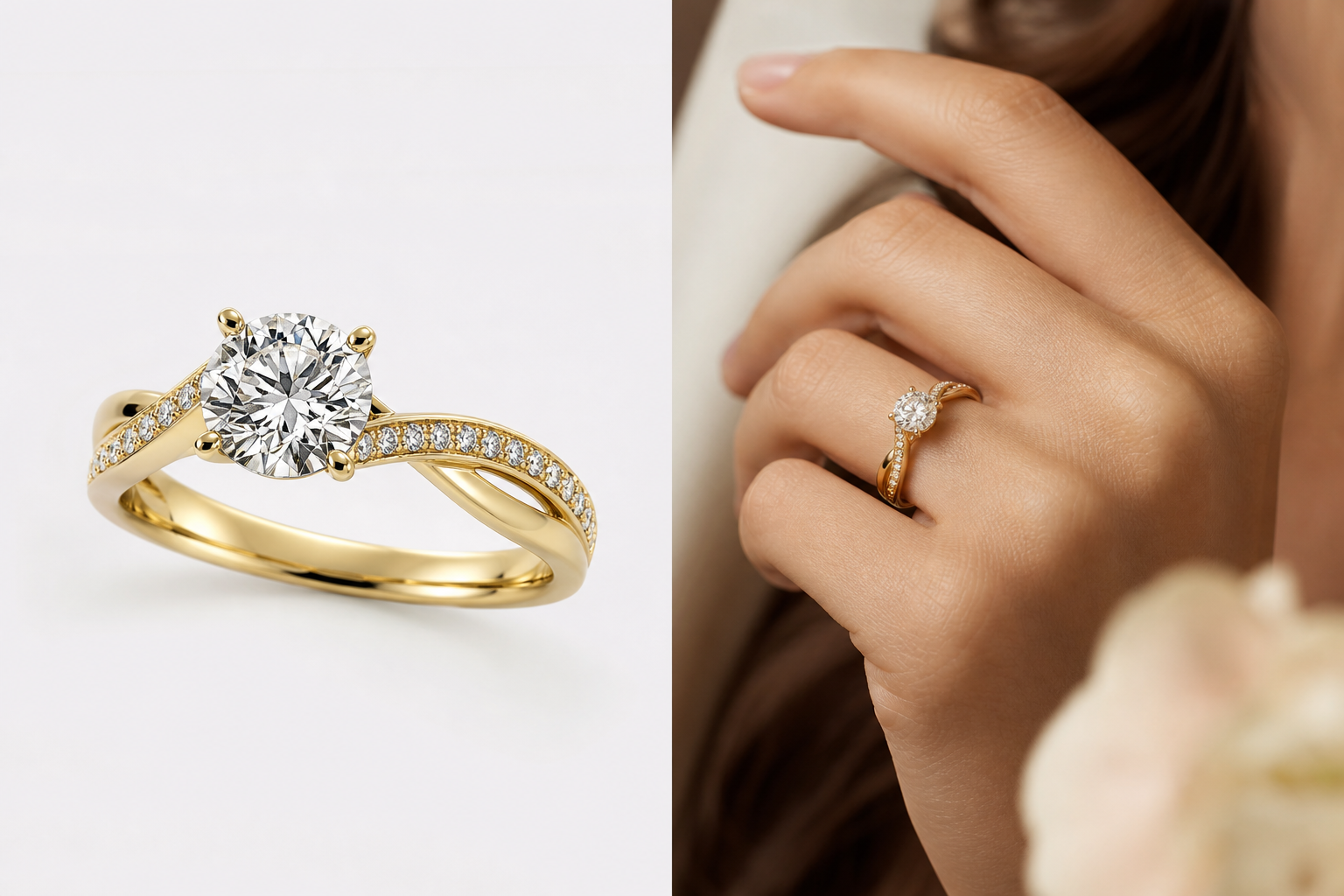
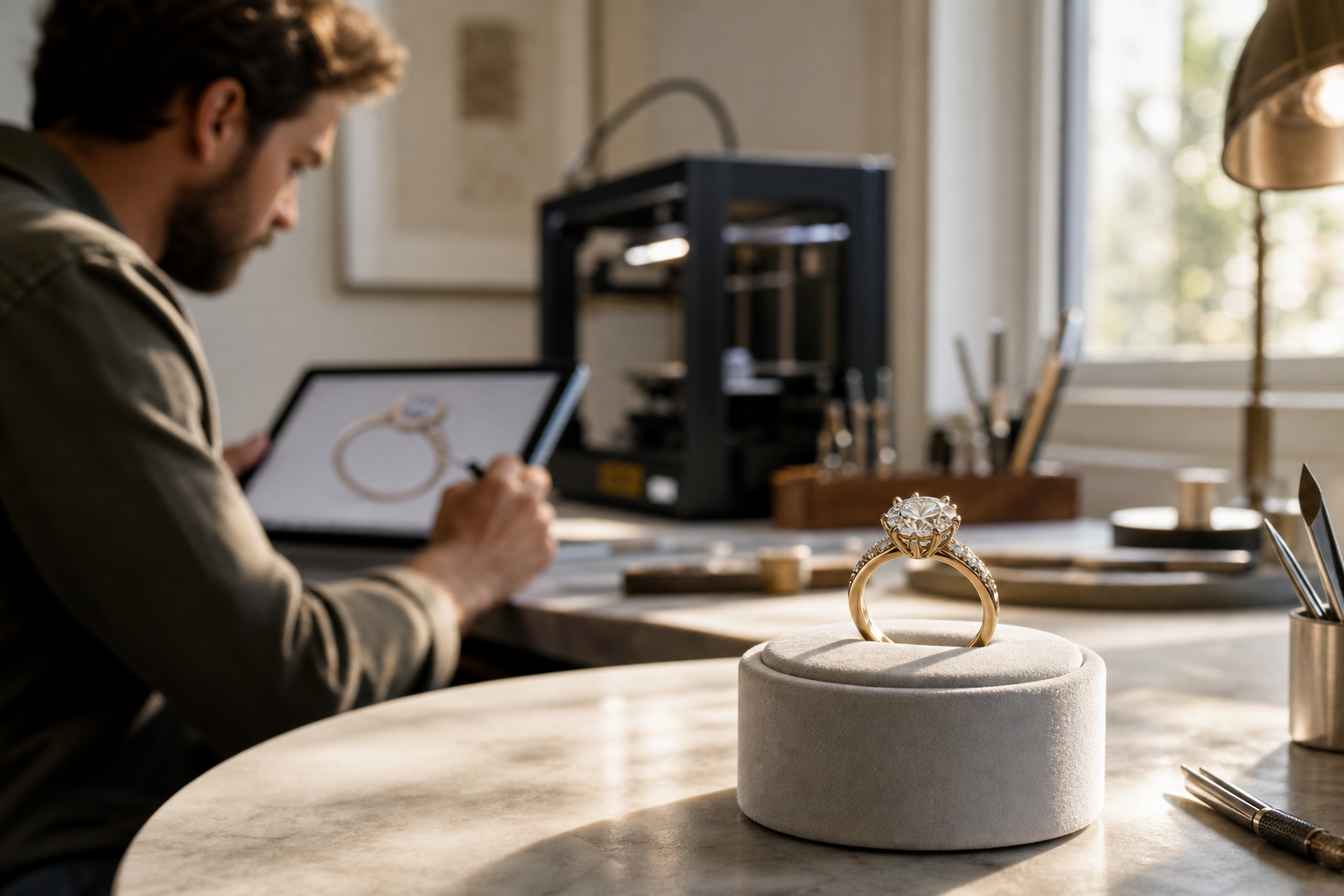
A 3D jewelry preview is a photorealistic digital model of your piece, created before any metal is cast. In plain terms, it’s a high-detail picture or rotatable model that shows how your design will look from every angle. Decades ago, you’d approve a sketch or rely on a phone chat. Now, you see the ring or pendant at true scale, with accurate metal color and stone layout. This shift cut guesswork and reduced “that’s not what I pictured” moments.
First, definitions help:
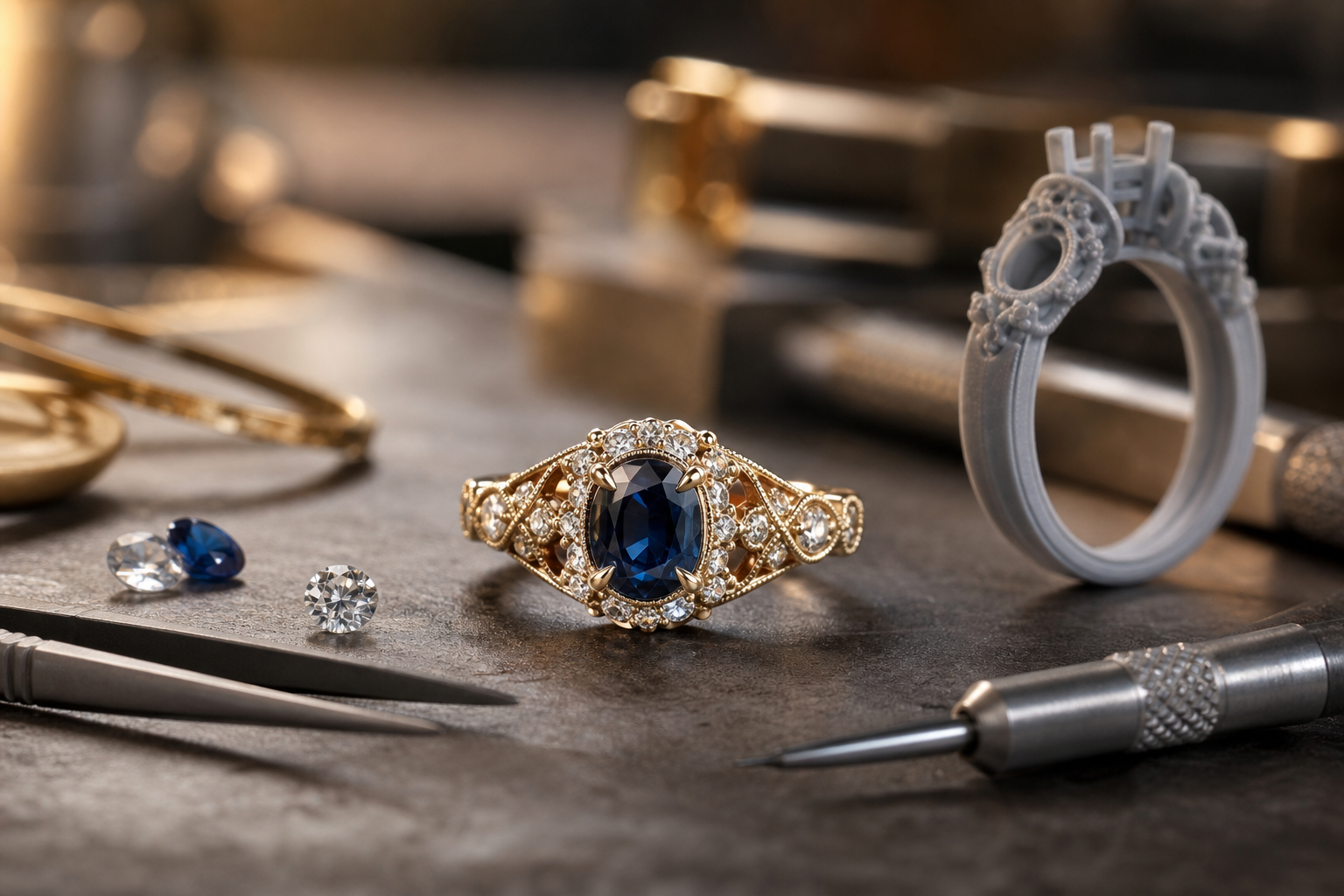
CAD (Computer-Aided Design): the technical 3D file that holds exact measurements and geometry used to make your piece. – 3D rendering: a static photoreal image created from the CAD file. – 3D mockup: an interactive or rotatable model you can view from different angles.
Prong setting: small metal claws that hold a stone in place. – Hallmark: an official stamp that verifies metal purity. – HUID: a unique 6-digit ID code tied to a BIS-hallmarked piece.
A good preview should do four things well. First, show precise proportions on a hand or wrist, not just a floating object. Second, match metal tone (yellow, white, or rose) and finish (high polish, matte) closely. Third, reveal prong style and thickness so you can judge security and look. Fourth, map stone sizes to the setting so there’s no surprise gaps.
Moreover, modern jewelry rendering usually hits 95%+ visual accuracy to the finished piece. Structure, thickness, and layout should match exactly; only tiny tolerances shift. For materials, BIS-hallmarked metal and IGI/GIA-certified diamonds add a safety net. If you’re new to hallmarking, the Bureau of Indian Standards manages hallmark norms in India, and the Gemological Institute of America (GIA) sets widely trusted grading standards for diamonds.
What You Should See in a Quality 3D Preview
- True-to-scale on-hand/on-body views
- Clear prong style (number, shape, and thickness)
- Accurate metal color preview
- Stone layout that matches the setting with no odd gaps
- Engraving placement and font visibility
In short, custom jewelry design with 3d rendering answers the key question: will the final look match my approval? In practice, yes, within small, normal tolerances.
Also Read!
Bride’s Guide to Gold Jewelry with Lifetime Exchange and Buyback Policies
NRI’s Guide to Buying GIA Certified Diamond Jewelry from India
Step-by-Step: How to Design Custom Jewelry Online with a 3D Preview
You don’t need design training. You need a process. Use this 7-step path to go from idea to finished piece without cost shocks.
1. Save 5–10 reference images of what you like and 3–5 of what you don’t. Pull from Pinterest, Instagram, or product pages. Include rings, pendants, or bangles if you’re unsure of the final form yet. A “do not want” row shortens the first consult by 10–15 minutes and prevents drift.
2. Custom pricing is math, not magic.
Price is calculated as: Total = Metal value (live rate x net weight) + Making charges + Stone charges + 3% GST on jewelry + 5% GST on making charges.
As an example, live rates recently listed: 22K Gold ₹6,673/g, 18K Gold ₹5,464/g, Silver ₹89/g. Because design affects net weight, your preview and CAD help the jeweler predict grams within a tight range. Therefore, ask for a weight estimate and making charges upfront.
3. Choose the right metal for your design.
22K gold (91.6% purity) is softer, with a rich warm hue. It’s great for traditional forms and pieces without many stones. – 18K gold (75% purity) is harder, better for daily wear and prong-heavy diamond work.
Platinum 950 is dense, strong, and naturally white. – Silver is budget-friendly but needs more care to keep tarnish at bay. For prong-intensive designs, 18K/Platinum usually holds stones more securely than 22K.
4. For natural diamonds, ask for IGI or GIA certificates on stones above 0.18 ct. Certification matters for trust and resale. For colored gems, request origin and treatment disclosure in writing. In addition, ask if melee (tiny side stones) is graded in-house and to what standard.
5. Skip forms for this part. A 15–30 minute video consultation lets a designer guide you through styles, purities, and weight impacts in one call. Tools like Caratflow and other full-service jewelers offer a live consultation before you commit to design fees, which saves time and clears jargon early.
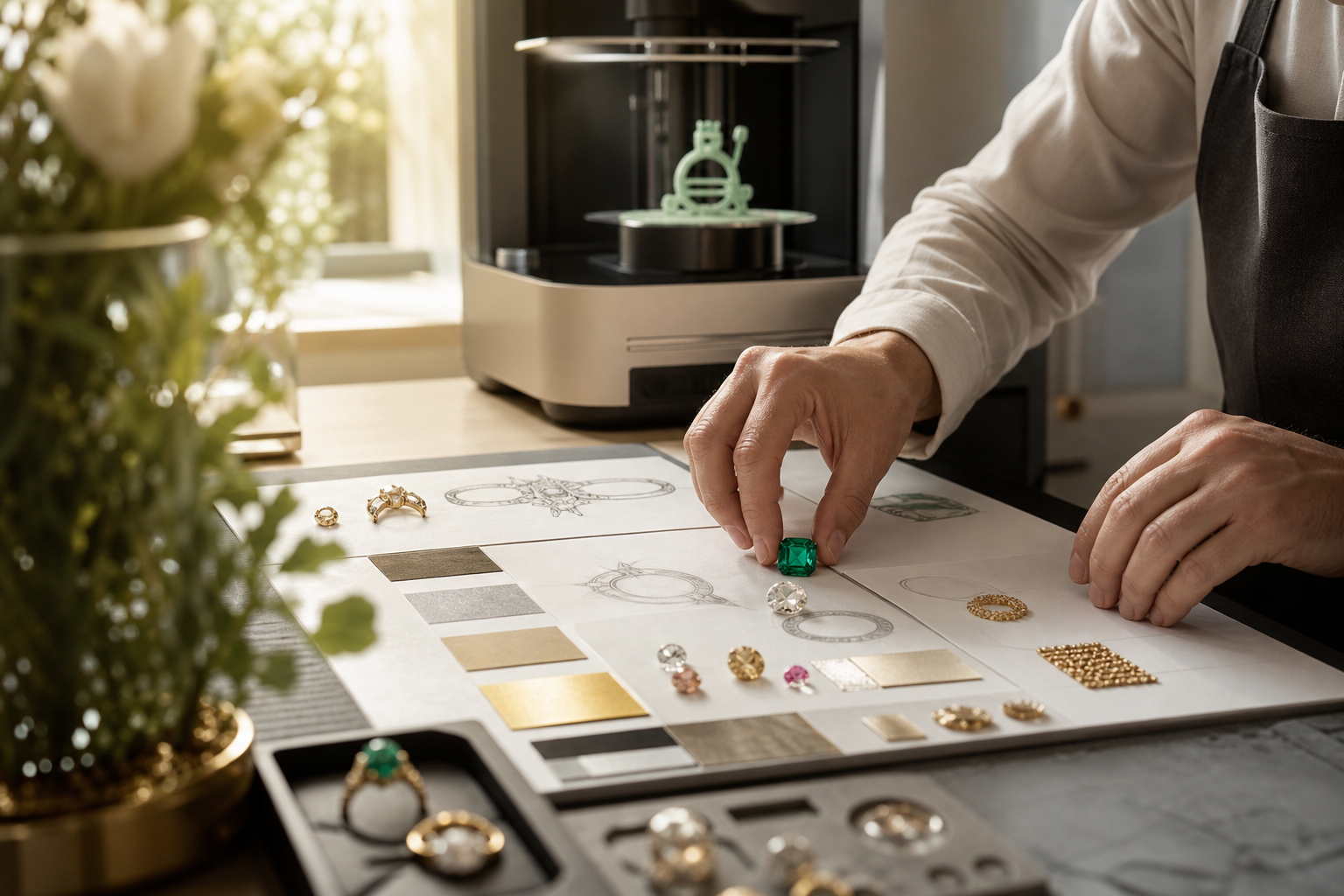
6. Look at proportions on-hand, prong style/number, stone size fit, band or shank thickness, and engraving placement. Request front, 45°, side, and top-down views. Ask for a scale reference against a standard ring size (e.g., US 6 or India 12) or a wrist diameter for bangles.
7. This is the cheapest point to make changes. Most reputable jewelers include 1–3 revision rounds on the 3D mockup without extra charge before casting. Be decisive on thickness and prong style here; a 0.3–0.5 mm tweak on screen can change metal weight and comfort in real life.
“I love that I can book a video consultation before buying. The designer walked me through three options over a call. Bought on the spot.” — Kavita Reddy, Hyderabad
For gift ideas with mockups, this walkthrough on how to design the perfect gift with a 3D preview shows helpful on-hand examples.
5 Mistakes First-Time Custom Jewelry Buyers Make (and How to Avoid Them)
Mistake 1: Skipping the consultation
Typing a long description into a contact form feels faster. However, a 15-minute video consult replaces weeks of back-and-forth. You’ll align on metal purity, weight, and prong style live. Moreover, you’ll get a read on the jeweler’s responsiveness, crucial for revisions and timelines.
Mistake 2: Ignoring proportions in the 3D preview
A ring that looks sleek head-on may feel bulky when seen from the side. Therefore, always ask for on-hand scale references and multiple angles. If your finger is slim, a 2.0 mm shank can look fine in isolation but thick on-hand. Conversely, a 1.6 mm band may feel too light for daily wear.
Mistake 3: Choosing metal purity based on price alone
22K can be cheaper in making charges and has that deep yellow tone. But it’s softer for prong-intense diamond settings. On the other hand, 18K costs more and holds stones more firmly. As a rule of thumb: go 18K or Platinum 950 for daily-wear rings with prongs; consider 22K for traditional, stone-light designs.
Mistake 4: Not asking about hallmarks and certifications upfront
Insist on BIS hallmarking with a unique 6-digit HUID you can verify via the BIS portal or BIS CARE app. Ask for IGI/GIA diamond certificates by stone number on natural diamonds. If a jeweler hesitates or cannot provide these, walk away. Many reputable retailers also commit to refund twice the difference if purity is below standard, ask in writing.
Quick Reality Check
Mistake 5: Assuming the 3D preview is the final piece
Expect tiny differences: ±0.5 mm in thickness, slight shifts in tone due to lighting, and natural inclusions visible under magnification. Structural elements, layout, prong count, head height, should match exactly. Therefore, treat the preview as a near-final contract for design, not a guarantee for micro-variations of color on your screen.
Quick Red Flags to Watch
- No video consultation available
- Vague making charges without a line-item breakdown
- No BIS hallmark/HUID on gold/silver
- No IGI/GIA for natural diamonds above 0.
- No clear revision policy for the 3D mockup
If you want a bride-focused walkthrough of approvals and timelines, see this bride’s guide to previews and design flow.
Also Read!
First-Time Buyer’s Guide to Gold Jewelry with Lifetime Exchange and Buyback
Tools and Platforms That Offer Custom Jewelry Design with 3D Preview
You have four broad routes. Your choice depends on how unique your idea is, how much guidance you want, and your comfort with technical files.
The Four Routes
Category 1: Full-service online jewelers with in-house 3D design
You brief a human designer, get a 3D mockup, revise 1–3 times, then they craft the piece. This route suits first-timers because you get live guidance, line-item pricing, and timeline clarity. Many promise transparent making charges, IGI/GIA for natural diamonds, and BIS-hallmarked metal. Some add strong risk reversal, such as 365-day free insured returns, a lifetime exchange policy, and buy-back at the prevailing rate. Tools like Caratflow fall here, and may also ship to 30+ countries via Brinks, fully insured.
Category 2: Self-service 3D configurators
You pick a setting and stone from a catalog and see a 3D composite. This is fast and great for classic solitaires or halo rings. However, it’s limited for non-standard head heights, unique motifs, or unusual stone shapes.
Category 3: Independent CAD designers on marketplaces
You hire a CAD specialist on a platform, get a 3D model, and take it to a local jeweler for casting. Control is high. Yet you’ll need to manage tolerances, prong strength, and supplier QC yourself. If you’re new, budget extra time for handoffs.
Category 4: Hybrid platforms
You start with a template and then customize through a consult. This balances speed and uniqueness. Turnaround times can be shorter than pure custom, and costs stay predictable.
“The bridal set I bought for my wedding was breathtaking. Craftsmanship is top and the BIS hallmark gave me total peace of mind.” — Priya Sharma, Mumbai
For a grounded comparison of retailers and safeguards, this piece contrasts a BIS-hallmarked jeweler with global e-commerce names: Which delivers better custom design for brides?
Trade-offs at a Glance
- Full-service: highest guidance, mid–high cost, steady timelines
- Self-service: fastest for standard looks, lowest guidance
- Independent CAD: highest control, most expertise needed
- Hybrid: balanced guidance and speed, moderate flexibility
Key Takeaways
Good custom work starts with clarity, not guesswork. Here are the points to keep in your notes before you book your first call.
A 3D preview shows your exact design before casting. You’ll see proportions, prongs, stone layout, and engravings at true scale. Modern previews reach 95%+ visual accuracy to the final piece, with only small real-world variances.
The price formula is fixed math. Total = Metal value (live rate x net weight) + Making charges + Stone charges + 3% GST on jewelry + 5% GST on making charges. Ask for a weight estimate and a clear line item for making charges so changes don’t surprise you.
Match metal to usage. 22K is richer in color but softer; 18K or Platinum 950 holds prongs and stones better for daily wear. If your piece uses many prongs or micro-pavé, 18K is usually the safer pick.
Certifications are non-negotiable. Ask for BIS hallmarking with a verifiable 6-digit HUID on each piece and IGI/GIA diamond certificates above 0.18 ct. For background, the GIA sets trusted grading standards worldwide.
Use video consultation and revisions. A 15–30 minute call plus 1–3 free 3D revisions will save weeks of edits and prevent misreads on scale. Changes are cheapest before casting—approve only when the preview matches what you want.
What to Do Next: Your First Custom Jewelry Design in 7 Days
Day 1–2: Build your mood board
Save 10 designs you like and 5 you don’t. Write your occasion, budget range, and preferred metal next to them. For rings, add your ring size. For bangles, add wrist diameter. These notes shave 20–30 minutes off your first consult.
Day 3: Shortlist 2–3 jewelers
Look for BIS hallmark commitments with a unique 6-digit HUID, IGI/GIA for natural diamonds, transparent making charges, and a video consultation before any design fee. Also check policies: 365-day free insured returns, a lifetime exchange policy, and buy-back at the prevailing rate. International shipping via Brinks, fully insured, is a plus if you live abroad.
Day 4–5: Book your first consultation
Come with your mood board and budget.
- How many 3D revision rounds are included at no extra charge?
- What certifications will I receive with the finished piece?
- What is the turnaround time from 3D approval to delivery?
If you want a deeper buyer’s angle, compare approaches in this piece on gifts and custom previews in 2026.
Day 6–7: Compare proposals beyond price
Score each proposal on clarity, preview detail, and how well the designer addressed your worries. In short, favor the shop that communicates clearly and shows measurements in the 3D mockup. Remember, custom jewelry design with 3d rendering has removed most of the old risk, so you can take your time and ask precise questions.
Finally, run a quick safety check before you approve: BIS hallmark + HUID present, IGI/GIA numbers listed for diamonds above 0.18 ct, and the price math shown line by line. If those are solid, you can approve with confidence.
**Start your custom design today →
If you want stories and step-by-steps from other first-timers, this walkthrough on how 3D previews make gifts feel “just right” is a candid read.