
This guide makes buying GIA- or IGI-certified diamond jewelry easy from abroad. The short answer: choose GIA for the main diamond and verify the report online; use IGI where your market accepts it. That’s how you remove the trust gap that distance brings.
You might be picking a ring for a 2026 wedding or a pendant for your mom’s 60th. You care about heritage and price, but the piece has to be right the first time. I’ve been the cousin on late-night video calls, comparing sparkle under different lights and walking through customs forms. The path is clear if you follow a few checks: independent grading (GIA/IGI), BIS hallmark + HUID for metal purity, transparent pricing, and insured logistics. For deeper bridal picks, you can also save this read for later: Best Bridal Picks with GIA Reports for 2026.
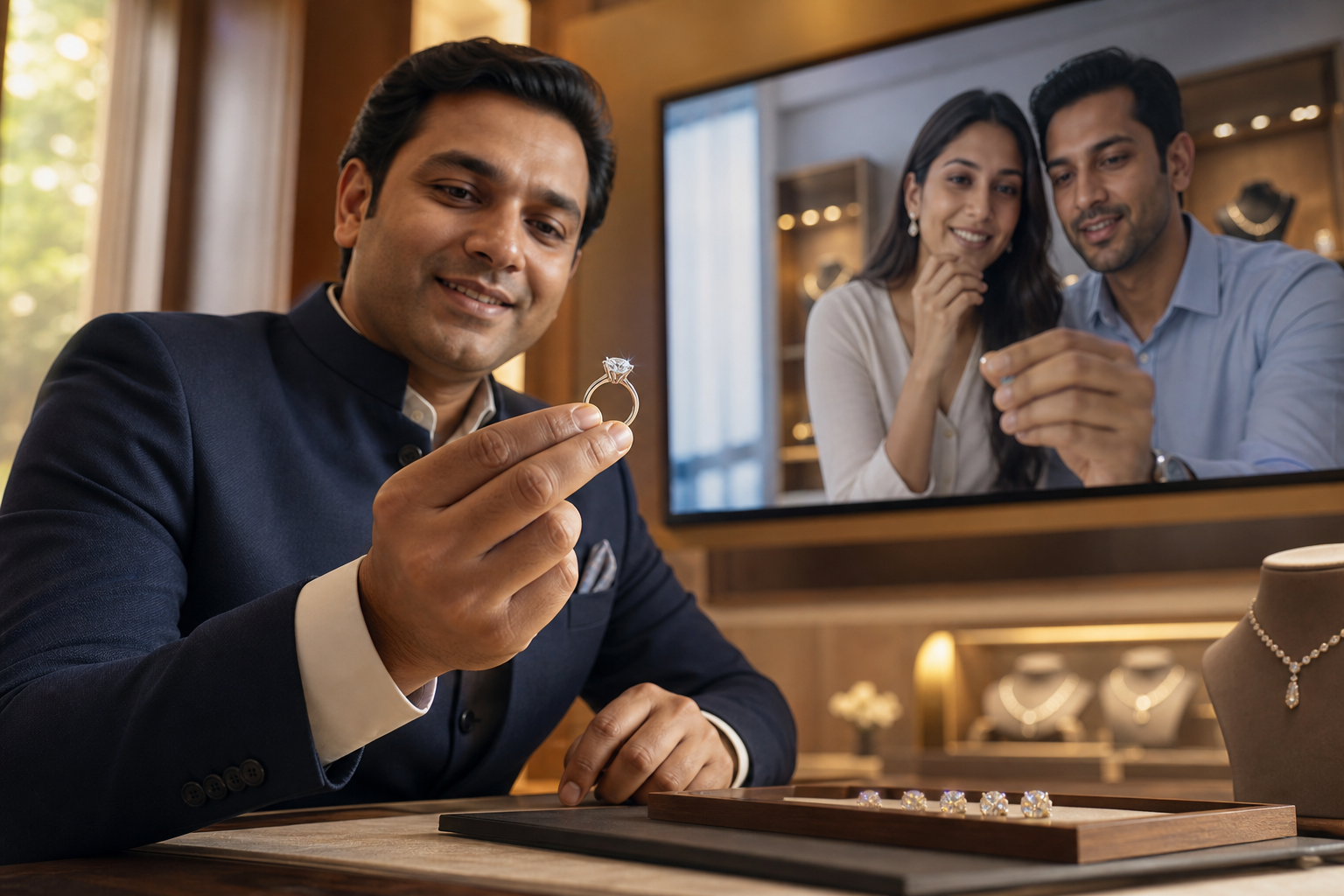
Why GIA Certification Matters When You’re Buying Diamonds from Overseas
If you’re abroad, you can’t loupe a stone in person. GIA closes that gap. The Gemological Institute of America built the modern 4Cs (Cut, Clarity, Color, Carat) system. Its reports are known in the US, UK, Canada, and the Middle East, so your piece appraises and insures smoothly there.
For high-value center stones, GIA is the gold standard.
Verify reports online
Specifically, GIA grades are consistent across labs and time. That consistency builds resale and insurance confidence. You can confirm any GIA report in minutes with the report number using the official GIA Report Check. For cross-border buys, that online verification is everything.
When IGI Makes Sense
On the other hand, IGI can be a solid fit for pieces sold in markets where IGI is widely accepted and for certain budget tiers. Many Indian retailers offer both IGI & GIA certified diamonds. A practical split is this: use GIA for the main diamond above 0.18ct that drives value, and accept in-house grading for melee diamonds (the tiny accent stones) where third‑party grading isn’t standard. That aligns with common retail practice: IGI or GIA certification for natural diamonds above 0.18ct, with in-house grading for melee.
Emotionally, this matters. NRIs buy for once-in-a-lifetime moments. A ring that will be seen by both families and set in photos for decades can’t be a guess. With natural diamonds and ethically sourced gemstones, a GIA report gives you the proof you need even if you’re 10,000 km away.
The 4Cs in Plain Language
The 4Cs. Cut, Clarity, Color, and Carat, summarize how a diamond looks and why it’s priced the way it is. Cut measures how well the stone returns light and is the biggest driver of sparkle.
Clarity reflects how free the diamond is from internal inclusions and surface blemishes. Color grades how white or tinted it appears, from D (colorless) downward. Carat is simply weight, and slight band jumps (for example, 0.90 ct to 1.00 ct) can cause sharp price spikes.
As a rule, prioritize Cut first. Then balance Color and Clarity to hit your budget and taste. Carat comes last once those boxes are ticked.
“I love that I can book a video consultation before buying. The designer walked me through three options over a call. Bought on the spot.” — Kavita Reddy
Step-by-Step: How to Buy GIA‑Graded Diamond Jewelry from India as an NRI
Here’s a seven-step framework I share with family and friends. Follow these, and long-distance buying feels local.
- Define budget and use India’s pricing math
- Price is calculated as: Total = Metal value (live rate x net weight) + Making charges + Stone charges + 3% GST on jewelry + 5% GST on making charges.
- Ask for live rates shown as 22K and 18K. For example, recent live rates listed were 22K ₹6,673/g and 18K ₹5,464/g, with Silver ₹89/g.
- Request an itemized quote to compare apples to apples.
- Pick the piece and metal purity
- Decide if it’s a solitaire ring, pendant, studs, or a bridal set.
- Choose 18K for diamond settings (stronger prongs and channels). Save 22K for plain gold pieces.
- Confirm the exact gold karat on your invoice.
- Verify BIS hallmark and HUID
- Look for “BIS hallmarked for purity” on the listing and invoice.
- Each piece should carry a unique 6-digit HUID, verifiable via the BIS portal or the BIS CARE app.
- Screenshot the HUID check for your records.
- Confirm the diamond report, not just a store card
- Ask for a GIA report for the main stone. Request the PDF and the report number.
- Know the norms: IGI or GIA certification for natural diamonds above 0.18ct; in-house grading for melee diamonds is common.
- Cross-check the report online before you pay.
- See it before it ships
- Book a video consultation or ask for a 360°/3D rendering.
- View the piece under bright white light and warm light, and compare finger or neckline scale.
- Confirm design tweaks and get them in writing.
- Lock in cross-border shipping and packaging
- Confirm international shipping to 30+ countries via Brinks, fully insured.
- Ask for declared value, tracking, and delivery timeline in writing.
- Eco-bonus: request FSC-certified packaging so it arrives gift-ready.
- Understand returns and lifetime value
- Look for 365-day free insured returns and a Lifetime exchange policy.
- Ask how buy-back works (e.g., buy-back guarantee at the prevailing rate).
- Save invoices, GIA/IGI certificates, HUID screenshots, and courier papers for customs and insurance.
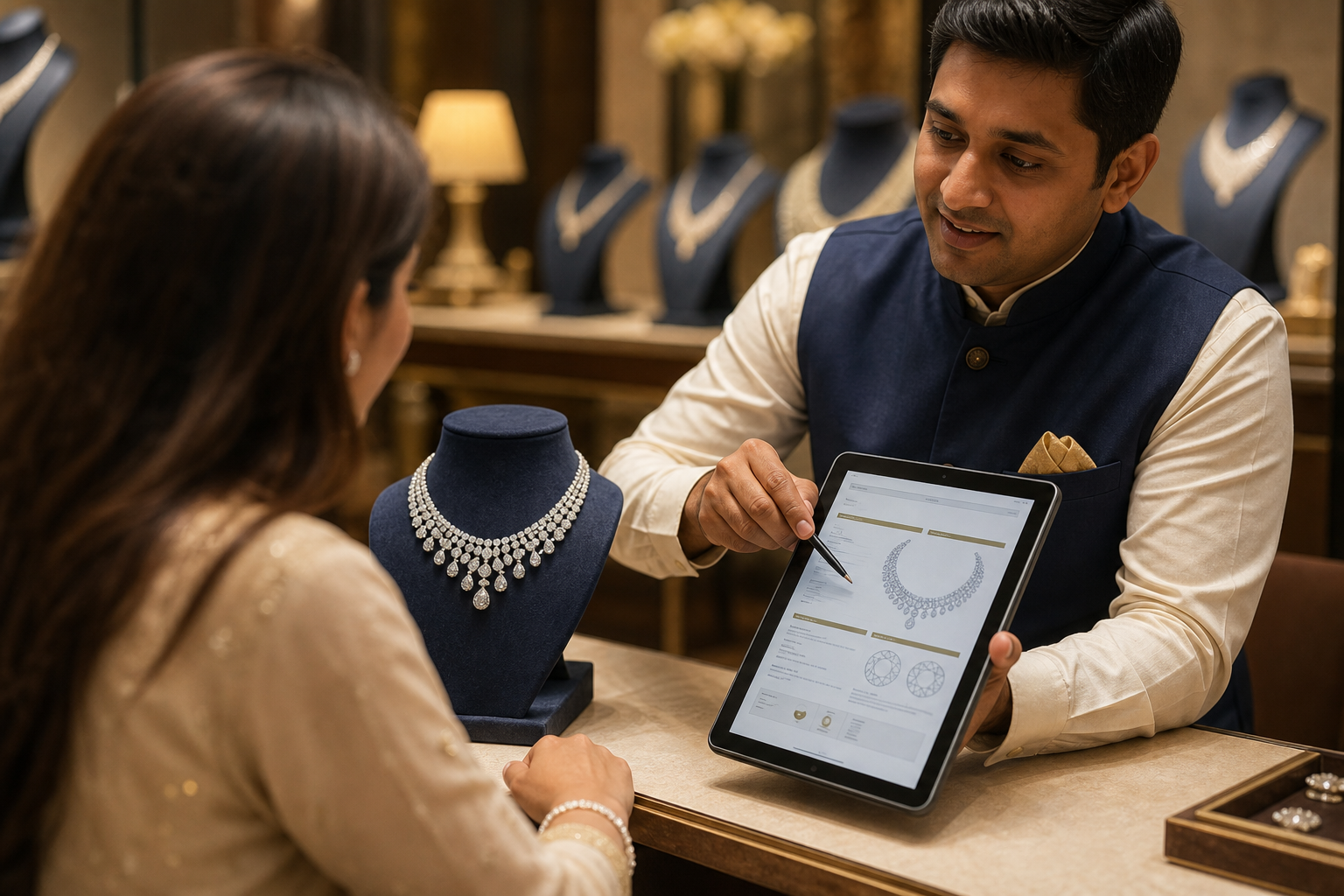
Moreover, bookmark a deeper explainer for first-timers: First-Time Buyer’s Guide to GIA Reports Online. It helps you set 4Cs guardrails before you start shortlisting.
Also Read!
First-Time Buyer’s Guide to Gold Jewelry with Lifetime Exchange and Buyback
5 Costly Mistakes NRIs Make When Buying Diamond Jewelry from India
Distance adds risk. These mistakes aren’t “rookie” errors. I’ve seen seasoned buyers make them while juggling time zones and events.
- Treating a store card as a lab report
- A jeweler’s in-house certificate is not the same as GIA/IGI.
- Only independent lab reports carry weight for insurance or resale abroad.
- For the main stone, insist on IGI or GIA certification for natural diamonds above 0.18ct.
- Overlooking customs and import rules
- Duties and limits change by country.
- Keep invoices, GIA/IGI reports, and HUID verification handy for declaration.
- For the US, see this primer from U.S. Customs and Border Protection: CBP customs duty information.
- Choosing 22K for diamond settings
- 22K is beautiful but softer; prongs can loosen with wear.
- 18K is structurally better for secure settings.
- Ask for “22K & 18K hallmarked gold” options and pick 18K for diamond pieces.
- Skipping BIS hallmark verification
- Not every Indian piece is hallmarked. Check before you pay.
- Verify the unique 6-digit HUID on each piece via the BIS portal or the BIS CARE app.
- Some retailers even state a commitment to refund twice the difference if purity is below standard.
- Buying high-ticket pieces without a live walkthrough
- A ₹2–5 lakh purchase needs more than studio photos.
- Schedule a live consultation with a designer before purchase.
- Record key calls or save recap emails to freeze details like ring size and setting height.
Finally, remember melee stones. In-house grading for melee diamonds is acceptable, but it should be stated clearly on your invoice alongside the GIA or IGI center-stone details. That clarity protects you in 2026 and in ten years when you appraise the piece again.
Tools and Resources for Verifying Diamond Jewelry Quality Remotely
Use this shortlist to do thorough checks from abroad. It turns a late-night WhatsApp chat into a clean paper trail. Start with the GIA Report Check, using the report number to validate your stone and match shape, measurements, 4Cs, fluorescence, proportions, and comments to your invoice. Then move to the BIS CARE app and portal from the Government of India to confirm the unique HUID and hallmark details; begin at the official Bureau of Indian Standards. Always keep a screenshot of your verification pages for your records.
For pricing context, review the Rapaport Diamond Price List to understand wholesale benchmarks by 4Cs. You won’t pay “Rap” at retail, but it helps frame value bands and spot outliers. Search for the latest list and use it as a directional guide rather than a checkout price.
Before you ship, check customs duty calculators and guidance for your destination country so your invoice is declaration-ready. For the US, rely on U.S. CBP’s guidance linked above, and for India-bound gifts, confirm current declaration rules on government portals. Prefer retailers that support remote due diligence with BIS hallmarked jewelry, IGI or GIA diamond certificates, international shipping to 30+ countries, and custom design services with 3D rendering; tools like Caratflow offer transparent making charges and insured global delivery as one option among several good choices.
Moreover, for brides narrowing choices, compare lab preferences here: GIA vs IGI for Bridal Diamonds: Which Is Better for Your Wedding?. It’s a helpful bridge between style and certification.
Your Diamond Buying Action Plan: What to Do This Week
You don’t need months. Spend one focused week and lock this in with confidence.
- Day 1 — Define the piece and budget: Pick the item (ring, pendant, studs, set) and your INR budget range. Use a live currency converter to frame it in your local currency. Ask for transparent making charges on quotes.
- Day 2 — Set your 4Cs floor: Read up on GIA’s 4Cs scale and decide your cut/color/clarity minimums. Note any must-haves (e.g., “no fluorescence” or “Excellent cut”). Save these as deal-breakers.
- Day 3 — Shortlist jewelers: Pick 2–3 that show BIS hallmark guarantees, GIA- and IGI-certified options, and itemized pricing. Check shipping to your country and a 365-day free insured returns policy.
- Day 4 — Book a live view: Do a video consultation. Ask to see the GIA report, the 6-digit HUID stamp, and a 360° video. Confirm ring size and prong style. Approve a 3D mockup if custom.
- Day 5 — Prep for customs and delivery: Review your country’s duty rules and confirm your invoice is customs-ready (HS code, karat, weight, declared value). Get insured tracking details and expected delivery date in writing.
By Friday, you’ll have a verified pick, a locked price, and an insured ship date. For first-time buyers, keep this primer handy too: Best Picks with GIA Reports for First-Time Online Jewelry Buying in 2026.

Key Takeaways
Trust the paper trail: use GIA for the main stone, verify BIS hallmark + HUID for metal purity, and retain insured courier documents. Compare quotes line by line with India’s pricing formula instead of judging only the final price. Choose 18K for diamond settings and reserve 22K for plain gold pieces where softness isn’t a risk.
Book a live video consult and approve a 3D mockup before production to lock design details. Keep every document. GIA/IGI report, HUID verification, and invoice, for customs and insurance.
Buying igi and gia certified diamond jewelry from India in 2026 is safe and cost-effective if you verify the report online, confirm BIS hallmark + HUID, and ship insured. That’s how you gift something timeless without boarding a flight.