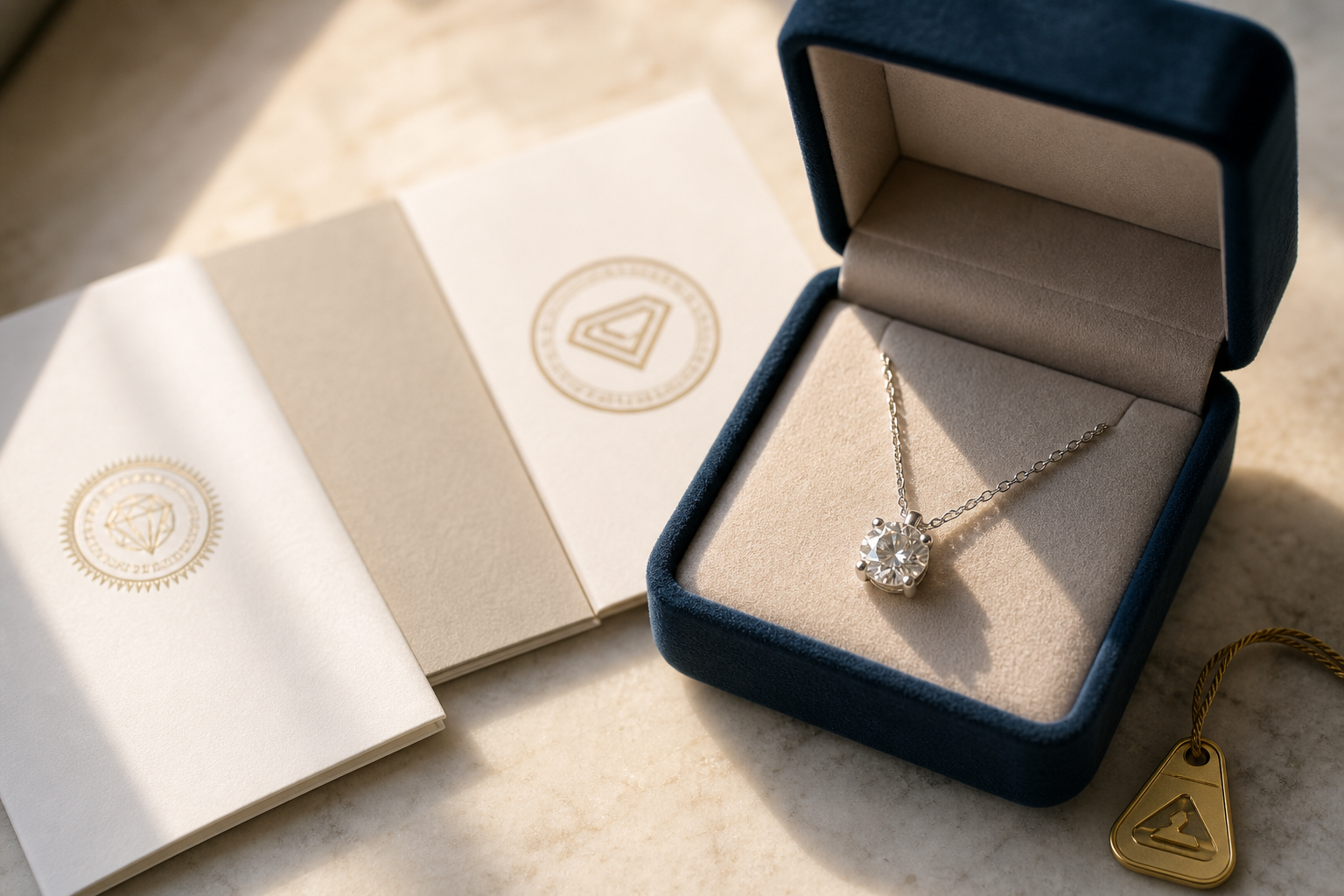
When comparing IGI and GIA-certified diamond jewelry for a gift, pick GIA for milestone gifts where grading accuracy and long‑term value matter; pick IGI for budget‑flexible sparkle and broader in‑stock choices. In short, both options work: choose GIA for top grading consistency and resale weight, and choose IGI for wider availability and value within a set budget. This guide explains the trade‑offs so you can choose with confidence in 2026.
GIA has the strongest prestige and consistency in grading. IGI offers wider availability in finished jewelry and stronger value per rupee. Both labs provide third‑party verification that the diamond’s stated grades are real. That certificate doesn’t make the diamond beautiful on its own; cut quality, design, and light performance do. However, the paper backs up what you’re gifting.
Moreover, you want a gift that feels right the moment it’s opened and still feels smart a decade later. Therefore, we’ll weigh grading consistency, verification ease, resale impact, availability in finished pieces, and price effects. Then we’ll map those to real gift moments, from a 10th anniversary to a graduation, so you can match the right trade‑offs to the occasion.
What Gift Buyers Actually Need From Graded Diamond Jewelry
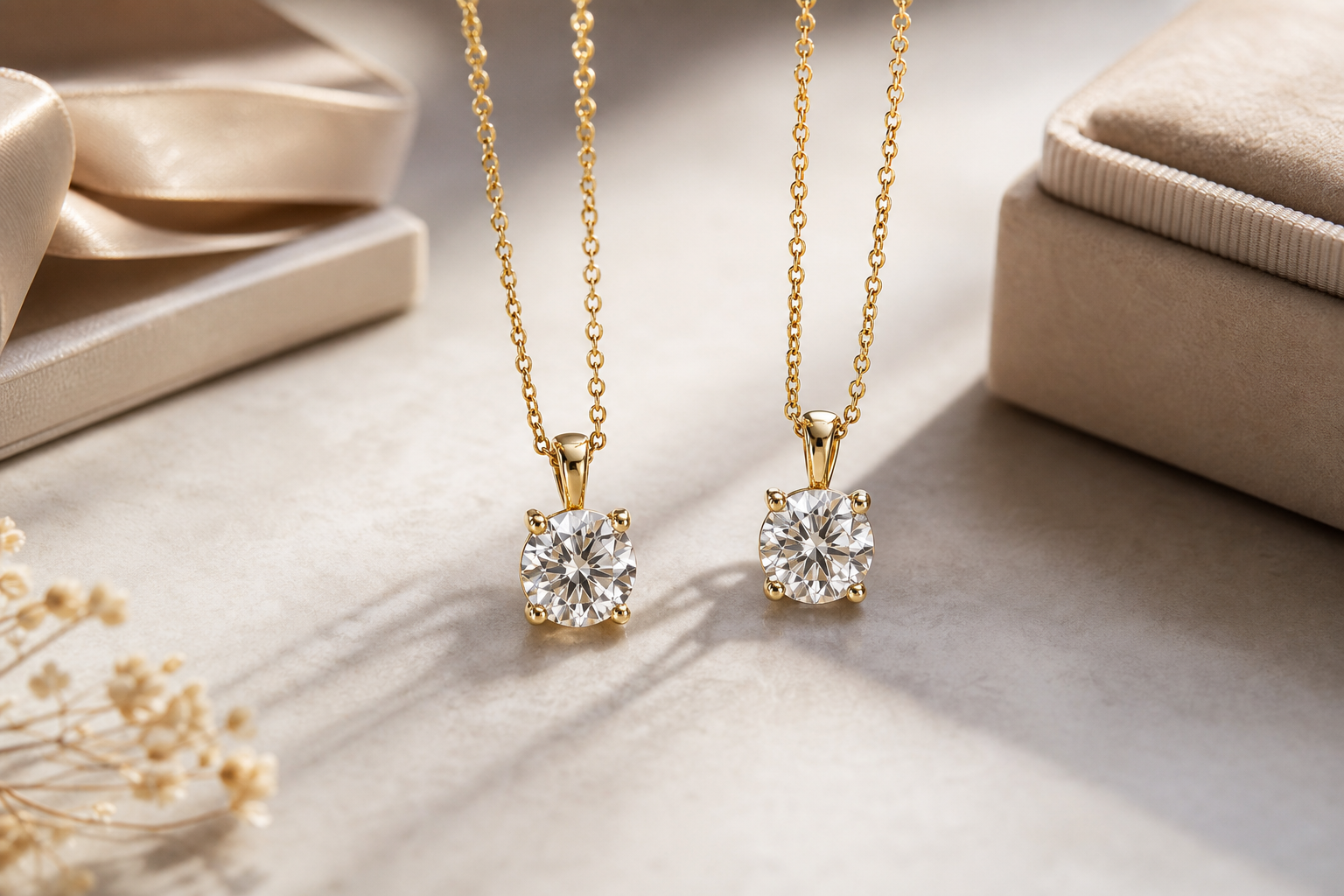
As a gift buyer, you don’t need lab jargon, you need a simple way to judge trust, value, and fit for the moment. Both IGI & GIA certified diamonds can be great gifts, but your priorities shift by occasion and budget. Remember, certification confirms independent grading accuracy; it does not guarantee beauty. A well-cut H color can dazzle more than a poorly cut F. Your eyes still matter.
Specifically, use this five‑point framework to decide:
- Grading consistency and reputation: How tightly does the lab grade vs what you see in hand?
- Ease of verification by the recipient: Can they look up the report number online in seconds?
- Impact on resale or trade‑in: If they ever upgrade, will buyers or jewelers trust the paper?
- Availability in finished jewelry: Can you find the right design in stock with that lab’s report?
- Price impact on the final piece: Does the lab choice push you up or down a grade or size within budget?
For many gifts, verification matters just as much as the name on the paper. Fortunately, both labs let you check report numbers online. As a result, your recipient can scan a QR code or type a number and see the same report you saw. That little step builds real trust.
Furthermore, availability is a practical constraint. GIA is more visible in loose stone markets and high‑end solitaires, while IGI has broader reach in finished jewelry, especially in Asia. If you’re choosing a ready‑to‑ship pendant this week, you may see more IGI options, which can stretch a budget further.
Match the framework to the occasion
- Milestone anniversary or engagement: Grade precision and resale weight climb the list. GIA’s stricter reputation is a plus.
- Birthday or festive gifting: Design, size-on-the-neck, and value may top the list. IGI can help you step up a size without blowing the budget.
- Heirloom intent: Pair trusted grading with metal assurance. Look for BIS hallmarked for purity and IGI or GIA certification for natural diamonds above 0.18ct. For tiny accent stones (melee), in-house grading for melee diamonds is the norm.
In addition, align your values. Caratflow features natural diamonds and ethically sourced gemstones in 22K & 18K hallmarked gold. That means the metal and the main stone both come with independent assurances, a clean, gift‑ready story the recipient can share.
For deeper background on grading basics before you shop, see the First-Time Buyer’s Guide to GIA‑graded diamond jewelry online.
Also Read!
GIA‑Graded Diamond Jewelry: Strengths and Limitations for Gift Giving
GIA is widely viewed as the gold standard for diamond grading, with consistent and conservative results across labs and years. A GIA report on a 0.50 ct diamond tends to “stick”, there’s less drift if a second lab rechecks it. In gift terms, that means what’s on paper will line up with what a careful recipient, appraiser, or insurer expects. The GIA name also carries instant recognition, which adds impact at unboxing.
Moreover, GIA reports are easy to verify online. You can enter the report number in the GIA Report Check portal and see the same details you see on paper. That simple step reassures a curious recipient or a family member who wants to confirm grades before adding the piece to insurance. For a primer on the institution itself, see the Gemological Institute of America.
However, GIA usually comes with a price premium. In like‑for‑like cases, the same physical diamond can price 10–20% higher with a GIA report than with an IGI report. That gap doesn’t make either stone “good” or “bad,” but it does shape what you can afford within a fixed budget.
In addition, GIA is more common for loose diamonds than for finished, in‑stock jewelry. If you want a ready‑made pendant or bangle this week, you might find fewer GIA‑papered SKUs on the shelf, especially from retailers who mostly stock IGI. For tiny accent stones (under 0.18 ct), GIA certification is rare; most jewelers rely on in‑house grading for melee, which is industry standard.
Where GIA shines for gifts
- Consistency: Tighter grading standards reduce variance between report and reality.
- Recognition: Family and friends who research will see GIA as most trusted, especially in North America and Europe.
- Resale and trade‑in: GIA papers carry more weight in second‑hand markets and upgrade programs.
Practical limitations to keep in mind
- Price: Expect a 10–20% premium at the stone level for equivalent stated grades.
- Availability: Fewer GIA‑certified finished pieces in some inventories; wider selection for loose stones.
- Melee: Accent diamonds are rarely GIA‑certed; expect in‑house grading for those stones.
For a “full trust” gift package, combine a GIA‑certified center diamond with BIS hallmarked for purity settings, transparent making charges, and a generous return window. That stack, lab + metal + policy, gives you and the recipient clarity at every step. You can also browse wedding‑focused guidance in the GIA‑ vs IGI‑graded diamond jewelry for brides: Which Is Better for Your Wedding? comparison.
IGI‑Graded Diamond Jewelry: Strengths and Limitations for Gift Giving
IGI has scaled a large global lab network, with especially strong coverage in Asia. As a result, certification turnaround is quick and finished jewelry with IGI reports is easy to find. For gift buyers, that means more styles in stock, faster delivery, and a broader range of price points without giving up third‑party verification.
In fact, IGI’s reputation has risen a lot in recent years. Your recipient will receive a real, verifiable certificate with online report lookup. If your budget is tight, IGI certified diamonds can stretch you to a larger look or a higher clarity within the same spend. That extra sparkle can matter more than the lab name for birthdays, graduations, and festive gifts.
On the other hand, IGI grading has historically been seen as slightly more lenient than GIA. For example, a stone graded G/VS2 by IGI might land at H/SI1 if sent to GIA. That variance doesn’t mean the diamond is poor; it means the strictness of the yardstick differs. Still, for a recipient who compares labs, GIA holds more sway in Western resale markets.
Where IGI fits best for gifts
- Availability: Wider selection of finished pieces ready to ship, across classic and trend‑led designs.
- Value: Lower stone cost at the same stated grades than GIA in many cases.
- Lab‑grown leadership: IGI dominates lab‑grown certification; for natural stones, it remains credible and verifiable.
Trade‑offs to weigh
- Grading leniency: Expect slight shifts if cross‑graded at GIA.
- Resale recognition: Slightly lower weight than GIA in North America and Europe.
- Occasion fit: For long‑term, investment‑minded gifts, the recipient may prefer GIA.
If you want certified natural diamonds with BIS hallmarked gold and silver jewelry, and you need a gift next week, IGI is an excellent lane. Many quality retailers, including Caratflow, offer IGI or GIA certification for natural diamonds above 0.18ct, plus in‑house grading for melee diamonds where full lab reports aren’t industry standard. That mix keeps the piece both verified and fairly priced.
Feature-by-Feature Comparison: GIA vs IGI for Diamond Jewelry Gifts
You asked for clear winners by category.
- Grading Consistency — Winner: GIA. Stricter standards, less variance.
- Global Recognition — Winner: GIA. Strongest in North America and Europe; IGI strong in India and across Asia.
- Availability in Finished Jewelry — Winner: IGI. More ready‑to‑ship, report‑backed pieces.
- Price for Equivalent Quality — Winner: IGI. Lower stone charges at the same stated grades.
- Resale Value Retention — Winner: GIA. Papers carry more trade‑in weight.
- Verification Ease — Tie. Both offer online report portals.
- Gift Presentation Impact — Slight edge: GIA. The name adds prestige at unboxing.
| Dimension | GIA Edge | IGI Edge | Verdict |
|---|---|---|---|
| Grading Consistency | High | Medium | GIA |
| Global Recognition | High | Medium | GIA |
| Finished Jewelry Availability | Medium | High | IGI |
| Price at Same Stated Grade | Medium | High | IGI |
| Resale/Trade‑In Recognition | High | Medium | GIA |
| Online Verification | Equal | Equal | Tie |
| Unboxing Prestige | High | Medium | GIA (slight) |
Moreover, the retailer experience can outweigh the lab choice.
- Lifetime exchange policy for upgrades over time
- 365-day free insured returns to remove gift risk
- BIS Hallmarked metal for purity assurance, with a unique HUID verifiable via BIS
- Buy-back guarantee at the prevailing rate for long‑term flexibility
- International shipping to 30+ countries via Brinks, fully insured, for safe delivery
Therefore, if you want the most complete package regardless of lab, choose a seller that offers both IGI & GIA certified diamonds, includes the original certificate, and backs the gift with strong policies.
Also Read!
Best Custom Jewelry Design with 3D Preview for NRIs in 2026
How to Buy Indian Jewelry Online with International Shipping for Celebration Gifts
How Certification Affects Pricing: What Gift Buyers Should Expect to Pay
Diamond jewelry pricing is a sum of parts. Here’s the clean model used by Caratflow: Price is calculated as: Total = Metal value (live rate x net weight) + Making charges + Stone charges + 3% GST on jewelry + 5% GST on making charges. The certification body affects the stone charges line, not the gold value or taxes.
For context, live rates cited on Caratflow include: 22K Gold ₹6,673/g, 18K Gold ₹5,464/g, Silver ₹89/g (Live Rates as of 06:44 am). Those numbers move with the market, so the metal value can shift day to day. However, the lab you choose mostly shifts the stone charges. A GIA certified 0.50 ct round with the same stated grades as an IGI stone usually costs about 10–20% more at the stone level.
As a result, with a gift budget of ₹50,000–₹1,00,000, you can sometimes step up a size or clarity with IGI while staying within budget. Conversely, you may choose to hold size steady and select GIA for milestone moments. Neither path is wrong; the occasion sets the bar.
Practical ways to control total cost
- Choose 18K over 22K when you want more of the budget to go to the diamond.
- Pick IGI at the same stated grades if you want a size bump without crossing a budget line.
- Use a transparent pricing breakdown so you can see metal vs making vs stone vs GST.
Risk reducers help too. COD available for orders up to Rs. 50,000 makes entry‑level gifts simpler.
Lifetime free polishing and re‑plating keeps the piece fresh. And 365-day free insured returns mean you can gift early without fear. In addition, transparent making charges let you compare apples to apples across designs.
Finally, remember that the best value isn’t always the lowest price. For an engagement pendant or a 25th anniversary, a GIA premium can be a smart trade‑off if you expect appraisal, insurance, or an eventual upgrade.
Verdict: Which Graded Diamond Jewelry Should You Gift?
For milestone celebrations, engagements, major anniversaries, wedding gifts. GIA‑graded diamond jewelry is the stronger pick. Its grading consistency, global recognition, and resale weight justify the 10–20% premium at the stone level. That premium buys you peace of mind when the recipient or an insurer scrutinizes the paper.
For birthdays, festivals, and graduation gifts, IGI‑graded diamond jewelry delivers excellent value. You’ll see broader availability in finished pieces and friendlier stone charges, which can translate to a larger look or a nicer design within the same budget. Both labs are legitimate, both are verifiable, and both can anchor a great gift. The difference lies in the priorities of the moment.
“Ordered a diamond pendant for my mother’s 60th. It arrived beautifully packaged, with a certificate and a personal handwritten note.” — Ananya Iyer, Bengaluru
Moreover, the retailer experience is often the tiebreaker. Look for IGI & GIA certified diamonds, BIS hallmarked for purity settings, a lifetime exchange policy, and 365-day free insured returns. Add video consultation available to preview designs, and custom jewelry design with 3D mockup if you want a one‑off heirloom. For a retailer match‑up on first‑time shopping, see this analysis: GIA‑graded jewelry online: This Retailer vs Blue Nile for First-Time Buyers. Which Is Better?
Quick Decision Guide
- Choose GIA if you need: maximum grading consistency, stronger resale recognition, and high‑stakes gifting confidence in 2026.
- Choose IGI if you need: more finished designs in stock, larger look per rupee, and a certified gift on a set budget.
- Consider custom with either lab if you need: a unique design, a 3D mockup approval, and personalized packaging for a once‑in‑a‑lifetime moment.