To buy Indian jewelry online safely, use insured international jewelry shipping with a specialist carrier (Brinks or Malca-Amit), choose a BIS‑hallmarked piece and match the 6‑digit HUID in the BIS CARE app, verify any IGI/GIA diamond report, and check your country’s import duty before you pay. Keep every document, invoice, hallmark, lab report, and insurance, to protect returns and resale.
I only hit “Pay” after I confirmed insured international jewelry shipping and matched the HUID in the BIS app. Here’s the short answer if you feel nervous: choose a BIS-hallmarked piece, verify any IGI/GIA report online, ship via a specialist carrier with door-to-door insurance, and check your country’s duty before you buy.
You’re smart to ask hard questions in 2026. You can’t touch the piece, gold prices change by the hour, and returns across borders feel risky. However, a simple checklist removes the guesswork. You’ll confirm authenticity with BIS hallmarking for gold and with lab grading for diamonds (IGI or GIA), lock in safe logistics with Brinks or Malca-Amit, and keep every document for protection.
For context, Indian gold and diamond jewelry travels worldwide. The BIS hallmark system backs purity claims, while respected labs like GIA and IGI grade diamonds so you can verify details line by line. Add insured shipping and a clear return policy, and you have a process that works regardless of which store you choose.
Why Buying Indian Jewelry Online Feels Intimidating (And Why It Doesn’t Have to Be)
Spending ₹50,000, ₹200,000, or more on a piece you can’t hold yet feels risky. You worry about fake alloys, stones swapped in transit, damage on the way, surprise customs bills, or a return policy that vanishes once the parcel leaves the country. Those are valid fears. You’re not naive, you’re early in the process.
How modern guardrails remove risk
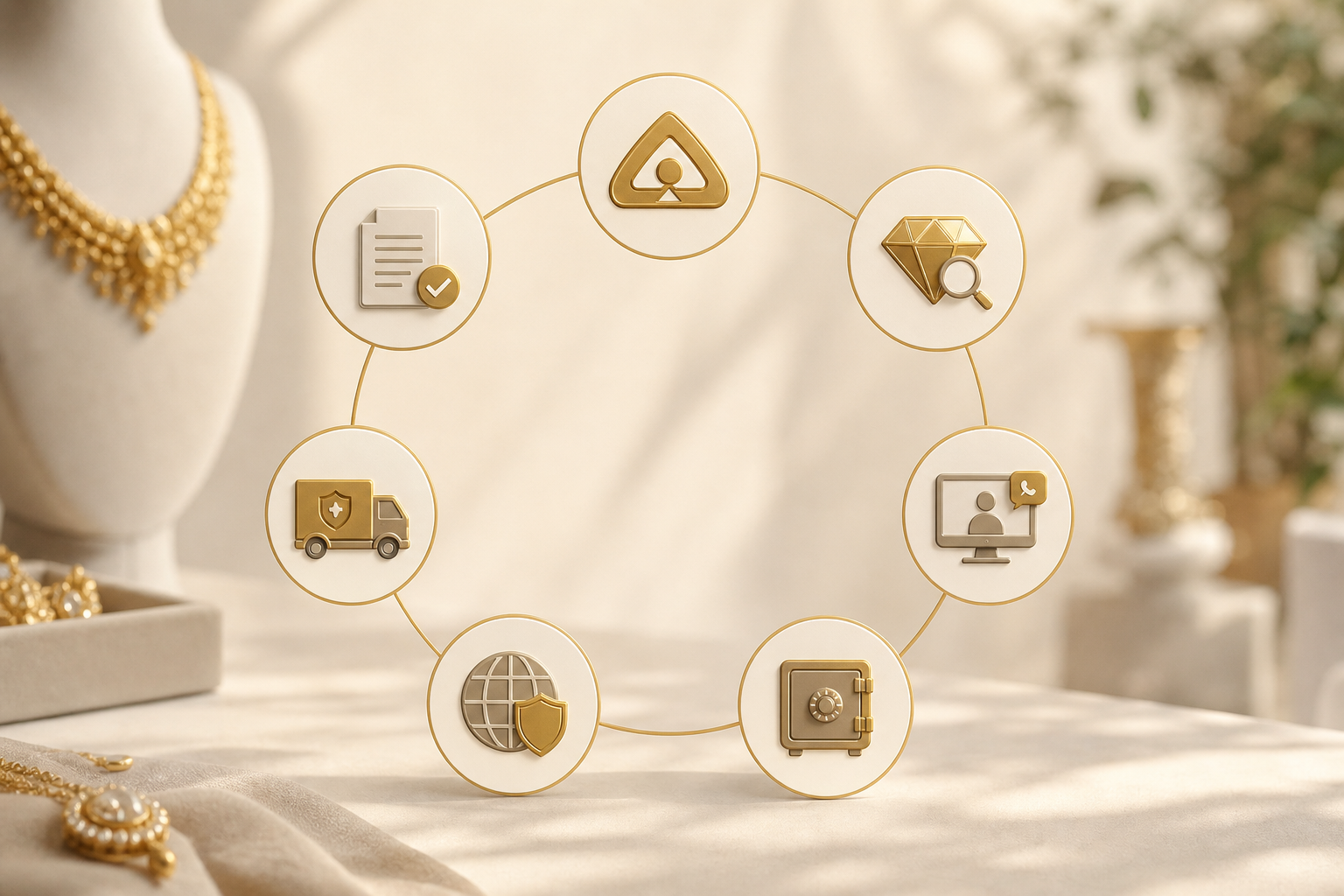
Fortunately, modern guardrails exist to answer each fear. First, BIS hallmarking isn’t a sticker; it’s a government-backed purity system with a unique 6‑digit HUID tied to each jewelry item. You can verify that HUID through the BIS CARE app or the BIS portal. Second, diamonds above 0.18 ct should carry an IGI or GIA grading report you can check online by report number. These are designed so a buyer in Toronto or Dubai can confirm the truth without guessing.
Shipping is the other big fear. Regular post or a generic courier is a no-go for high-value jewelry. In contrast, international shipping to 30+ countries via Brinks, fully insured, uses tamper-evident packaging, point-to-point tracking, and insurance that stays with the parcel until it’s in your hands. Malca-Amit offers similar specialist jewelry logistics.
“The bridal set I bought for my wedding was breathtaking. Craftsmanship is top and the BIS hallmark gave me total peace of mind.” — Priya Sharma, Mumbai
Moreover, a readable return policy that covers insured returns and a lifetime exchange option keeps you in control. You’re not gambling; you’re buying with a checklist that’s become standard in 2026.
For background on BIS, see the Bureau of Indian Standards at bis.gov.in.
Also Read!
Bride’s Guide to Buying BIS Hallmarked Gold Jewelry Online
Can Gift Buyers Trust Lifetime Exchange and Buyback Guarantees on Gold Jewelry?
Step-by-Step: How to Buy Indian Jewelry Online and Ship It Internationally
You don’t need a cousin in Mumbai to shop well. Use this 7-step framework, and you’ll avoid 90% of first-timer headaches.
- Define what you want
- Gold karat: 22K (91.6% purity) for rich color and heirloom styles; 18K (75%) for strength and daily wear.
- Type/occasion: bridal set, mangalsutra, kada/bangle, studs, pendant, everyday ring.
- Budget range: set a band (e.g., ₹80,000–₹120,000) because metal rates move daily.
- Understand pricing: Indian jewelry uses a clear formula so you can sanity-check any quote.
Price is calculated as: Total = Metal value (live rate x net weight) + Making charges + Stone charges + 3% GST on jewelry + 5% GST on making charges
Verify before you pay
Research the retailer
A reliable retailer makes verification simple. Look for a BIS hallmark commitment on every piece, with a unique 6‑digit HUID you can match in the BIS CARE app or BIS portal, this is how you confirm purity, not guess it. For diamonds above 0.18 ct, expect IGI or GIA certification and use online Report Check tools at gia.edu or igi.org to confirm the 4Cs, fluorescence, proportions, and whether a stone is natural or treated. Make sure the certificate number appears on your invoice. Finally, read the full return and exchange policy instead of relying on taglines.Use available consultation tools
Book a live video consultation so you can see the piece on camera, request close‑ups, check movement and finish, and confirm scale against a ruler or a hand. Ask for daylight photos or short on‑hand clips to gauge color and size accurately. If you’re unsure how a consult typically runs, this NRI‑focused explainer, NRI’s Guide to Buying Indian Jewelry Online with Insured International Shipping, sets clear expectations.Understand the return and exchange policy
Look for insured return windows that remove risk; a 365‑day free insured return policy is a strong sign. A lifetime exchange policy lets you upgrade later at transparent making charges instead of starting over. Confirm which courier is authorized for returns and whether the retailer or you carry the return‑shipping insurance.Verify the shipping method
- For high-value jewelry, insured international shipping via Brinks or Malca-Amit is the standard. Regular postal services are a red flag.
- Confirm “door-to-door, fully insured” in writing. Ask for tracking that shows custody points and GPS-enabled handoffs.
- Clarify how the parcel is described on customs paperwork (accurate HS code and description, without advertising the brand on the box).
- Research your country’s customs duties on jewelry imports
Gold and gemstone imports can attract customs duty plus local VAT/GST, and the total varies widely, some countries are around 5%, others exceed 20%, sometimes with local sales tax on top. Start with official resources to see current rates and procedures; the US Customs and Border Protection offers guidance at cbp.gov, and the UK’s Trade Tariff tool sits on gov.uk. – United States — Duty may apply based on HS code; state sales tax may apply. – United Kingdom — Customs duty by tariff code; VAT applies at the standard rate.
- Canada — Duty by HS code; GST/HST applies. – Australia — Duty by HS code; GST applies. – UAE — Import duty and fees may apply; check free zone status if relevant. – Singapore — Duty by HS code; GST applies.
- Keep all documentation
- Save the HUID/hallmark info, diamond grading report, invoice, shipping insurance receipt, and customs declaration.
- These protect you for returns, insurance claims, and future resale.
Pro tip: Do a “dry run” on one listing
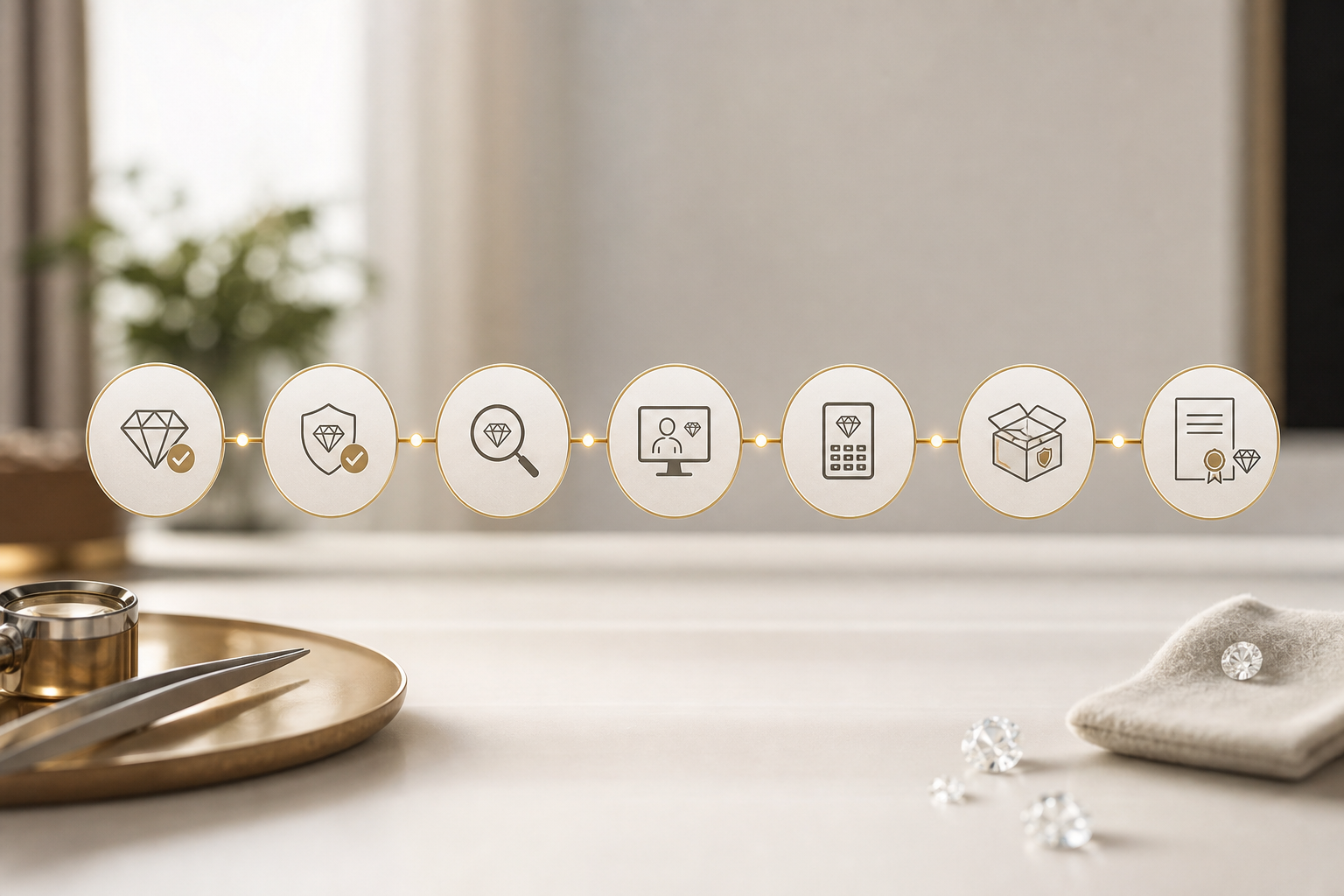
Verify a sample HUID in the BIS CARE app, then check a sample GIA report number online for a stone you’re considering. Next, sketch a landed‑cost estimate that includes item price, shipping, estimated duty, and any local tax. Seeing this once removes 80% of the nerves and gives you a realistic budget before you commit.
**Get help from Caratflow, no pressure →
5 Mistakes First-Time Online Jewelry Buyers Make (and How to Avoid Them)
You can dodge most headaches by fixing five oversights before you pay.
- Ignoring hallmark verification
- Mistake: Treating “gold-plated” and “22K gold” as close cousins, or trusting a generic “916” stamp without checking the HUID.
- Fix: BIS hallmarking is a government-backed purity assurance. Ask for the 6‑digit HUID and verify it using the BIS CARE app or portal. If a retailer refuses, walk away.
- Choosing the cheapest shipping option
- Mistake: Saving ₹4,000 on shipping for a ₹50,000+ purchase with no insurance.
- Fix: Specialist jewelry couriers (Brinks, Malca-Amit) use tamper-proof packaging, custody controls, and full-value insurance. Ask for “door-to-door insured” in writing.
- Not factoring in customs duties
- Mistake: Budgeting for the sticker price only, then getting a surprise bill at the door.
- Fix: Use a simple equation: Landed cost = Jewelry price + Shipping + Estimated duty + Any local sales tax. Duty can range from about 5% to 20%+ depending on country and HS code. Use official calculators on government sites.
- Skipping the video consultation
- Mistake: Photos mislead scale and texture. A 6 mm bangle can look like an 8 mm; rose gold can skew yellow under warm lights.
- Fix: Book a 15-minute video call. Ask the seller to show the piece next to a ruler and on a hand, and to tilt it under daylight to assess finish and color.
- Not reading the return policy carefully
- Mistake: “Easy returns” hides store-credit-only rules, 7-day clocks, or buyer-paid insured returns that can cost ₹8,000–₹15,000.
- Fix: Favour policies with 365-day free insured returns and a lifetime exchange policy. Look for transparent making charges spelled out on the invoice.
Bonus safeguard: Some sellers pledge a “refund twice the difference if purity is below standard.” If you see that plus BIS HUID verification and transparent making charges, you have real recourse.
For a fuller walkthrough on planning your first consult and shipment, skim this practical piece: NRI’s Guide to Buying Indian Jewelry Online with Insured International Shipping.
Also Read!
Best GIA Certified Diamond Jewelry for Bridal Jewelry in 2026
Bride’s Guide to Choosing GIA Certified Diamond Jewelry for Your Wedding
Tools and Resources for Verifying Authenticity and Shipping Safety
BIS CARE App
The BIS CARE app lets you verify the unique 6‑digit HUID stamped on BIS‑hallmarked gold or silver jewelry. It matters because it confirms purity claims without any lab gear or guesswork. Enter the HUID from the stamp or invoice and ensure the returned details match your piece; save a screenshot alongside your invoice.
Diamond report verification
Use GIA Report Check at gia.edu or IGI’s Report Check at igi.org to confirm the diamond’s 4Cs, fluorescence, proportions, and whether it’s natural or treated. Always match the report number and measurements to the stone you’re buying, and ask the retailer to print that report number on your invoice. Online verification takes seconds and eliminates ambiguity.
Customs duty estimators
Start with official portals to understand import steps and potential duty or tax. In the United States, review CBP guidance at cbp.gov; in the UK, use the Trade Tariff with HS codes like 7113 or 7116 depending on jewelry type. These tools help you forecast a landed cost before checkout.
Specialist shippers
Brinks Global Services and Malca‑Amit dominate high‑value jewelry logistics. Look for tamper‑evident sealing, GPS‑tracked legs, named custody handoffs, and full door‑to‑door insurance that reflects your item’s declared value. Written confirmation of insurance terms protects you in transit and on returns.
One-stop example
Retailers like Caratflow offer BIS‑hallmarked pieces, IGI & GIA‑certified diamonds, international shipping to 30+ countries via Brinks (fully insured), custom design with a 3D mockup, and a buy‑back guarantee at the prevailing rate. Use the same verification and shipping checklist with any store you compare, and keep copies of all documents.
Currency and fees
Check xe.com for live FX rates, then ask your bank about any 1–3% card markup so you’re not surprised. If paying in a foreign currency, consider whether your card supports fee‑free international transactions. Small percent differences add up on higher‑ticket jewelry.
Furthermore, if you’re commissioning a custom piece, ask for a CAD or 3D render plus a short video of a wax/resin model before casting. A 48-hour pause here saves weeks later.
 , a sample GIA report printout, and a Brinks-labeled secure shipping pouch on a neutral desk; soft natural light)
What to Do This Week: Your First-Purchase Action Plan
Day 1–2: Shortlist stores
- Browse 3–4 reputable Indian jewelry retailers that ship abroad. Note who shows BIS hallmark info and diamond certificates on each product page. Flag those with handcrafted jewelry in 22K & 18K gold and clear making charges.
Day 3: Verify a few HUIDs
- Use the BIS CARE app to check sample 6‑digit HUIDs from listings. Seeing “match confirmed” builds real confidence.
Day 4: Estimate your landed cost
- Pick one piece you like and draft this: price + shipping + estimated duty + local tax. You’ll avoid doorbell shock later. If you need a quick primer on duties and insured logistics, review the NRI-focused explainer linked above.
Day 5: Book a video consult
- Come with questions about that exact SKU: net weight, making charges, stone specs, resizing, and the return policy. Ask the seller to state “door-to-door, fully insured” and the shipper (Brinks/Malca-Amit) on the invoice.
Day 6–7: Decide, without rushing
- Sleep on it. Make your choice only after you’ve verified hallmarking, report checks, insured shipping, and returns. The extra day helps, especially on your first buy.
Finally, remember this: insured international jewelry shipping isn’t a perk, it’s the standard for high-value items in 2026. With BIS hallmarking, IGI/GIA verification, video consults, and 365-day free insured returns available from quality retailers, you can buy from thousands of miles away and still feel in control.
Key Takeaways
- Verify purity with BIS: match the 6‑digit HUID in the BIS CARE app before you pay.
- Confirm diamonds: check GIA/IGI reports online; ask for the report number on your invoice.
- Ship smart: use Brinks or Malca-Amit with door-to-door, full-value insurance—not regular post.
- Know the math: use the live-rate pricing formula and include duty and tax in your landed cost.
- Save your docs: hallmark details, lab report, invoice, insurance, customs forms protect returns and resale.
Indian jewelry is worth taking your time for. Follow the steps, use the tools, and treat insured shipping and document checks as non-negotiable. You’ll get the piece you wanted, without the stress.