
Yes, you can buy bis hallmarked gold with purity guarantee online in 2026 and feel calm about it. Check three marks, the BIS logo, the purity grade (22K/18K/24K), and the 6-digit HUID, verify the HUID in the BIS CARE app, choose 22K for heavy bridal pieces, and price it with a simple formula: live rate × net gold weight + making charges + stone charges + GST.
For a big purchase like your bridal set, clarity beats hype. As a confidence check for today’s math, the live rate snapshot lists 22K (916) at ₹6,673/g and 18K (750) at ₹5,464/g, with 24K (999) at ₹7,285/g. Those numbers give you a hard base to estimate. More importantly, BIS hallmarking reduces guesswork and protects value for decades.
I’m writing this like the sister who has sat through karigars, showroom lights, and last-minute blouse mismatch drama. Bridal gold is not just metal. It’s the gift your mom fastens on your neck with teary hands and the set your kids will point to in family photos. Let’s make sure it’s right.
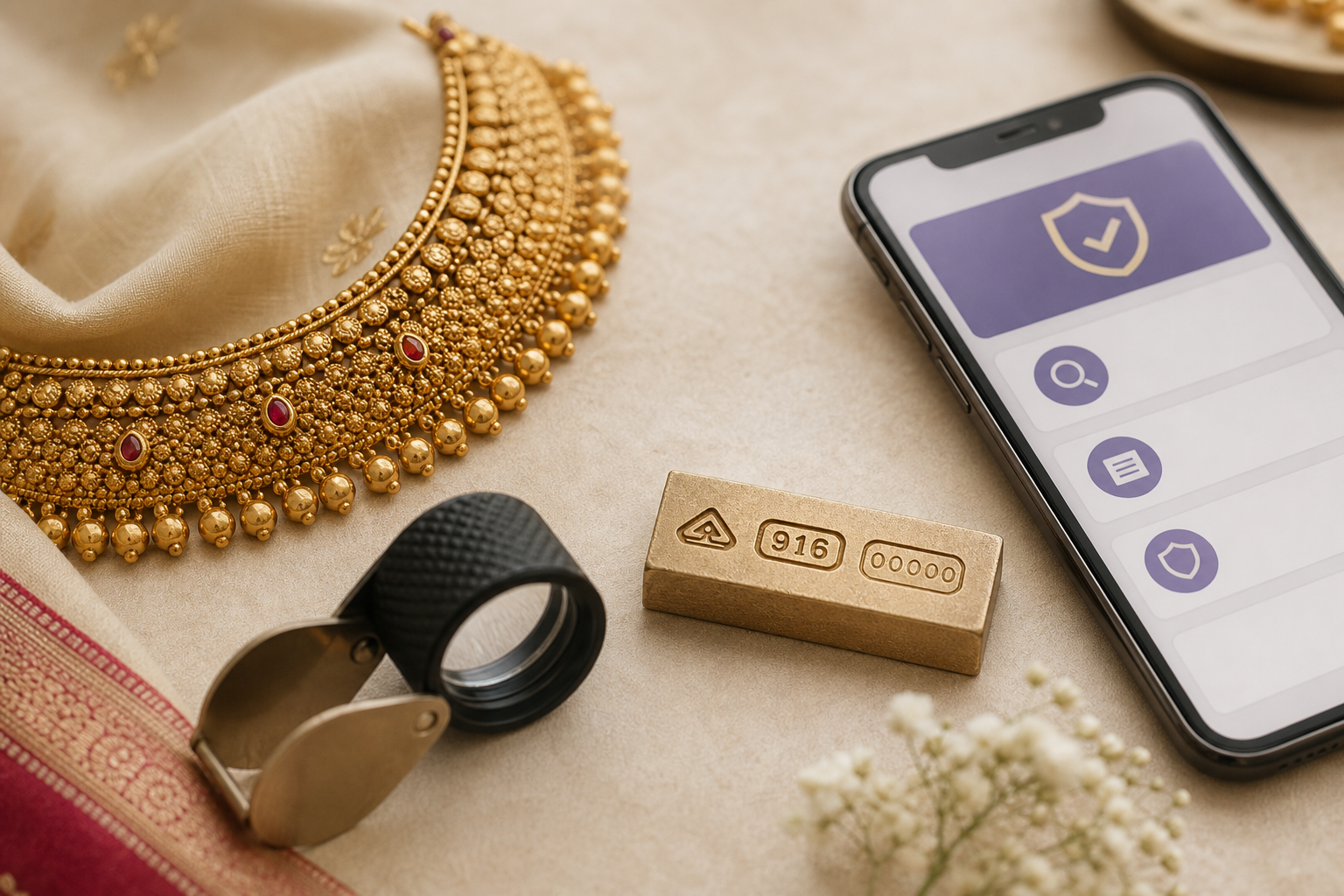
What Does BIS Hallmarking Actually Guarantee for Your Bridal Gold?
BIS hallmarking is India’s official purity assurance for gold jewelry. Practically, it’s a three-mark system stamped on each piece and backed by a government-managed database. Since June 2021, hallmarking has been mandatory for gold jewelry sold in India. That matters for brides because it is your single best shield against under-carat metal in a purchase that can run into lakhs.
Specifically, the BIS scheme prints three marks on your jewel:
- BIS logo — shows it has gone through a licensed assay center.
- Purity grade — 22K (916), 18K (750), or 24K (999) stamped clearly.
- HUID — a unique 6-digit code tied to that exact piece.
Moreover, the HUID links your bangle or mangalsutra to a digital record. Therefore, you can verify it via the BIS CARE app or the BIS hallmark verification portal. If the stamp says 916 and the app confirms it, you know the purity is 91.6% gold in that alloy.
22K vs 18K vs 24K — Which Purity for Bridal Pieces?
- 22K (916): The standard for traditional Indian bridal jewelry because it balances purity with strength. For heavy necklaces, chokers, rani haars, thick bangles, and mangalsutras, 22K holds shape yet gives that deep, rich gold glow.
- 18K (750): Great for diamond-studded pieces like maang tikkas, cocktail rings, or delicate jhumkas. The higher alloy content improves prong strength and stone security.
- 24K (999): Almost pure gold. It’s too soft for daily-wear jewelry, so you’ll rarely find intricate bridal sets in 24K.
For budget planning, anchor your math on live rates. For instance, Gold 916 cost ₹6,673/g and Gold 750 cost ₹5,464/g in the latest live rates. As a result, 22K is your go-to for the heirloom core, while 18K is smart for diamond-intensive designs.
“The bridal set I bought for my wedding was breathtaking. Craftsmanship is top and the BIS hallmark gave me total peace of mind.” — Priya Sharma, Mumbai
Emotionally, hallmarking respects what this gold stands for: your family’s pride and your future family’s heirloom. Financially, it preserves resale and exchange value, so you’re not stuck with a discount later due to purity doubts.
Also Read!
Can Gift Buyers Trust Lifetime Exchange and Buyback Guarantees on Gold Jewelry?
Best GIA Certified Diamond Jewelry for Bridal Jewelry in 2026
Step-by-Step: How to Buy BIS Hallmarked Bridal Jewelry Online Safely
You don’t need insider access; you need a clear path. Follow this 7-step framework, and you’ll feel in control at each click.
- Set your budget with live rates and a real formula
- Use today’s 22K/18K live rates to estimate metal value. For example, if your 22K necklace net gold weight is 60g and 22K is ₹6,673/g, metal value ≈ ₹400,380.
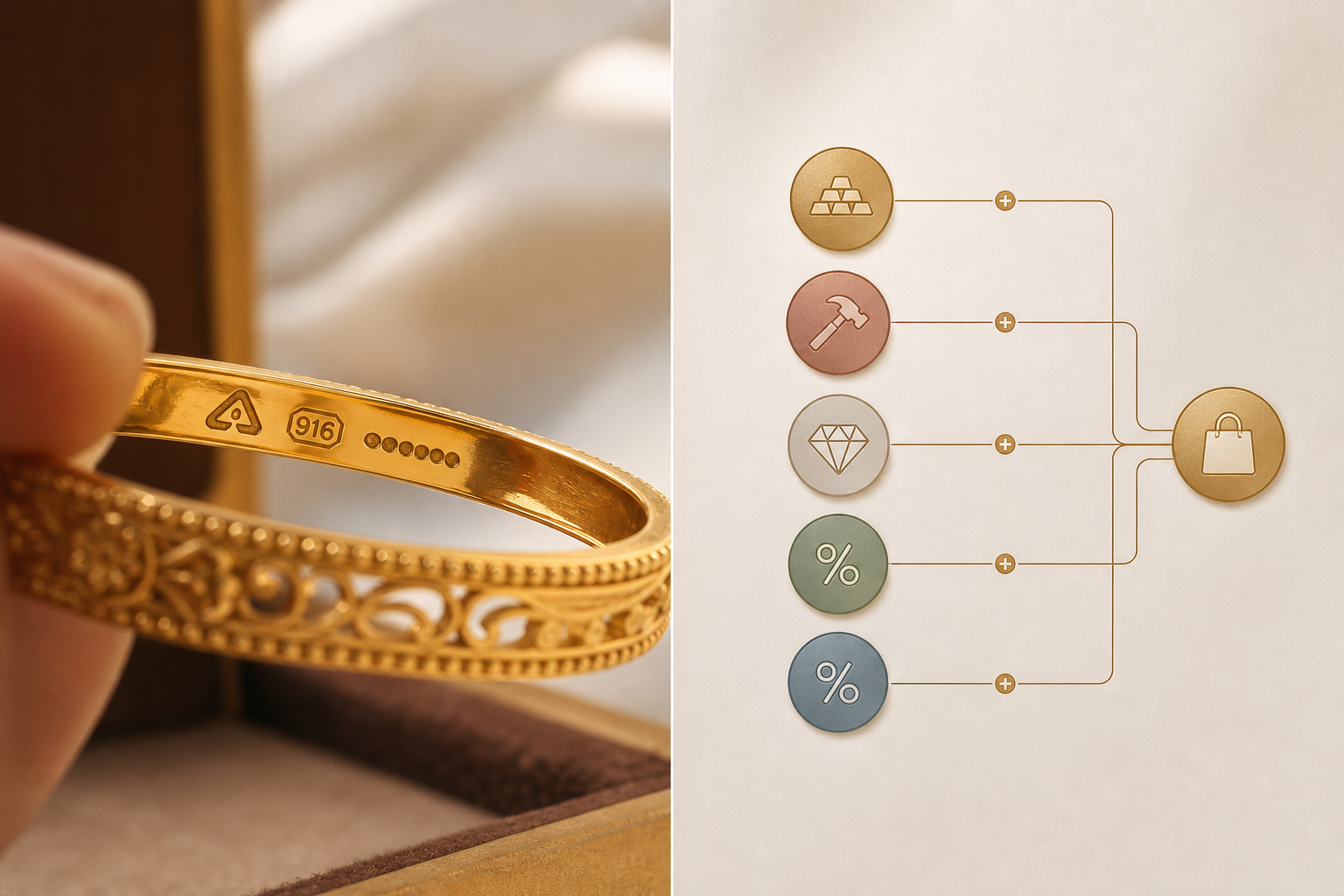
- Standard pricing formula: Total = Metal value (live rate x net weight) + Making charges + Stone charges + 3% GST on jewelry + 5% GST on making charges.
- For a shorthand: a 2% drop in making charges on a 60g heavy set can save you several thousand rupees. Therefore, push for clarity on each line item.
- Decide on purity by piece type
- 22K for heavy traditional pieces (rani haars, chokers, thick bangles, and mangalsutras).
- 18K for diamond-studded pieces (maang tikkas, delicate necklaces, and earrings) where stone security matters.
- If someone suggests 24K for a complex set, ask why. In most cases, it’s not practical for settings.
- Shortlist retailers with clear hallmark guarantees
- Check that every product page shows the BIS hallmark and the HUID, not just a “BIS available” banner.
- Look for “100% BIS hallmarked gold and silver jewelry,” “22K & 18K hallmarked gold,” and “Transparent making charges.
- As a cross-reference on buying for gifts or family events, see this practical explainer: How to Choose BIS Hallmarked Gold Jewelry Online for Gifts.
- Verify the HUID on the BIS CARE app or hallmark portal
- Ask for the 6-digit HUID before purchase if possible; otherwise, verify immediately after delivery.
- In the app or portal, you’ll see the jeweler name, purity, and hallmarking center. If details don’t match, pause and contact support.
- This is the heart of bis hallmarked gold with purity guarantee: the code must check out.
- Check diamond certifications separately
- For bridal sets with diamonds: insist on IGI or GIA certification for any stone above 0.18 ct.
- For small melee diamonds, many retailers do in-house grading; ask for a written grade range and total carat weight listed on the invoice.
- Remember, diamond certs are separate from BIS metal hallmarking.
- Review return, exchange, and buyback policies
- Strong signals include “365-day free insured returns,” “Lifetime exchange policy,” and a “Buy-back guarantee at the prevailing rate.
- Some sellers add a “commitment to refund twice the difference if purity is below standard,” which is a powerful risk reversal.
- Make sure returns are insured and easy to schedule. Moreover, confirm timelines align with your wedding date.
- Use video consultations to see the real piece
- Ask to see the actual set, its movement, lock-in clasp, backs of settings, and hallmarking close-ups.
- Request a scale reading on camera if feasible. In addition, ask the consultant to state net gold weight, stone weight, and making charges.
- If you plan custom work, request a 3D mockup to approve design details before production.
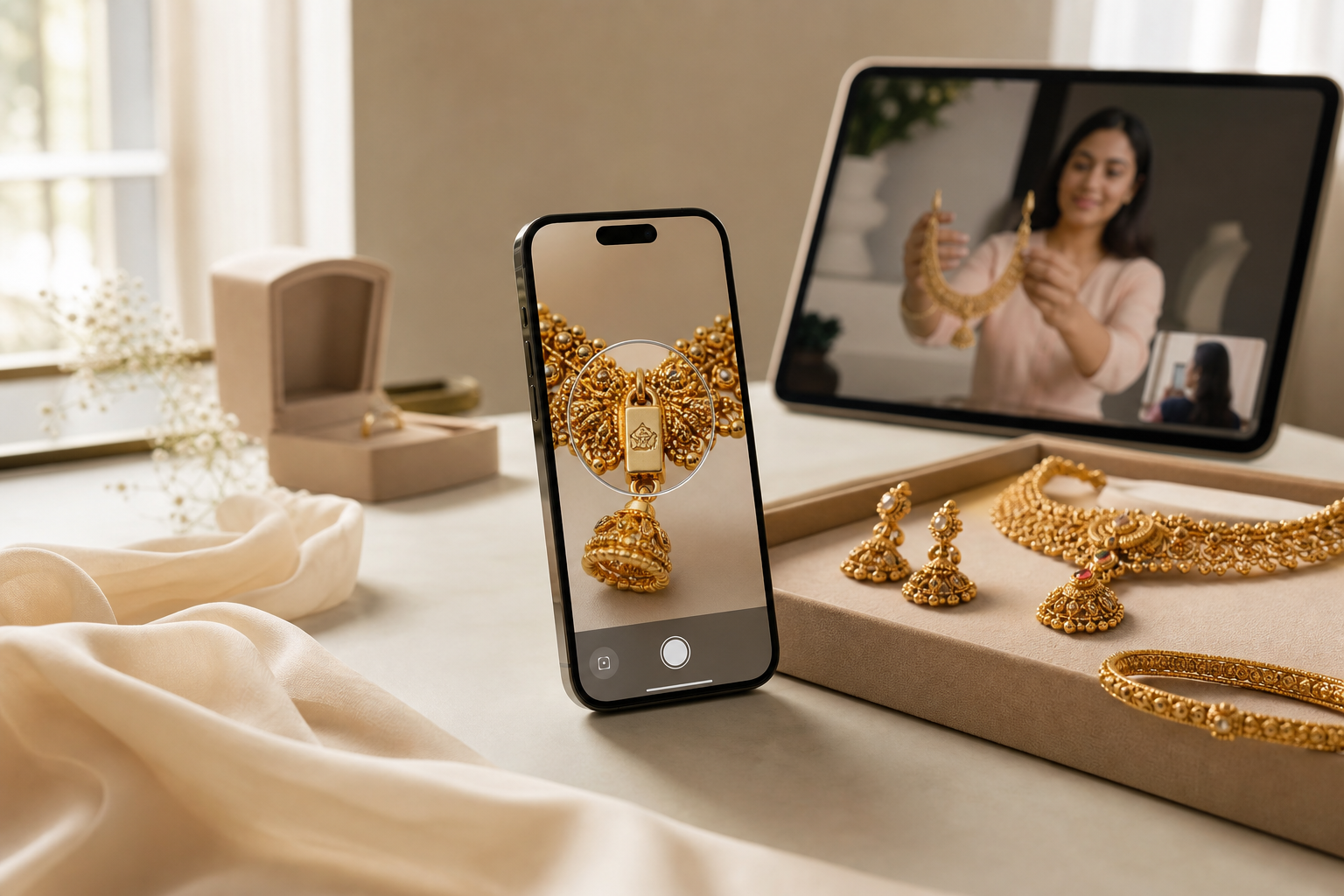
As you compare platforms, keep an eye on the basics. Furthermore, tools like Caratflow and other reputable retailers make these checks part of the process by default. BIS hallmarking on every piece, IGI/GIA for diamonds, and video consultation available when you need a closer look.
**Get a free purity check plan →
For a deeper comparison angle on gifting versus bridal buys, you might also find this helpful read: BIS Hallmarked Gold Jewelry Online vs Tanishq for Jewelry Gifts: Which Is Better for Purity-Guaranteed Gold?.
5 Costly Mistakes Brides Make When Buying Gold Jewelry Online
You’re not alone. Here’s what we see go wrong, and how to fix it with calm, simple checks.
- Ignoring HUID verification
It’s tempting to trust the stamp you can see. However, counterfeit stamps exist. Always cross-check the 6-digit HUID on the BIS CARE app or the portal.
If the app shows a mismatch in purity or jeweler, don’t rationalize it. Pause and escalate. This one step turns a guess into a guarantee.
-
Confusing gross weight with net gold weight
Gross weight includes stones and non-gold parts; net gold weight is only the gold content used for pricing. If a seller quotes on gross weight, your cost balloons. Therefore, insist the invoice lists net gold weight clearly. For example, a 90g gross necklace with 20g of stones means only 70g is gold for the price calculation. -
Not comparing making charges
Making can range from 8% to 25%+ of metal value. On a large bridal set, a 3% difference can save thousands. Request “Transparent making charges” as a separate line item. Moreover, ask if your piece has a fixed per-gram rate or a percent of metal value; then run the math yourself on a calculator. -
Skipping diamond certification for bridal sets
Bridal sets with uncertified diamonds can hide lower color or clarity than promised. For stones above 0.18 ct, ask for IGI or GIA certificates. In addition, request the certificate numbers on the invoice so you can verify on IGI or GIA portals later. Certification is the diamond parallel to BIS for metal. -
Not checking return and exchange policies early
Wedding timelines add pressure. If sizing is off or the design clashes with your lehenga shade, you’ll need options. Seek “365-day free insured returns,” “Lifetime exchange policy,” and “Buy-back guarantee at the prevailing rate.” In fact, some retailers state a “commitment to refund twice the difference if purity is below standard,” which adds real peace of mind.
“I love that I can book a video consultation before buying. The designer walked me through three options over a call. Bought on the spot.” — Kavita Reddy, Hyderabad
Emotionally, it’s easy to say yes under the glow of a video call. However, your future self will thank you for five minutes of policy reading and a two-minute HUID check. That’s how you hold both beauty and prudence on your big day.
Also Read!
Bride’s Guide to Choosing GIA Certified Diamond Jewelry for Your Wedding
Tools and Resources for Verifying Bridal Gold Jewelry Online
A short toolkit saves hours of second-guessing. Bookmark these and you’ll feel in charge.
Verification tools
-
BIS CARE App (Bureau of Indian Standards)
Use it to scan or enter the 6-digit HUID. You’ll see purity, jeweler name, and the hallmark center tied to that exact piece. Tip: screenshot results for your records alongside your invoice. -
BIS hallmark verification portal
The browser-based twin of the app. If you’re on a laptop during a video consult, this is perfect for quick checks. For background on the standards body, here’s the Bureau of Indian Standards (BIS) overview.
Pricing, certificates, and retailers
-
Live gold price tracking
Check India Bullion and Jewellers Association (IBJA) for the reference daily rates. In addition, follow financial apps like Moneycontrol or ET Markets to watch short-term swings before you place a big order. -
Diamond certificate verification
Both IGI and GIA have online portals where you can enter a certificate number to confirm a stone’s report. Therefore, always list the cert number on your invoice for easy lookup later. -
Online retailers to evaluate
When evaluating any online jeweler for bridal purchases, look for retailers that provide BIS hallmarking on every piece, certified diamonds, transparent pricing breakdowns, and reliable return policies, tools like Caratflow and other trusted platforms offer these as standard. Furthermore, several established names in India’s market also operate online and can be part of your shortlist. The point is to choose based on verification, not just brand recall. -
Custom design consultations
If you have a design in mind, ask for “Custom jewelry design with 3D mockup” and a “Live consultation with a designer before purchase.” Moreover, confirm if they offer “International shipping to 30+ countries via Brinks, fully insured” if your ceremony is abroad.
As you use these tools, remember the heart of bis hallmarked gold with purity guarantee is your own verification step. The seller provides the stamp. You confirm the record.
What to Do Next: Your Bridal Jewelry Action Plan
Here’s a week-by-week plan you can stick on your fridge. Start at least 8–12 weeks before the wedding for ready designs and 16+ weeks for custom work. That buffer keeps alterations and delivery stress out of your sangeet week.
-
Week 1: Set up your tools and budget
Download the BIS CARE app and bookmark a live gold rate tracker (IBJA/Moneycontrol/ET Markets). Then calculate a rough budget using: Total = Metal value (live rate x net weight) + Making charges + Stone charges + 3% GST on jewelry + 5% GST on making charges. As a result, you’ll see how purity and weight drive the final bill. -
Week 2: Style and purity planning
Create a mood board with categories: necklace set, bangles, maang tikka, jhumkas, kamarbandh. Label which are 22K (traditional/core pieces) and which might be 18K (diamond-heavy designs). Moreover, note weights from similar designs online to refine your estimates. -
Week 3: Retailer shortlist and verification
Shortlist 3–4 online retailers. Compare: BIS hallmark shown on each product page, HUID visibility, IGI/GIA policy for diamonds over 0.18 ct, transparent making charges, 365-day free insured returns, lifetime exchange, and buy-back at the prevailing rate. Then do a sample HUID lookup on at least one piece per retailer to confirm authenticity flow. -
Week 4: Live reviews and timelines
Schedule video consultations with your top 1–2 choices. Ask to see hallmark close-ups, scale readings, and stone settings. Furthermore, discuss “Custom jewelry design with 3D mockup” if you’re tailoring a set, and lock delivery timelines relative to your wedding date.
Bridal jewelry is memory cast in metal. Taking these steps protects both money and meaning. You won’t just wear your set for a day, you’ll tell its story for years.
**Schedule a free design consult today →
Key Takeaways
- Verify the three BIS marks—logo, purity grade, and the unique 6-digit HUID—and confirm the HUID in the BIS CARE app or portal.
- Choose 22K (916) for heavy traditional pieces and 18K (750) for diamond-set designs; anchor budgets on live rates like ₹6,673/g (22K) and ₹5,464/g (18K).
- Price with the full formula: Metal value + Making + Stones + 3% GST on jewelry + 5% GST on making charges.
- Demand IGI or GIA certification for diamonds above 0.18 ct, and insist on transparent making charges listed on the invoice.
- Favor strong policies: 365-day free insured returns, lifetime exchange, buy-back at the prevailing rate, and—where offered—twice-the-difference refund if purity falls short.
What to Do This Week
Open the BIS CARE app, pick two favorite designs, and run a mock budget with today’s rates. Then line up one video consultation and ask for a 3D mockup if you’re customizing. Small, steady steps now mean smooth, joy-filled trial days later, and a bridal set you’ll be proud to pass on.
**Start your custom design now →
For background on BIS as India’s standards body, see the Bureau of Indian Standards entry on Wikipedia.